
Claim boundaries
Common Misconceptions About Root Chakra Stone Claims
The easiest way to read root chakra stone claims is to separate the stone from the meaning attached to it.
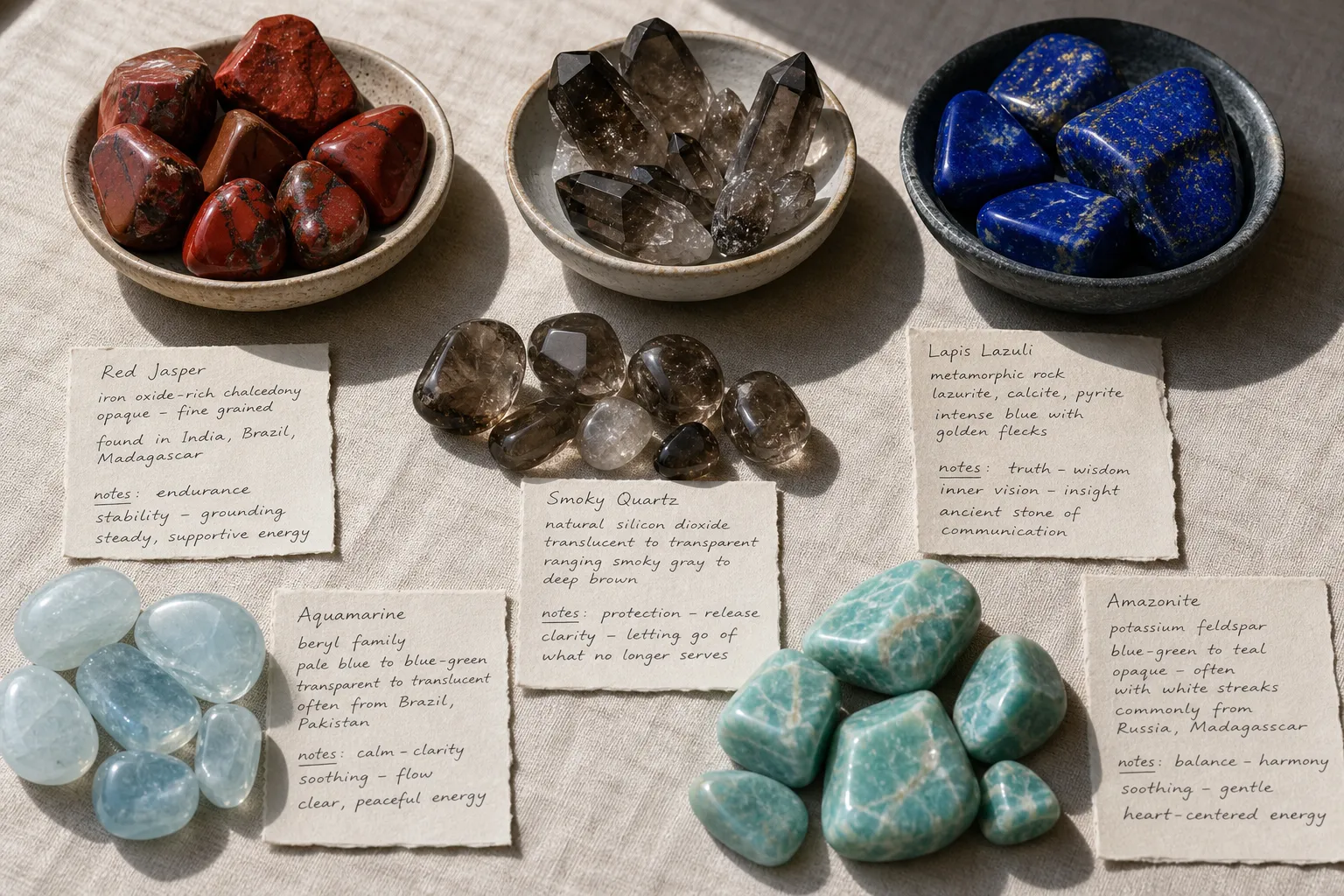
A piece of red jasper, smoky quartz, lapis lazuli, aquamarine, or amazonite can have visible color, texture, mineral identity, and care needs. A “root chakra stone” label is different. It is a symbolic, practitioner, or retail category, not a mineral classification, anatomy statement, or formal approval system.
Most root chakra stone claims misconceptions come from blending those layers together. A useful question is: Is this an observable stone fact, a chakra association, or a promise-like statement that goes further than the support allows?
upward
Start with the broader guide
Use the broader guide first if you need the full scope before this page.
The Three Layers Behind Most Root Chakra Stone Labels
Many confusing descriptions become clearer when you sort them into three buckets.
Stone identity
This can reasonably mean a material name, color, inclusions, hardness range, or gem and mineral family.
It should not be stretched into a body or emotional result.
Chakra meaning
This can reasonably mean a symbolic association in chakra traditions, crystal practice, or personal ritual.
It should not be stretched into a measurable body system or universal rule.
Retail language
This can reasonably mean sales wording that makes a stone feel desirable or useful.
It should not be stretched into formal classification, clinical guidance, or a guaranteed result.
The first layer is the most concrete. Gem and mineral references can describe what a stone is. Aquamarine, for example, is known in gemology as a blue to greenish-blue variety of beryl. Amazonite is commonly described as a variety of microcline feldspar. Lapis lazuli is not a single mineral in the same simple way; gem references describe it as a rock, often associated with lazurite along with other components such as calcite or pyrite.
The second layer is interpretive. In chakra traditions and modern crystal practice, people may associate certain stones with grounding, foundation, steadiness, or the root chakra. That language may be meaningful in a ritual or reflective setting, but it is not the same kind of statement as “this stone is blue-green beryl” or “this lapis piece has visible pyrite flecks.”
The third layer is where many crystal claims misconceptions start. Retail pages may mix gemstone facts, chakra words, emotional language, astrology-style categories, and strong action phrases. Some of that wording works as metaphor. It becomes misleading when it sounds like a supported health-outcome claim or an official system of approval.
Misconception 1: “Root Chakra Stone” Is a Mineral Category
A root chakra stone label does not identify a mineral species. It tells you how a seller, practitioner, author, or tradition is grouping the stone symbolically.
That distinction matters because the same stone can appear in more than one symbolic system. Red, brown, and black stones are often placed near the root chakra in popular charts because modern retail language frequently links the root chakra with earthy colors and grounding imagery. But a color-based chakra chart is not a mineral classification chart. It is an interpretive map.
A beginner might see a product card that says:
- “Root chakra stone”
- “Grounding crystal”
- “For stability”
- “First chakra support”
- “Energy center stone”
Those phrases do not tell you whether the stone is jasper, garnet, obsidian, smoky quartz, or another material. They also do not confirm quality, origin, durability, authenticity, or suitability for jewelry. For those questions, look for ordinary stone information: material name, whether it is natural or altered, how it is cut, whether it is fragile, and how it should be cleaned or stored.
This is especially useful when reading about blue-green stones such as lapis lazuli, aquamarine, and amazonite in root chakra-themed practice. Their color may not match the common red-black-brown shorthand for the root chakra, but a practitioner might still use them symbolically in a grounding ritual, a personal altar, or a reflective practice. That use is a personal or tradition-based association, not a mineral rule.
Misconception 2: Stone Color Automatically Confirms Chakra Meaning
Color can be observed. Meaning has to be attributed.
You can say that amazonite is often blue-green, that aquamarine ranges from pale blue to greenish blue, or that lapis lazuli is known for deep blue color sometimes broken by lighter or metallic-looking areas. Those are visible descriptions. But when color is used to state a chakra result, the sentence has moved into symbolic interpretation.
Careful wording sounds like this:
- “Many crystal practitioners associate dark red and black stones with the root chakra.”
- “Some people use blue-green stones as personal grounding reminders, even when those stones are more commonly linked with other chakra colors.”
- “In retail chakra charts, color is often used as a quick sorting tool, but it is not a scientific test.”
Less careful wording implies that color itself causes a specific inner change. That is too strong. A stone’s color may help someone choose a piece that feels visually right for a ritual space. It may help a shop organize a root chakra stones chart. It may make symbolism easier to remember. But color does not confirm a promised result.
A root chakra stones chart is best read as a guide to common associations, not as a universal map. Charts can help beginners compare retail language, but they often compress complex traditions into tidy color rows.
Misconception 3: Chakras Are Physical Body Parts
For this page, chakras are best approached as religious, spiritual, and cultural concepts that have been interpreted in different ways over time. General reference works describe chakras within Indian religious and spiritual contexts, while modern chakra language often reworks those ideas for personal growth, meditation, yoga-adjacent practice, and crystal use.
The common mistake is to talk about chakras as if they were physical organs or measurable structures. Some modern materials connect chakras with glands, nerves, organs, or body zones. Those correlations may appear in practitioner systems, but they should not be used to argue that a crystal changes the body.
For root chakra stone belief boundaries, this is one of the clearest lines: a chakra association is not anatomy. A stone placed near the body, held during meditation, or displayed on an altar can be part of a personal ritual. It should not be described as reading a condition, changing a body system, or standing in for ordinary care.
That distinction does not require dismissing the belief. Many people use symbolic systems to reflect on themes such as steadiness, home, survival, belonging, or routine. The problem begins when symbolic meaning is presented as health-adjacent certainty.
Misconception 4: A Stone Can Open or Reset the Root Chakra Instantly
Instant-result language is common in commercial and practitioner spaces. A product page may say that a stone “activates,” “unblocks,” “aligns,” or quickly changes the root chakra. For an informational page, that wording needs a lighter, more accurate frame.
A more grounded version would be:
- “Some people hold a stone during meditation as a symbolic focus.”
- “Some practitioners associate the stone with root chakra themes.”
- “A reader may use the stone as a reminder to slow down, breathe, or return attention to the present setting.”
- “Retailers often use stronger action words, but those words should be read as belief-based or promotional language.”
The difference is small in grammar but large in meaning. “This stone opens the root chakra” states an outcome. “Some people use this stone in a root chakra ritual” describes a practice. The second version leaves room for personal meaning without promising that the stone produces a result.
This is also where root chakra stones meaning can stay useful without being overextended. The meaning may be symbolic: earthiness, steadiness, foundation, security, or presence. A stone can be chosen because its weight, color, pattern, or cultural association helps someone focus on those ideas. That is different from saying the stone changes a person’s condition.
Misconception 5: Gemstone Identity and Chakra Meaning Are the Same Thing
Gemstone identity and chakra meaning often sit side by side on product labels, which makes them easy to confuse.
A label might say: “Amazonite — root chakra grounding stone.” The first part points toward the material. The second part is a symbolic claim or retail description. If the material name is accurate, that still does not confirm the chakra statement. If the chakra meaning feels personally useful, that still does not confirm the material identity.
For a beginner, it helps to ask two separate questions.
What is the stone?
Look for the material name, color description, whether it is tumbled or rough, and any care notes. For higher-value pieces, identity can be more complicated and may require gemological evaluation.
What is being claimed about the stone?
Is the description talking about appearance, tradition, personal ritual, mood language, or a strong outcome promise?
This separation is especially helpful with blue-green stones. Lapis lazuli, aquamarine, and amazonite each have their own material identities and visual character. Their root chakra use, when described, should be framed as a practitioner or personal association. The stone can be real; the meaning can be meaningful; the outcome language still needs careful wording.
A Practical Reading Test for Root Chakra Stone Claims
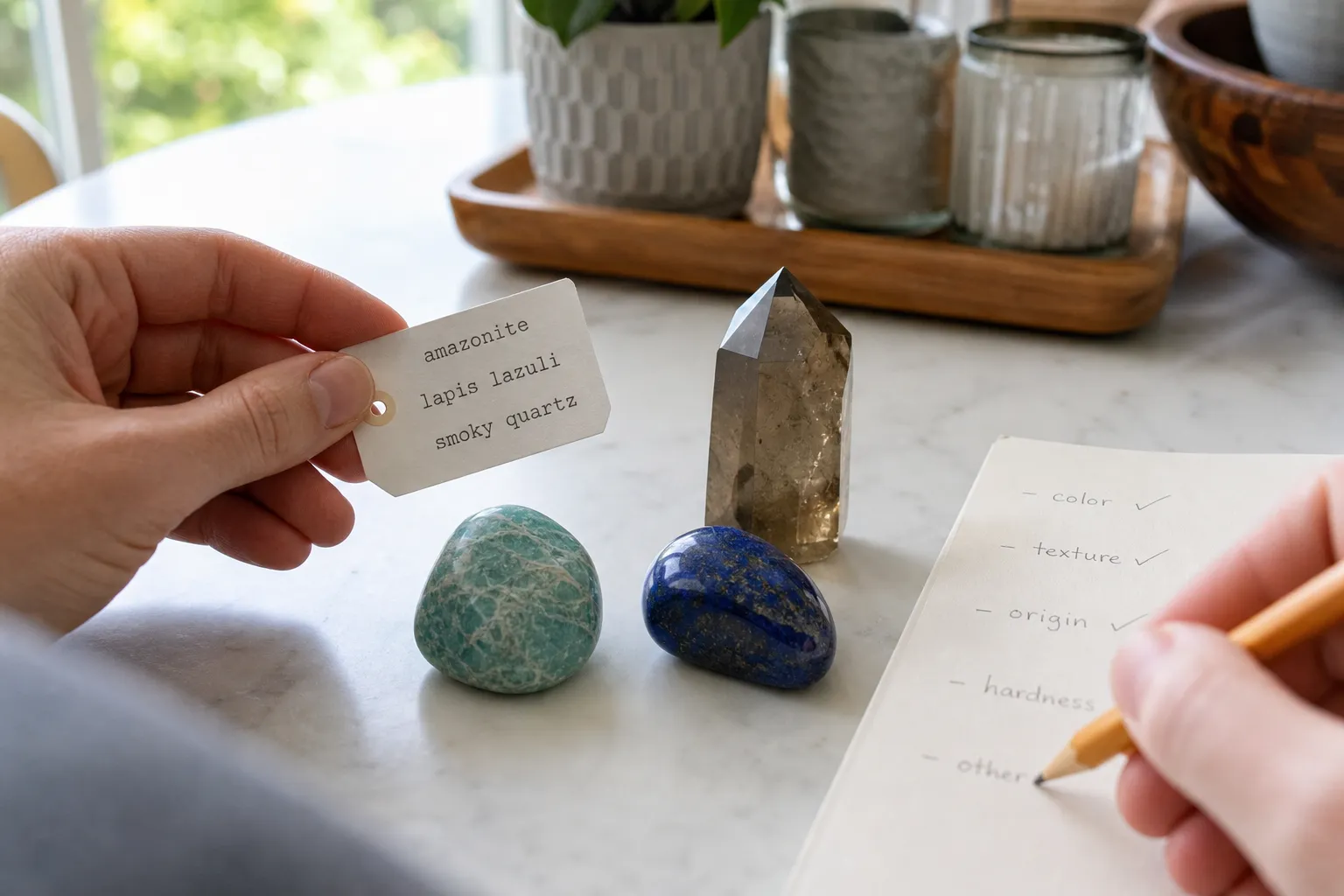
When you see a root chakra stone label, run it through this quick check.
1. Can I see or verify the statement?
Observable or material statements include:
- The stone is blue, red, black, brown, greenish, opaque, translucent, polished, rough, carved, or beaded.
- The listing names a material such as jasper, obsidian, garnet, smoky quartz, lapis lazuli, aquamarine, or amazonite.
- The seller gives ordinary care information, such as avoiding harsh cleaning methods for delicate materials.
These statements are not automatically correct, but they are the right kind of statement to check through gem and mineral information.
2. Is the statement clearly symbolic?
Symbolic wording can be useful when it is attributed properly:
- “In chakra traditions, the root chakra is often linked with foundation and stability themes.”
- “Many crystal practitioners associate dark stones with grounding imagery.”
- “Some people use this stone as a personal ritual object.”
This language presents meaning as a belief-based or personal-use frame.
3. Does the statement sound like an outcome promise?
Be cautious when wording suggests that the stone will change health, emotions, life circumstances, or the body in a specific way. Also be cautious when a listing borrows scientific-sounding language without a clear, non-promotional basis.
A better editorial rewrite would move the sentence back into attribution: “Some retail descriptions present this stone as connected with calm or steadiness themes.” That keeps the reader informed without presenting the claim as established fact.
4. Is the label pretending to be a formal classification?
There is no single universal authority that approves a stone as “the” root chakra stone. Gemology can describe material identity. Religious and cultural references can provide context for chakra concepts. Crystal practitioners and retailers can describe their own symbolic systems. Those are different kinds of knowledge, and they should not be collapsed into one label.
What Beginners Can Keep, and What to Set Aside
You do not have to reject crystal symbolism to read root chakra stone claims carefully. The useful middle ground is to keep the personal meaning while setting aside overextended promises.
Keep
- The stone’s visible qualities
- Accurate material names when available
- Cultural and spiritual context stated with care
- Personal ritual use, such as holding, displaying, journaling with, or meditating beside a stone
- Symbolic root chakra stone meanings described as associations
Set aside
- Claims that turn chakras into physical body parts
- Claims that a stone creates instant inner change
- Claims that mineral identity confirms a chakra effect
- Claims that a retail label equals formal approval
- Claims that use clinical or scientific-sounding language without appropriate support
- Claims that present stones as substitutes for ordinary care or practical decision-making
The most reliable approach is modest: describe what the stone is, name how it is commonly used in chakra or crystal communities, and avoid turning symbolic language into result language.
The Bottom Line
Most root chakra stone claims are mixed rather than simply true or false. The stone may be physically real, the label may reflect a common retail or practitioner association, and the stronger outcome wording may go beyond what can be responsibly supported.
For beginners, the best reading habit is simple: treat “root chakra stone” as symbolic labeling unless the sentence is specifically about observable stone facts. Use chakra meanings as personal or cultural interpretation, not as anatomy, science, or a formal classification system. That leaves room for meaningful personal ritual while keeping gemstone identity, chakra symbolism, and unsupported crystal wellness claims in their proper places.