
Root Chakra Stone Meanings Without Health Claims
If you search for root chakra stone meanings without health claims, you may be trying to keep the symbolism you like while avoiding language that sounds like a promised result. That distinction is worth keeping.
Root chakra stones are often described with words such as grounding, safety, stability, protection, and Muladhara. Those words can be useful in a personal ritual, a jewelry choice, a meditation corner, or a simple reminder object. They become less careful when written as if a stone changes health, resolves serious distress, or produces a measurable physical outcome.
This page reads root chakra stone meanings as symbolic, cultural, retail, and personal-practice language—not as clinical, scientific, or guaranteed-effect guidance.
upward
Read the full overview first
Use the broader guide first if you need the full scope before this page.
What a Root Chakra Stone Meaning Actually Describes
A root chakra stone meaning usually combines several layers:
- A traditional chakra theme.
- A visible stone cue, such as red, black, brown, smoky, metallic, opaque, or polished.
- A retail or practitioner label.
- A personal intention chosen by the reader.
The root chakra, often called Muladhara, is commonly discussed in modern chakra settings as the first chakra and is associated with rootedness, stability, survival themes, base-of-spine imagery, and earth symbolism. Britannica describes chakras as concepts within Indian spiritual and religious traditions, not as ordinary physical anatomy. That background helps keep chakra language in its symbolic and cultural lane.
When a crystal shop says “red jasper root chakra meaning,” the wording usually does not mean that red jasper has a verified physical effect. It more often means:
- The stone’s red or earthy color fits common root chakra color symbolism.
- The stone is used in personal practices connected with steadiness or grounding.
- A shop, chart, or practitioner tradition places it in a root chakra category.
- The buyer may use it as a physical reminder of an intention.
The stone itself can still be described plainly. Jasper, for example, is an opaque siliceous stone in the quartz family, and mineralogical material describes jaspers as appearing in colors such as red, green, yellow, and brown, with color influenced by mineral inclusions. That supports a modest statement about appearance and material character. It does not support a promised effect on the person holding it.
A careful root chakra stone meaning keeps two things separate:
- Observable description: color, opacity, polish, shape, texture, jewelry form, display use.
- Attributed meaning: what chakra traditions, crystal practitioners, retail descriptions, or personal rituals commonly associate with the stone.
That separation is the main skill behind reading root chakra stones meaning carefully.
Root Chakra Meanings vs Health Claims: What Changes the Sentence
The difference is often not the stone name. It is the verb.
A careful meaning sentence says that a stone is “associated with,” “used as a symbol of,” “chosen for,” or “carried as a reminder of” a theme. A stronger outcome sentence says or implies that the stone changes a person’s physical or emotional condition.
The U.S. Federal Trade Commission’s Health Products Compliance Guidance is not about chakra stones specifically, but it is useful as a boundary source: health-related advertising claims require appropriate support. For a beginner reading crystal copy, the practical takeaway is simpler. If a sentence sounds like it promises a result for the body, mind, illness, or serious distress, it has moved beyond symbolic meaning.
If the wording says…
It is usually functioning as…
Careful reading
“Red jasper is associated with grounding in root chakra practice.”
Symbolic meaning
A belief-based or tradition-based association
“Black tourmaline is used in protection symbolism.”
Personal or retail symbolism
A meaning some practitioners use
“Smoky quartz is carried during meditation as a reminder to feel steady.”
Personal-practice language
A ritual object or focus cue
“This stone changes health outcomes or resolves distress.”
Health-adjacent claim
Not supported by the meaning label alone
“This stone shows that the root chakra is physically changed.”
Scientific-sounding claim
Not established by ordinary crystal meaning sources
The careful sentence does not need to be dull. “Black tourmaline is commonly presented as a dark grounding stone in crystal shops” still gives the reader useful meaning. It explains how the label works without turning the label into a result.
How to Read Crystal Shop Root Chakra Claims Carefully
Crystal shop language is where much of the confusion starts. Shops often use warm, confident phrases: grounding energy, protection, safety, stability, root support, earth energy, crystal grid, intention-setting, carrying stones, and meditation placement. Those phrases may help a reader find a stone that matches a personal theme. They should not be read as proof that the stone creates the outcome named in the phrase.
A practical reading process has four steps.
1. Start with the stone description
Begin with what can be seen or handled. Is the stone red, black, brown, smoky, metallic-looking, opaque, polished, rough, tumbled, carved, or set in jewelry?
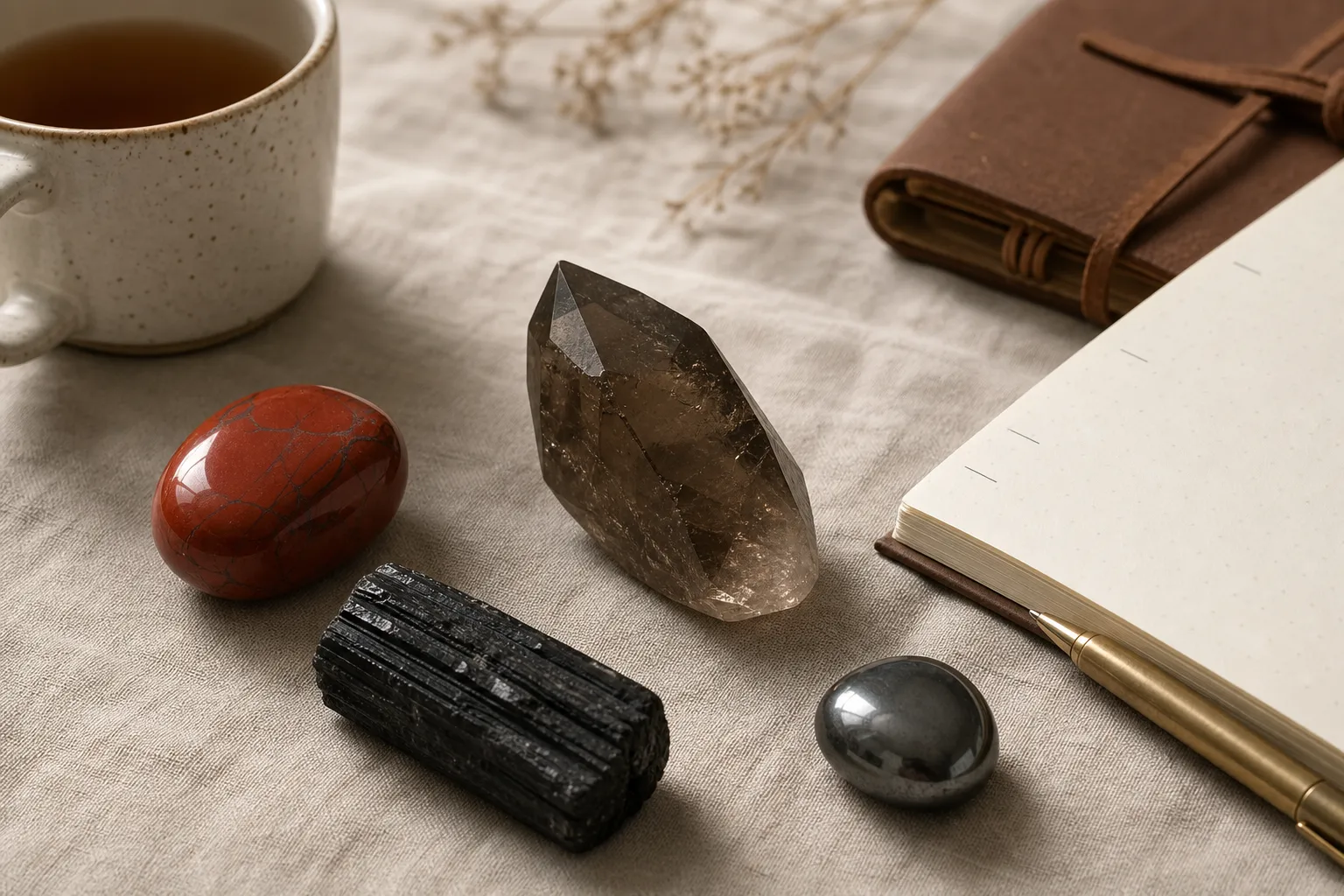
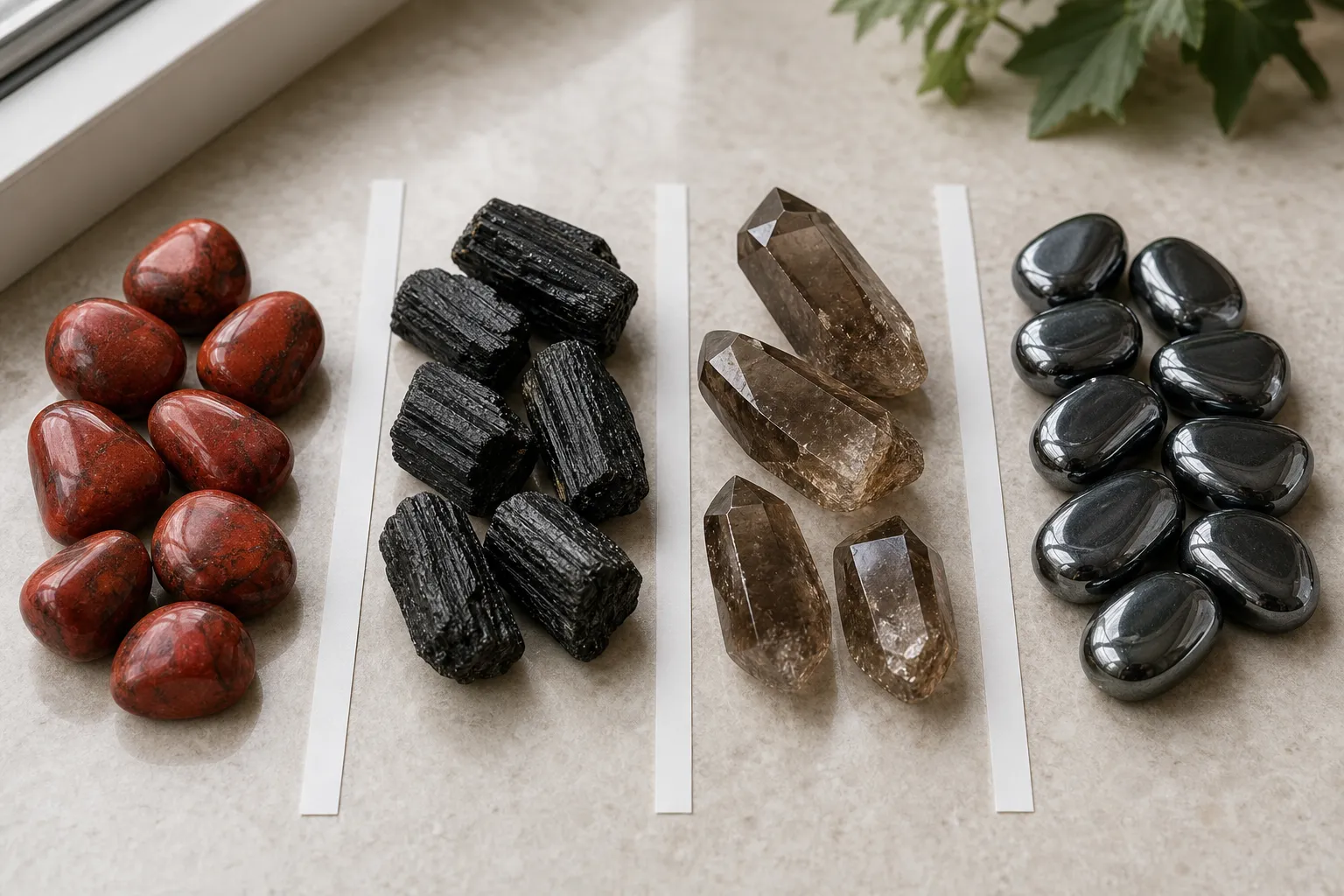
Red jasper is often chosen for root chakra symbolism because its earthy red appearance fits common root chakra color associations.
Black tourmaline often appears near grounding and protection symbolism in retail language because of its dark color and strong visual presence.
Smoky quartz is commonly grouped with earthy or grounding-style crystal language because of its brown-gray transparent or translucent look.
Hematite is often recognized by its dark metallic appearance, which can feel visually weighty or steady in jewelry and display contexts.
The visual cue is not a verified effect. It is one reason the stone fits a symbolic category.
2. Notice who is making the meaning connection
Good wording tells you where the meaning comes from. Phrases such as “in chakra traditions,” “many crystal practitioners associate,” “in retail crystal language,” and “some people use” are useful because they show that the statement is about belief, practice, or market convention.
Less careful wording removes the attribution and makes the sentence sound universal. “This stone provides protection” is stronger than the available support allows. “This stone is used as a protection symbol” stays inside the meaning frame.
3. Separate personal ritual from promised results
Jewelry, carrying stones, meditation setups, and intention-setting can all be described without promising outcomes.
A person may wear a red jasper bracelet because it reminds them of steadiness. Another may keep black tourmaline on a desk because they like its dark, protective symbolism. Someone else may place smoky quartz nearby during meditation because it fits the mood of a quiet practice.
Those are personal-use contexts. They do not require a claim that the stone changes the body, proves an energy mechanism, or guarantees emotional change.
4. Watch for bundled claims
Commercial pages sometimes blend harmless symbolism with much stronger assertions. A single paragraph may move from “grounding” as a metaphor to statements about health, distress, vitality, or environmental protection.
When that happens, keep the symbolic part and set aside the outcome language unless it is supported in a way appropriate to that type of statement. Root chakra stone symbolism can be discussed clearly without importing stronger commercial claims into the meaning.
What “Energy” and “Protection” Can Mean Without Overclaiming
Two words cause a lot of confusion: energy and protection.
In root chakra crystal descriptions, “energy” may mean several things at once. It can refer to the mood of a color, the felt character of a stone, a chakra-practice concept, or a personal ritual phrase. A reader may say a stone has “earthy energy” when they mean it looks heavy, dark, red, brown, smoky, or grounding in a symbolic sense.
A careful page does not need to argue with every spiritual use of the word. It only needs to avoid presenting “energy” as a measured physical force unless a source actually supports that kind of statement. For root chakra stone meanings, “energy” is best read as tradition-based or personal-practice language.
“Protection” needs the same care. In crystal shops, black tourmaline root chakra meaning is often tied to protection symbolism. That can be written more carefully as:
- “Black tourmaline is commonly used as a protection symbol in crystal-practice language.”
- “Some readers choose black stones when they want a visual reminder of boundaries or steadiness.”
- “In root chakra-themed displays, dark stones may be used to represent groundedness and protection.”
Those sentences describe meaning. They do not promise that the stone prevents harm, blocks environmental stressors, or creates guaranteed safety.
The same approach helps with “grounding symbolism in crystals.” Grounding can be a metaphor for steadiness, earth connection, weight, routine, or feeling oriented. It should not be quietly upgraded into a claim about body systems or formal care outcomes.
Why the Same Root Chakra Stone Can Have Different Meanings
Beginners often expect a root chakra stones chart to give one fixed meaning per stone. Charts can be useful as a starting point, but they flatten context.
The same stone can carry different meanings because different systems emphasize different cues.
Color changes the first impression
Red and black stones dominate many root chakra lists because root chakra symbolism is often tied to red, earth, survival, and stability themes. Red jasper, garnet, black tourmaline, smoky quartz, obsidian, and hematite may appear in similar categories even though they look and feel different in hand.
Color is a symbolic shortcut. It does not prove an effect.
Form changes the use
A polished palm stone, bead bracelet, pendant, and rough display piece can all be sold under the same stone name. The meaning may be similar, but the use changes.
- Jewelry makes the meaning portable and visible.
- A carried stone works more like a private reminder.
- A display piece becomes part of a room, shelf, or altar arrangement.
- A meditation stone may act as a focus object.
These are ordinary ways people interact with meaningful objects. None of them requires a result claim.
Retail language changes emphasis
One shop may describe red jasper as steady and earthy. Another may emphasize courage or endurance. A third may place it in a chakra set with a short label such as “root.”
Those differences do not mean one shop has found the single final meaning. They show how flexible crystal meanings are in modern retail and practitioner language.
Personal intention narrows the meaning
A reader may choose hematite because it looks solid and minimal. Another may choose smoky quartz because it feels visually softer than a black stone. Someone else may choose red jasper because its color fits Muladhara stone meanings more directly.
The meaning becomes clearer when the reader can say, “This is the association I am choosing,” rather than, “This is what the stone will do.”
A Decision Frame for Choosing by Meaning Without Expecting an Outcome
Choosing a root chakra stone by meaning is simpler when the decision is framed as symbolic selection rather than result shopping.
Start with one theme
Choose one theme, not a long list. For example:
- Grounding as a reminder of steadiness.
- Safety as symbolic comfort or familiarity.
- Stability as a focus for routine.
- Protection as boundary symbolism.
- Muladhara as a chakra-practice theme.
The more specific the theme, the easier it is to choose a stone without drifting into inflated claims.
Match the theme to a visible cue
Let the stone’s appearance do part of the work.
- Choose red jasper if earthy red color is central to your root chakra symbolism.
- Choose black tourmaline if dark protection symbolism is the main attraction.
- Choose smoky quartz if you want a softer, translucent earth-toned look.
- Choose hematite if a dense-looking, metallic visual style fits your idea of steadiness.
These are symbolic and aesthetic reasons. They are enough.
Choose the use setting
Ask where the stone will actually live.
For jewelry, comfort and durability matter. For carrying stones, smoothness and size matter. For a meditation corner, color, shape, and how the stone looks beside other objects may matter more. For a small grid or display, contrast between red, black, brown, and metallic stones may be the most useful feature.
The setting is practical. The meaning is personal. Neither one needs a health promise.
Write the meaning in one careful sentence
This is the simplest test. If you can describe the stone in one sentence without promising an outcome, the meaning is probably framed well.
“I use red jasper as a root chakra symbol because its earthy red color reminds me of stability.”
“I keep black tourmaline on my desk as a protection symbol, not as a guaranteed safeguard.”
“I wear smoky quartz because its muted color fits my grounding-themed meditation practice.”
“I include hematite in a root chakra display because its dark metallic look feels visually steady to me.”
These are personal belief statements. They are clear, modest, and still meaningful.
Common Misconceptions About Root Chakra Stone Claims
The main misconception is that “meaning” means “what the stone does.” In a careful crystal guide, meaning is not a performance claim. It is a symbolic association.
A second misconception is that a chakra label makes a statement more factual. Calling a stone a “root chakra stone” tells you how it is categorized in a tradition, shop, or personal practice. It does not show that the stone changes the root chakra in a measurable way.
A third misconception is that ancient or spiritual language automatically supports modern commercial claims. Chakra concepts have cultural and religious background, but modern crystal retail often mixes that background with newer shopping categories, stone charts, and sales-friendly phrases. Those layers should not be treated as the same thing.
A fourth misconception is that avoiding health claims removes all meaning. It does not. A stone can still be chosen for color, texture, symbolism, memory, ritual, beauty, or the way it helps structure a personal moment. The meaning is quieter, but often clearer.
A Clearer Way to Describe Root Chakra Stones
A balanced root chakra description usually follows this pattern:
Name the stone. Name the visible cue. Attribute the chakra meaning. Keep the outcome modest.
For example:
“Red jasper is an opaque red stone often placed in root chakra categories because its earthy color fits Muladhara symbolism around stability and groundedness.”
That sentence describes appearance, explains the association, and uses “symbolism” rather than promising a result.
For black tourmaline:
“Black tourmaline is commonly presented in crystal shops as a dark grounding or protection stone; in a no-health-claim reading, those words describe symbolic use and personal intention.”
That is the practical center of root chakra meaning without health claims. You can keep the language of grounding, safety, stability, Muladhara, jewelry, carrying stones, meditation, and intention-setting. Just keep those words attached to tradition, symbolism, retail context, and personal belief—not to guaranteed physical or emotional outcomes.