
Lapis Lazuli, Aquamarine, and Amazonite in Chakra Practice
Lapis lazuli, aquamarine, and amazonite are often grouped together because they sit in the blue, pale blue, and blue-green range that many readers find calming or reflective. In chakra practice, though, they are best understood through two different lenses: what you can actually observe in the stone, and what a practitioner or individual chooses to read into it symbolically.
For a beginner-friendly lapis lazuli aquamarine amazonite chakra practice, that distinction matters. A stone may be chosen for its color, weight in the hand, pattern, polish, or display value. Its chakra meaning belongs to belief-based practice, personal ritual, and spiritual interpretation. This page gives the root map: how these three stones are commonly framed, how to compare them without overstating their role, and how to decide which narrower topic to explore next.
A simple framework: stone, meaning, practice, limit
A grounded crystal practice starts by keeping the categories clean.
| Layer | What belongs here | How to use it |
|---|---|---|
| Observable stone qualities | Color, pattern, translucency, finish, size, shape, and presentation | Start here because these are visible and comparable |
| Common symbolic meaning | Phrases such as lapis lazuli meaning, aquamarine meaning, or amazonite meaning in crystal-practice language | Treat these as interpretation, not universal fact |
| Personal ritual use | Carrying, placing, journaling near, arranging, or quietly focusing with a stone | Use the stone as a chosen reminder or symbol |
| Practical limit | The difference between the stone as an object and the meaning assigned to it | Keep chakra language in the realm of belief, culture, and personal practice |
For example, a piece of lapis lazuli may visibly appear deep blue. Some crystal practitioners may associate that blue with voice, insight, or inner steadiness. A reader may place it near a notebook before reflection. Those are three different statements: observation, symbolic association, and personal use.
This article keeps that separation visible. It does not present crystals as producing guaranteed physical, emotional, or measurable energetic outcomes. It treats chakra practice as a reflective or spiritual context that some readers value, while keeping stone choice grounded in what can be seen, handled, compared, and described carefully.
Lapis lazuli, aquamarine, and amazonite at a glance
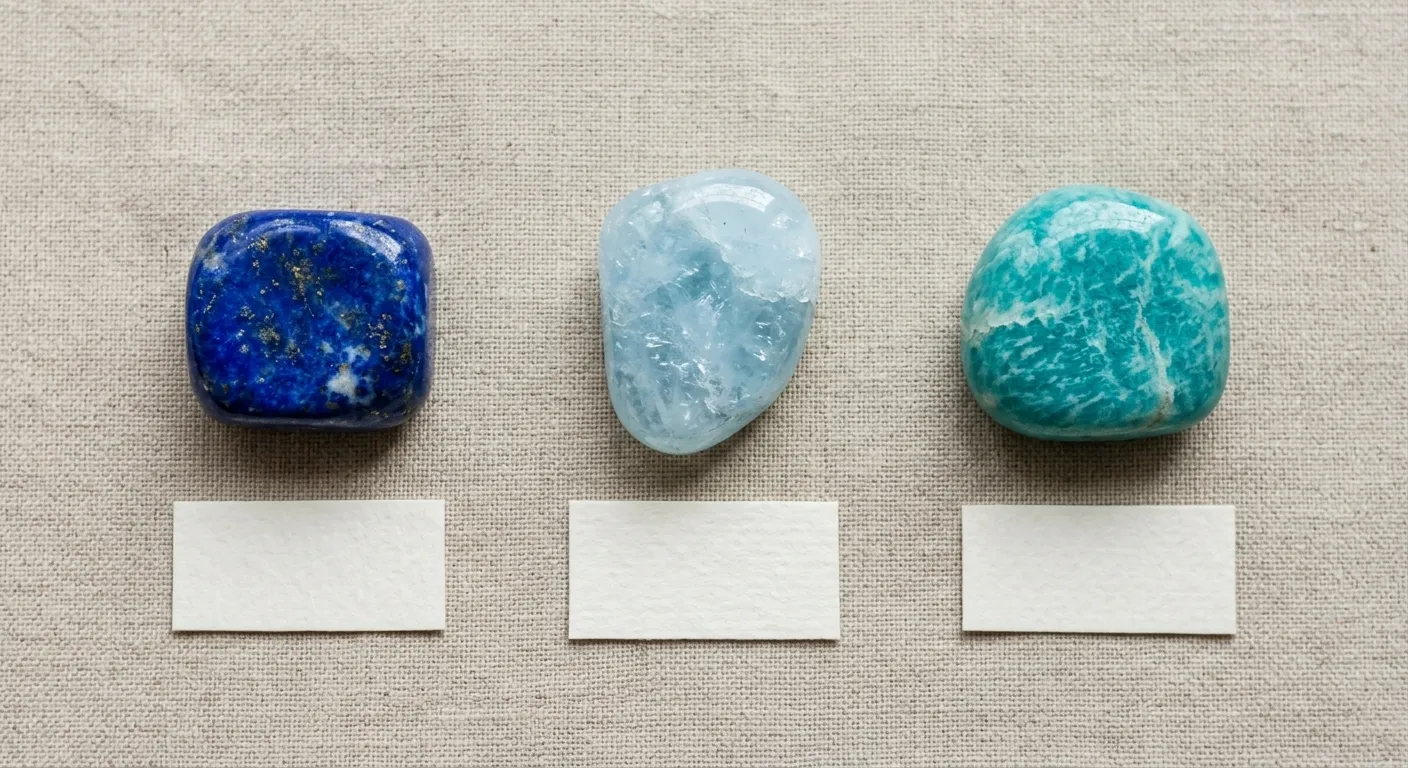
Beginners often arrive at these stones through color: deep blue, pale blue, blue-green, teal, or greenish tones. That is why they are frequently grouped as blue green crystals, even though each has a different look and a different set of symbolic associations.
This is a high-level orientation, not a technical mineral identification guide.
| Stone | Common visual impression | Common meaning language in crystal circles | Beginner use context |
|---|---|---|---|
| Lapis lazuli | Rich, darker blue; sometimes described with contrasting flecks, mottling, or variation | Often linked with truth, insight, voice, wisdom, or inner authority | Chosen when someone wants a bold visual focal point |
| Aquamarine | Pale blue or blue-green; often described as light, clear, or water-like | Often framed around calm expression, openness, clarity, or gentle communication | Chosen when someone prefers a softer-looking stone |
| Amazonite | Blue-green, greenish, teal, or turquoise-like; sometimes visibly patterned | Often associated with personal expression, steadiness, choice, or a soothing presence | Chosen when someone wants an earthy blue-green piece |
These descriptions reflect broad reader-facing language. Exact mineral identity, composition, locality, durability, and authentication require stronger gemological or geological references than this page currently has available.
For chakra practice, the more useful beginner question is usually not “Which stone is objectively best?” It is: “Which visible piece, symbolic meaning, and personal ritual setting make sense for the way I practice?”
Why blue and green stones show up in root chakra practice
Many chakra introductions associate the root chakra with red, black, brown, or other earth-toned stones. So it is reasonable to wonder why lapis lazuli, aquamarine, and amazonite appear in root chakra crystal practice at all.
The short answer: some personal chakra systems are not built from color matching alone. They may use contrast, companion themes, intention, or a full-body symbolic map.
In a simple color-based approach, red and black stones may feel closer to root chakra language because they visually suggest earth, weight, depth, or foundation. Blue and green stones are more often linked elsewhere in many chakra descriptions. But personal practice can be more flexible. A reader may include a blue or blue-green stone in a root-themed arrangement because it represents a quality they want to bring into their sense of steadiness: clearer speech, quieter reflection, gentler self-expression, or a feeling of spaciousness.
That does not make blue stones “classic root stones” in every system. A more careful reading is:
In some belief-based chakra practice, lapis lazuli, aquamarine, and amazonite may be used as companion or contrast stones in a root-focused ritual.
A simple arrangement might include:
- an earth-toned stone or object for the central root theme;
- a blue stone for expression or reflection;
- a blue-green stone for softness, proportion, or personal choice;
- a short journal prompt that connects the symbolic ideas.
The stone does not carry one universal interpretation by itself. The meaning comes from the practice, the tradition, and the individual using it.
What the three stones look like in beginner terms
Before asking which stone “means” what, look at the piece itself. Color, contrast, opacity, polish, and shape often guide a better decision than a long list of symbolic claims.
Lapis lazuli: darker blue and visually strong
Lapis lazuli is commonly noticed for its rich blue appearance. Many pieces look bold rather than delicate. Some are described with lighter or metallic-looking flecks, patches, or natural-looking variation, depending on the specimen and how it has been cut or polished.
In personal practice, that darker visual presence can make lapis feel like a strong focal object. Readers who want a stone that stands out on a desk, shelf, cloth, or quiet practice corner may be drawn to it.
The lapis lazuli meaning often seen in crystal language leans toward voice, truth, insight, learning, or inner authority. Keep that wording in the symbolic category. It may be useful in a personal ritual, but it is not the same as a verified effect.
Aquamarine: pale blue and quiet-looking
Aquamarine is often approached through its pale blue or blue-green impression. Many readers describe it as gentle, clear, airy, or water-like. Compared with lapis, it is usually imagined as lighter in mood and softer in visual weight.
The aquamarine meaning in crystal communities is often phrased around communication, calm presence, openness, or clarity. In chakra practice for beginners, a person might choose aquamarine when they want a stone that visually feels less intense than lapis and more spacious than amazonite.
The distinction stays simple: pale blue appearance is observation; symbolic calmness or expression is interpretation.
Amazonite: blue-green, earthy, and approachable
Amazonite often sits visually between green and blue. Some pieces look more green; others lean more teal or turquoise-like. The surface may look soft, patterned, streaked, or slightly cloudy depending on the piece.
Amazonite meaning is commonly described in crystal circles with words such as expression, steadiness, self-trust, choice, or emotional softness. For a root-adjacent personal practice, a reader may choose it because blue-green feels like a bridge: not as dark as lapis, not as light as aquamarine, and often visually connected to both water and earth.
For beginners choosing lapis lazuli or amazonite, the decision often comes down to visual preference: deep blue focus versus blue-green grounded softness.
Lapis lazuli vs aquamarine vs amazonite: practical comparison
A comparison helps most when it avoids ranking the stones as if one is universally stronger or more correct. Compare them by what you can see, how they are commonly described, and how you might use them in a quiet personal practice.
| Decision point | Lapis lazuli | Aquamarine | Amazonite |
|---|---|---|---|
| Visual mood | Darker, stronger, more saturated blue | Light, pale, watery blue or blue-green | Blue-green, teal, greenish, often earthier |
| Symbolic language | Voice, insight, truth, wisdom, inner authority | Gentle expression, clarity, openness, calm communication | Personal expression, steadiness, choice, soft confidence |
| Beginner fit | If you want a bold focal stone | If you prefer a quieter, lighter stone | If you like blue-green stones with an earthy feel |
| Root-adjacent role | Companion for speaking from a steadier foundation | Companion for soft reflection around expression | Companion for grounded self-expression or personal choice |
| Selection caution | Do not treat meaning lists as fixed rules | Do not assume a pale color makes it better for every practice | Do not rely on color names alone; pieces vary visually |
The root-level point is not to settle every detail of lapis lazuli vs aquamarine vs amazonite. It is to give you a clear decision frame.
Start with appearance:
- Do you prefer dark blue, pale blue, or blue-green?
- Do you want a polished palm stone, a small tumbled piece, a bead, or a display stone?
- Do you like visual contrast, soft translucency, or cloudy patterning?
- Would you use this near a journal, on a shelf, during quiet sitting, or as a carried object?
Then consider symbolic fit. If you are drawn to directness and reflection, lapis may fit your personal vocabulary. If you want a lighter association around pausing before expression, aquamarine may feel more natural. If you like the idea of blue-green steadiness and choice, amazonite may make sense.
Finally, think about setting. A stone used on a desk, beside a bed, in a pouch, or as part of a small arrangement may need a different size, shape, or finish. As a general care habit, avoid rough handling, scraping, unnecessary moisture, heat, chemicals, or abrasive surfaces. For valuable, delicate, dyed, or jewelry-set pieces, look for appropriate gem or mineral care guidance before experimenting.
A beginner path for belief-based chakra practice
A useful chakra practice for beginners does not need many stones or dramatic language. It can be as simple as choosing one object, naming why you chose it, and using it as a cue for reflection.
| Step | What to do | Example |
|---|---|---|
| 1. Name your purpose plainly | Write one ordinary sentence before choosing a stone | “I want a blue stone to remind me to speak more carefully.” |
| 2. Choose one stone | Avoid starting with a full collection | Lapis for deep blue focus, aquamarine for a pale blue look, amazonite for blue-green steadiness |
| 3. Give it a place | Put the stone somewhere repeatable | Beside a journal, on a tray, near a chair, or in a pouch |
| 4. Use a short prompt | Let the stone support attention, not expectation | “What would feel more grounded in my next small decision?” |
The sentence is not a result claim. It is a way to focus your attention. The stone becomes part of the setting, not the source of a promised outcome.
A few beginner prompts that work well with these three stones:
- “What does steadiness mean to me today?”
- “Where do I want to speak more simply?”
- “What choice am I returning to?”
- “What would make this practice easier to repeat?”
These prompts fit the spiritual interpretation of crystals while staying rooted in reflection, language, and personal meaning.

Everyday practice ideas with lapis lazuli, aquamarine, and amazonite
If you already have one of these stones, keep the practice small enough to repeat. The following ideas are personal-use formats, not instructions for guaranteed results.
One-stone desk practice
Choose one stone and place it where you write, plan, or read. Keep a short note nearby:
- Lapis lazuli: “Speak clearly.”
- Aquamarine: “Pause before answering.”
- Amazonite: “Choose with steadiness.”
The note does not need to match anyone else’s interpretation. It only needs to make sense to you.
Root-themed journal layout
For a root chakra crystal practice that includes blue or green stones, use the stone as a companion rather than the whole focus.
- Write one sentence about what “rooted” means to you.
- Place the stone beside the page.
- Write one practical action that would support that feeling in ordinary life.
- Close the notebook and return the stone to its place.
This keeps the practice connected to reflection and ordinary action.
Color comparison tray
If you own more than one of the stones, place them together and observe them before reading a meaning list.
Notice:
- Which color draws your eye first?
- Which piece looks heavier, lighter, brighter, or softer?
- Which one feels suited to morning?
- Which one feels better for evening reflection?
After observing, you can add symbolic language if you want it. This order helps prevent meaning lists from overriding your own response to the object.
Carried-stone reminder
Some readers like to carry a small stone in a pouch or pocket. If you do this, choose a piece that is not sharp, fragile, or likely to rub against keys or coins. Keep the reminder simple: when you notice it, return to one word such as “steady,” “clear,” or “present.”
Small arrangement with contrast
For a root-themed arrangement, you might pair one blue or blue-green stone with a darker or earth-toned object. The contrast can make the symbolic relationship easier to see: foundation plus expression, steadiness plus clarity, grounding plus choice. The arrangement can be as minimal as two objects on a cloth.
Common beginner mistakes
The most useful correction for beginners is not “you are using the wrong stone.” It is often “you may be asking the stone to carry too much meaning.” A careful practice uses stones as symbols, reminders, and objects of attention.
| Mistake | Better approach |
|---|---|
| Treating meaning lists as universal rules | Use them as vocabulary, not commands |
| Ignoring the actual piece in front of you | Look at color, pattern, polish, size, and shape before interpreting |
| Assuming blue and green stones must fit the root chakra in the same way | Read them as companion or contrast stones unless your own tradition says otherwise |
| Using spiritual wording when ordinary wording would be clearer | Translate the idea into a sentence you can repeat |
| Skipping basic care and storage | Keep pieces from scraping, clutter, moisture experiments, harsh light, salt, oil, or rough surfaces unless you have reliable care guidance |
A stone name is not the same as a stone experience. Two pieces sold under the same name may look quite different. If you are choosing for personal ritual use crystals, the actual object matters.
How to choose between the three stones
Choosing among lapis lazuli, aquamarine, and amazonite does not have to begin with a chakra chart. Begin with the role you want the stone to play.
| If your main question is… | Start with… | Why |
|---|---|---|
| “I want a visually strong blue focal point.” | Lapis lazuli | It is commonly chosen for a darker, more saturated blue impression |
| “I want something light, pale, or water-like.” | Aquamarine | It often appeals to readers who prefer a softer blue or blue-green look |
| “I want a blue-green stone that feels earthy.” | Amazonite | It sits naturally in the green-to-blue-green visual range |
| “I am comparing meaning language.” | Any of the three | Symbolic fit depends on your own practice vocabulary |
| “I am building a root-themed practice.” | Pair or contrast thoughtfully | Blue and green stones may work as supporting symbols rather than classic root-color stones |
If you are choosing for display, consider color contrast with the surface beneath it. Lapis may stand out on pale cloth. Aquamarine may look subtle unless light and background make it visible. Amazonite often works well with neutral, brown, cream, gray, or dark surfaces, depending on its tone.
If you are choosing for symbolic meaning, use your own words:
- Lapis lazuli: “I want to speak with more clarity.”
- Aquamarine: “I want to pause and soften my tone.”
- Amazonite: “I want to make choices from a steadier place.”
You can also reject common meanings. If a phrase does not feel natural, do not force it. The point of personal ritual is not to memorize crystal vocabulary; it is to create a meaningful cue.
Reader path: where to go next
This page is the root map. The next step depends on the question you are really asking. Use the entries below as routes into narrower topics rather than trying to answer everything at once.
Lapis Lazuli vs Aquamarine vs Amazonite: Meanings and Chakra Associations
Use this path if you want a side-by-side comparison of appearance, common symbolic meaning, chakra association, and everyday use context.
Why Blue and Green Crystals Appear in Root Chakra Practices
Use this path if you are confused by blue or green stones in a root chakra setting. The key question is how some practitioners use contrast, companion themes, and personal symbolism alongside more familiar root-color associations.
What Lapis Lazuli, Aquamarine, and Amazonite Look Like
Use this path if you want help recognizing visible differences among the three stones before leaning on meaning language.
How to Choose Between Lapis Lazuli, Aquamarine, and Amazonite
Use this path if you are ready to make a practical choice based on appearance, handling preference, symbolic fit, and how you plan to use the stone.
Everyday Chakra Practice Ideas for Lapis Lazuli, Aquamarine, and Amazonite
Use this path if you already have a stone and want simple ways to include it in reflection, display, journaling, carrying, or quiet ritual.
A grounded way to read crystal meanings
Crystal pages often move too quickly from “this stone is blue” to “this stone does something.” A better reading habit is to slow the sentence down.
Try translating any crystal statement into three parts:
- The visible part: What does the stone look like?
- The practitioner part: What do some people associate with it?
- The personal part: How might I use that association as a reminder or symbol?
For lapis lazuli
- Visible: “This piece looks deep blue.”
- Practitioner language: “Some crystal practitioners associate lapis with voice or insight.”
- Personal use: “I might place it beside my notebook when I write about speaking clearly.”
For aquamarine
- Visible: “This piece looks pale blue or blue-green.”
- Practitioner language: “Some people connect aquamarine with gentle expression or clarity.”
- Personal use: “I might use it as a quiet object before journaling.”
For amazonite
- Visible: “This piece looks blue-green or greenish.”
- Practitioner language: “Some people frame amazonite around personal expression or steadiness.”
- Personal use: “I might include it in a root-themed practice about making a small decision.”
This approach preserves the usefulness of chakra symbolism without turning symbolic language into mineral fact.
The root takeaway
Lapis lazuli, aquamarine, and amazonite can all fit into chakra practice when they are used thoughtfully, but they do not fit in the same way. Lapis lazuli is often chosen for a deep blue focal presence and symbolic language around voice or insight. Aquamarine is often chosen for a lighter blue or blue-green look and gentler expression language. Amazonite is often chosen for blue-green tones and associations with steadiness, choice, or personal expression.
For root chakra-themed practice, these stones are usually best understood as companion or contrast stones unless your own tradition frames them differently. Start with what you can see. Add meaning carefully. Use the stone as a personal ritual object, not as a source of guaranteed outcomes.
Because no public references were available for this draft, this page avoids detailed claims about composition, hardness, origin, historical lineage, exact chakra mapping, or stone-specific care rules. For valuable pieces, specimen identification, or delicate materials, consult reliable gemological, geological, or care-focused sources.
The cleanest beginner path is simple: observe, choose, interpret, practice, and keep the difference between object and meaning visible.