
Beginner framework
Root Chakra Stones: Meanings, Colors, and Belief Boundaries
Root chakra stones are usually red, black, brown, smoky, or earthy-looking stones chosen in modern chakra practice as symbols of grounding, steadiness, foundation, and connection to the earth. The phrase root chakra stones meanings often mixes two different layers: what you can see and handle in a stone, and what crystal practitioners or shops say the stone represents.
Those layers are not the same. Red jasper may be opaque, brick red, smooth, and easy to carry. In chakra traditions, many people associate it with steadiness or foundation. The first statement describes the object. The second describes a belief-based meaning.
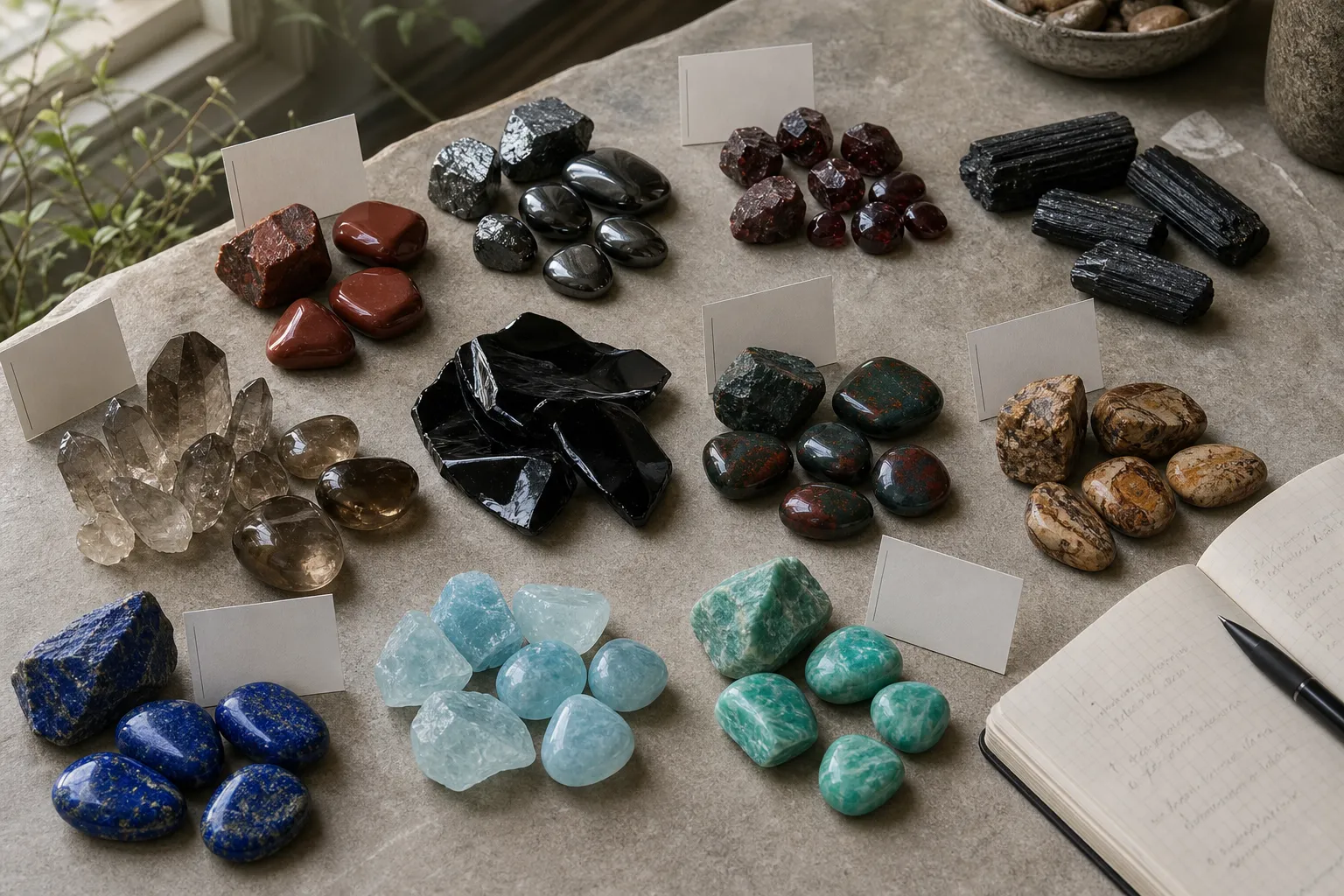
Red jasper, hematite, garnet, black tourmaline, smoky quartz, obsidian, bloodstone, and brown jasper appear often in modern root chakra lists. They are common associations, not a single universal list from one fixed ancient source. Use the meanings as symbolic language for personal practice, reflection, or display—not as clinical guidance or promised results.
What Counts as a Root Chakra Stone?
A root chakra stone is not a gemological category. It is a stone placed into a chakra-practice context because of its color, symbolism, retail tradition, or personal meaning.
In modern chakra writing, the root chakra is often called the first chakra, base chakra, or Muladhara. Beginner-friendly chakra charts commonly connect it with red, earth, foundation, steadiness, and feeling grounded. Crystal shops and practitioner guides usually translate that into red stones, black stones, smoky stones, brown stones, and dense-looking polished pieces.
A useful way to read the topic is to separate four layers:
Stone appearance
Color, polish, texture, transparency, weight, inclusions, and shape.
Example: “This is a glossy black stone” or “this jasper is opaque red-brown.”
Stone identity
The common or trade name used for the material.
Example: hematite, garnet, black tourmaline, or smoky quartz.
Chakra meaning
The symbolic role assigned in personal or practitioner language.
Example: grounding, steadiness, foundation, or boundary imagery.
Claim boundary
What the stone should not be asked to prove.
Example: not a body-reading tool, not a guaranteed outcome, and not professional care.
This distinction is the backbone of the whole guide. A stone can be beautiful, meaningful, and useful as a reminder object without being treated as an evidence-based tool.
Start With What You Can See and Use
Beginners often arrive after seeing confident online claims. A calmer way to choose is to begin with visible selection cues: color, finish, size, durability, and how the stone will actually live with you.
Color: red, black, brown, and smoky tones
The most common root chakra stone colors are red and black, followed by brown, smoky gray, deep burgundy, and other earth-toned appearances.
- Red stones are popular because red is the most recognizable root chakra color in modern charts. Red jasper and garnet are the most familiar examples.
- Black stones are often described in crystal-market language as grounding or protective. Hematite, black tourmaline, and obsidian are common examples.
- Brown and smoky stones fit the earth-language side of root chakra symbolism. Smoky quartz and picture jasper often appear here.
- Green-red stones, especially bloodstone, show up because their earthy look and red markings have long been used symbolically in crystal communities.
Color does not create a measurable chakra result. It gives people a visual and symbolic anchor. For many readers, that is the real reason a stone “fits” a root chakra practice.
Finish: polished, raw, carved, or faceted
The same stone can feel very different depending on its form.
Tumbled stone
Small, smooth, and easy to carry. Good for pockets or pouches.
Palm stone
Larger, polished, and comfortable in the hand. Useful as a tactile reminder.
Bracelet
Wearable and visible, but exposed to impact, water, soap, and elastic wear.
Raw piece
Textured and natural-looking, often more dramatic. May chip, shed, or feel rough.
Display stone
Good for desks, shelves, altars, or quiet corners. Needs stable placement and dusting.
Faceted gem
More jewelry-oriented. Value and care depend on gem quality and setting.
For a beginner, form may matter more than the exact stone name. A smooth black pocket stone may be more useful than a fragile rough specimen. A bracelet may be convenient, but it also needs more care than a stone kept on a shelf.
Size and handling style
Root chakra stones are often used as reminder objects. That does not require an elaborate ritual. Common formats include:
- carrying a small polished stone in a pocket or pouch;
- holding a palm stone during quiet reflection;
- placing a stone on a desk as a visual cue;
- wearing a bracelet for symbolic reasons;
- arranging a small group of red, black, and earthy stones in a display.
If you dislike heavy jewelry, a bracelet may not suit you. If you misplace small objects, a display piece may be easier. If you want something private, a pocket stone may feel more natural than visible jewelry.
Common Root Chakra Stones Chart
This root chakra stones chart is a beginner map, not a final authority list. These stones appear often in modern crystal shops, chakra guides, and personal-practice language. Their meanings should be read as common associations.
Red jasper
Usually opaque red, brick red, brownish red, and sometimes patterned. Commonly associated with steadiness, foundation, and earthy presence. Often sold as tumbled stones, palm stones, beads, and carvings.
Hematite
Metallic gray to black, often shiny, and may feel weighty. Commonly associated with solidity, grounding imagery, and focus as a reminder object. Polished pieces feel dense; some jewelry sold as “hematite” may be treated or imitation material.
Black tourmaline
Black, often striated or textured in rough form. Commonly associated with boundary and protection symbolism in belief-based language. Rough pieces can chip or shed; store away from softer polished stones.
Garnet
Deep red, wine red, reddish brown, and sometimes transparent. Commonly associated with root energy symbolism, intensity, and vitality language in practitioner writing. Gem-quality garnet belongs partly to jewelry culture; beads and chips are common in crystal retail.
Smoky quartz
Transparent to translucent smoky brown or gray. Commonly associated with earthy anchoring language and a calm visual tone. Durable for ordinary handling, but points and clusters still need care.
Obsidian
Black volcanic glass, including glossy, mahogany, snowflake, or rainbow varieties. Commonly associated with dark reflection, grounding, and strong symbolic language in some communities. Broken or raw edges can be sharp.
Bloodstone
Dark green chalcedony with red spots or markings. Commonly associated with strength, endurance, and earth-and-red symbolism. Appearance varies; the red markings are visual symbolism, not a body claim.
Brown jasper or picture jasper
Brown, tan, cream, or landscape-like patterns. Commonly associated with earth connection, patience, and grounded perspective. Often chosen for earthy appearance rather than classic red color.
Instead of asking which stone is “strongest,” ask:
- Which color family draws me in?
- Do I want polished, raw, wearable, or display form?
- Do I want classic red symbolism or dark grounding imagery?
- Am I comfortable with belief-based language, or do I only want the stone as a visual reminder?
- Is the stone durable enough for how I plan to use it?
That line of questioning keeps the decision close to the actual object.
Red and Black Root Chakra Stones: What the Colors Usually Mean
Red and black stones dominate root chakra language because they match the two most familiar symbolic routes: red as the classic chart color, and black as the market language of weight, depth, grounding, and boundary imagery.
Red stones: warmth, foundation, and visible intensity
Red jasper and garnet are the red stones beginners most often encounter in root chakra lists.
The red jasper root chakra meaning is usually framed around steadiness, endurance, earthiness, and practical foundation. Red jasper is commonly opaque and can range from brick red to brownish red. Its look fits the “earth material” feeling many people expect from a root stone.
The garnet root chakra meaning is often more intense in tone. Garnet can appear deep red, wine red, or reddish brown, and some gem-quality garnets are transparent enough to belong strongly to jewelry culture. In chakra-practice language, garnet is often associated with drive, vitality, and rooted presence. Those are symbolic meanings, not measurable effects.
Red stones work well for readers who want a clear color match: red chart, red stone, root chakra theme. The limitation is that color matching can become too rigid. A stone does not need to be red to hold personal meaning in a root chakra practice.
Black stones: weight, contrast, and boundary imagery
Black tourmaline, hematite, and obsidian often appear in lists of red and black chakra stones.
The hematite root chakra meaning is commonly tied to grounding because hematite can look metallic, dark, and solid. Polished hematite may feel weighty in the hand, which makes it a popular reminder object. The weight is a handling cue; the meaning is an interpretation placed around that cue.
The black tourmaline root chakra meaning is often written in boundary or protection language. In retail and practitioner settings, black tourmaline is commonly placed near doors, desks, or personal spaces as a symbolic object. Its black color and striated rough texture make it visually different from smooth polished hematite or glossy obsidian.
Obsidian is another common black stone in root chakra lists. Because it is volcanic glass, it can look reflective and sharp-edged when broken. Many people choose it for its dark, mirror-like appearance. The symbolic language around obsidian can become dramatic, so it is especially important to keep the meaning in the realm of personal interpretation.
What “Grounding Crystals” Usually Means
“Grounding crystals” is one of the phrases readers often see before they search for root chakra crystals meaning. In crystal-practice language, grounding usually points to symbolism: steadiness, weight, earth imagery, routine, presence, and a sense of foundation.
A practical comparison is more useful than a ranked list.
If you want a classic root color
Consider red jasper or garnet because their strong red or deep red appearance creates a clear visual match.
If you want a dark, dense look
Consider hematite, black tourmaline, or obsidian because black, metallic, or glassy appearance fits grounding imagery.
If you want a softer earthy style
Consider smoky quartz, brown jasper, or picture jasper because brown, smoky, or landscape-like tones feel quieter.
If you want a pocket reminder
Consider tumbled jasper, hematite, or smoky quartz because smooth forms are easy to carry.
If you want a desk or shelf object
Consider black tourmaline, obsidian, or a jasper palm stone because each works as a visible symbolic cue.
If you want a jewelry piece
Consider garnet, hematite beads, or jasper beads, while remembering that durability and construction vary.
In everyday crystal communities, grounding can mean choosing earth-colored stones, using a stone as a reminder to slow down, pairing the stone with quiet breathing or reflection, arranging red and black stones in a personal ritual space, or using symbolic language around steadiness and foundation.
Two stones may carry similar grounding crystals meanings but feel completely different in use. Hematite may appeal to someone who likes a smooth, metallic, weighty object. Black tourmaline may appeal to someone who likes a rough, dark, textured mineral look. Red jasper may appeal to someone who wants warmth and earth color. Smoky quartz may appeal to someone who prefers translucency over opaque stones.
The meaning label may be similar; the object experience is not. That is why comparison should start with the stone in front of you.
Why Blue-Green Crystals Sometimes Appear in Root Chakra Practice
Classic root chakra color language points to red, black, brown, and earthy tones. Yet readers sometimes see lapis lazuli, aquamarine, and amazonite discussed near root chakra-themed personal practices. That can be confusing because blue and blue-green stones are more often connected with other chakra color systems in modern charts.
The simplest explanation: personal practice does not always follow chart color rules.
- A person might include a blue-green stone because it has personal meaning.
- It may already be part of a collection.
- It may create visual contrast with red or black stones.
- It may be used in a broader personal theme around foundation and expression.
- It may be paired with root stones rather than replacing them.
- The practitioner may be building a symbolic set, not following a strict chart.
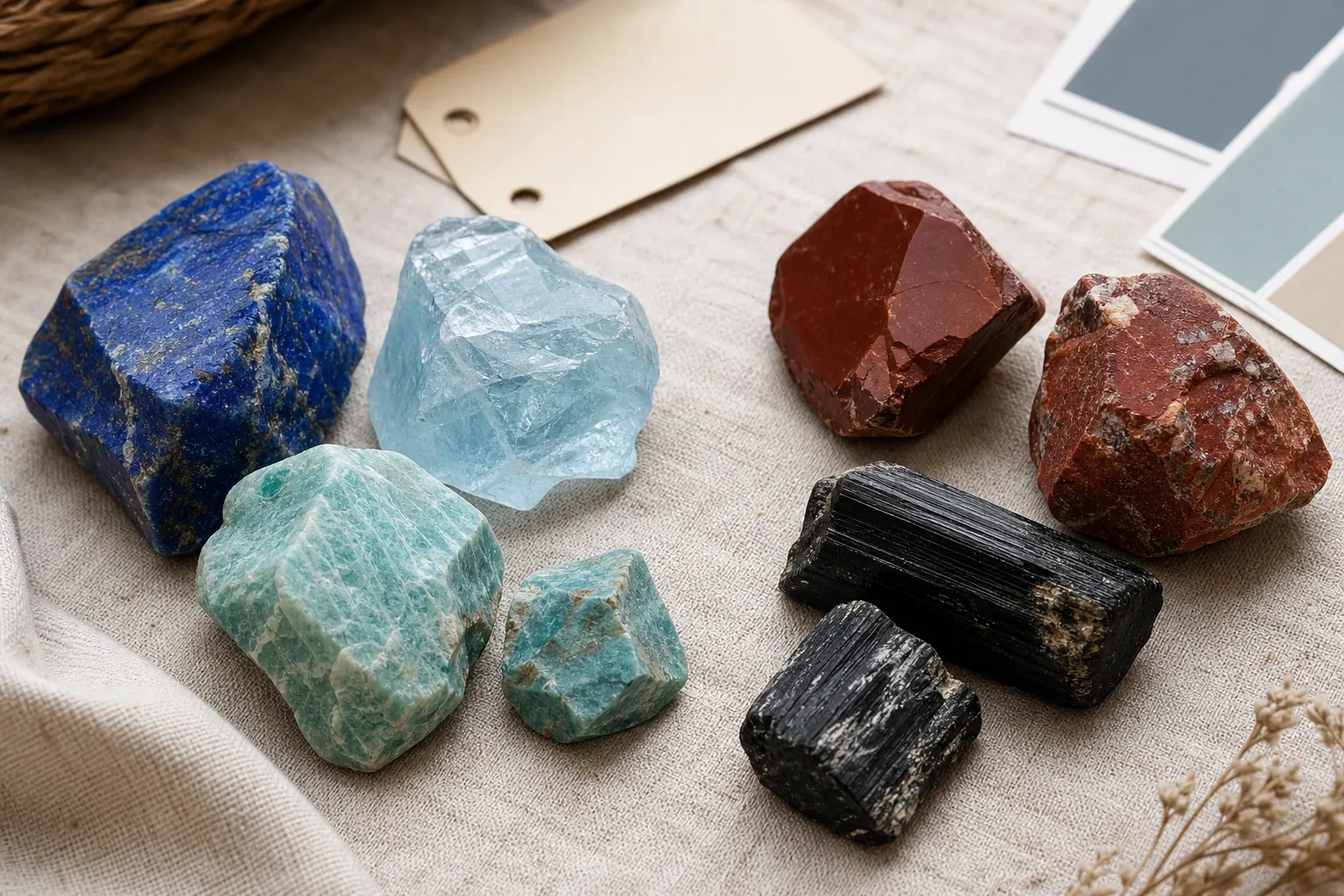
Lapis lazuli is known for deep blue color, often with golden pyrite flecks. Aquamarine is commonly recognized for blue to blue-green color. Amazonite is known for green to blue-green tones. These are observable color descriptions and gem-market identities; they do not establish chakra outcomes.
A reader might place lapis lazuli near red jasper because the pairing feels personally meaningful. Someone else might combine amazonite with black tourmaline because the colors feel balanced. Another person might compare aquamarine with smoky quartz because both feel visually quiet.
The key is to name the shift honestly: blue-green crystals can be part of a personal symbolic arrangement, but they are not the classic red-black root chakra pattern.
Root Chakra Meanings Without Overstating the Claims
Root chakra stone beliefs can be meaningful without becoming health-outcome claims.
1. Observable statement
“This stone is red, black, metallic, smoky, polished, raw, transparent, or opaque.”
2. Symbolic statement
“Many chakra practitioners associate this stone with grounding, steadiness, boundary imagery, or foundation.”
3. Overextended statement
“This stone will create a specific physical or emotional result.”
The first two can be discussed responsibly. The third should be avoided.
When a shop says a stone is “for grounding,” read it as shorthand. It may mean the stone is red, black, brown, or earthy; the stone appears in modern root chakra lists; the seller is using common crystal-community vocabulary; the stone is meant for personal ritual, display, meditation, or reflection; and the meaning is symbolic rather than measurable.
This approach lets you enjoy the language without giving it more authority than it can carry.
Crystal use belongs to personal, spiritual, cultural, and reflective contexts. People may use stones as visual anchors, ritual objects, or reminders of an intention. Research discussions around ritual, expectation, and personal meaning can help explain why objects may feel significant to people, but they do not turn root chakra stones into clinical tools.
A root chakra stone can be personally meaningful. It should not be used to interpret the body, replace higher-stakes care, or promise results.
How to Compare Root Chakra Stones Before Choosing One
When you compare root chakra stones, use a practical sequence. This keeps you from getting lost in long lists or dramatic claims.
1. Choose your color route
Start with the visual language you want.
- Choose red if you want the classic root chakra color match.
- Choose black if you like dense, dark, grounding imagery.
- Choose brown or smoky if you prefer a quieter earth tone.
- Add blue-green only if it has personal meaning or belongs to a mixed practice.
This step alone narrows the field quickly.
2. Decide how the stone will live with you
A stone used on a shelf is different from a stone carried every day.
Pocket stone
Smooth tumbled jasper, hematite, or smoky quartz. Watch for scratches, loss, and small pieces.
Bracelet
Beads of jasper, garnet, or hematite-style material. Watch for water, impact, elastic wear, and uncertain treatments.
Palm stone
Jasper, obsidian, or smoky quartz. Watch for chips, drops, and storage.
Desk display
Black tourmaline, obsidian, jasper, or smoky quartz. Watch for dust, fragile points, and sharp edges.
Jewelry
Garnet, jasper beads, and selected polished stones. Watch for durability, setting quality, and care needs.
If you plan to carry a stone, comfort and durability matter. If you plan to display it, appearance and stability matter. If you plan to wear it, jewelry construction matters as much as the stone name.
3. Keep naming and trade language realistic
Gem names can be precise, loose, or retail-friendly depending on the seller. Naming standards and trade references matter because color, treatment, imitation, and variety names can confuse buyers.
- Do not assume every dramatic name is a separate mineral.
- Ask whether a stone is natural, dyed, coated, reconstructed, or synthetic if the claim matters to you.
- Expect color variation in natural materials.
- Be cautious with vague labels such as “root chakra crystal set” if individual stones are not identified.
- Remember that a chakra label is not a gemological identity.
A bag labeled “root chakra stones” may contain several common stones, but the category itself is symbolic and retail-based.
4. Match care to the actual material
Ordinary care should stay practical. General handling notes:
- Avoid breathing dust from broken or carved mineral pieces.
- Avoid placing uncertain stones in drinking water.
- Avoid soaking stones when you do not know how they respond to water.
- Keep small stones away from children and pets.
- Store sharp, brittle, or rough pieces away from softer polished stones.
- Wipe dust gently rather than using harsh cleaners.
Different stones have different durability and surface traits. Obsidian is glassy. Rough tourmaline can be brittle. Jewelry stones may have settings, coatings, stringing, or treatments. When in doubt, keep care simple and dry.
Common Misreadings Beginners Should Watch For
The root chakra topic attracts confident language. Some of it is harmless when read as symbolism. Some of it becomes misleading when it sounds like certainty.
“A red stone is automatically a root chakra stone.”
Red is the most familiar root chakra color, but ruby, garnet, red jasper, red agate, and red glass are not interchangeable just because they are red. Color is a cue, not a full identity.
“A black stone always protects.”
Protection language around black tourmaline, obsidian, onyx-style labels, and hematite is symbolic. It may matter personally, but it should not be treated as a verified shield against life events or other people.
“Every root chakra stone list is authoritative.”
Many lists come from shops, practitioner pages, or modern crystal books. They overlap, but they vary. Red jasper, hematite, garnet, black tourmaline, smoky quartz, bloodstone, and obsidian appear often, but there is no single universal list.
“Feeling unsettled proves a blocked root chakra.”
Chakra language can be part of a belief system, but ordinary discomfort or life stress should not be turned into a body-reading label.
“Stone meaning equals mineral identity.”
Hematite’s metallic look, garnet’s red color, black tourmaline’s striated form, and jasper’s opaque earthiness are observable qualities. Grounding and foundation language are interpretations placed around those qualities.
A Simple Four-Lens Framework
If you want a beginner-friendly way to read root chakra stones meanings, use four lenses: appearance, meaning, use, and boundary.
Appearance
Ask what you can see and handle: color, polish, texture, size, transparency, weight, and durability. This keeps the object real before symbolism takes over.
Meaning
Ask what the stone is commonly said to represent. This lets you read chakra language as cultural, retail, or personal symbolism.
Use
Ask how the stone will fit ordinary life: pocket, palm stone, jewelry, display, or quiet reflection object. This prevents overcomplicated choices.
Boundary
Ask what the claim is asking you to believe. This keeps symbolic use separate from promised outcomes.
“I choose red jasper because its warm red color fits the root chakra symbolism I like.”
That is a grounded personal statement.
“Many crystal practitioners associate hematite with grounding, and I use it as a reminder object.”
That is also careful because it names the belief context.
The strongest beginner approach is neither cynical nor credulous. It lets stones be beautiful, tactile, and symbolically rich without asking them to become something else.
Reader Paths From This Root Guide
This page is the map. Deeper pages can answer narrower questions without turning this guide into a full encyclopedia.
Red and black root chakra stones
Start here if your main question is color. This path explains why red and black stones appear so often, how red jasper differs from hematite or black tourmaline visually, and why color meanings are useful but not fixed rules.
Grounding crystals meanings
Choose this path if you want to compare grounding language across stones. It focuses on appearance, handling style, and symbolic wording rather than ranking stones by claimed strength.
Blue-green crystals in root chakra practice
Use this path if you are wondering why lapis lazuli, aquamarine, or amazonite show up near root chakra practice even though they are not classic red or black stones.
Root chakra meanings without health claims
Go here if you want the cleanest belief-boundary framework. This path helps you read chakra and crystal language as symbolic, cultural, or personal interpretation.
How to compare root chakra stones
Use this path when you are ready to choose a stone. It compares color, finish, durability, size, care, meaning language, and comfort with belief-based claims.
A Calm Way to Choose Your First Root Chakra Stone
If you want a simple first choice, do not start with the longest list. Start with the clearest use.
For a classic red root chakra stone, choose red jasper if you like opaque, earthy, warm color. Choose garnet if you prefer deep red, jewelry-like richness.
For a black grounding crystal, choose hematite if you like smooth metallic weight. Choose black tourmaline if you prefer a rougher, darker, more textured mineral look. Choose obsidian if you like glossy black glassiness and will handle it with care.
For a quieter earth-tone stone, choose smoky quartz, brown jasper, or picture jasper if you want the root theme without the intensity of bright red or solid black.
For a mixed personal set, combine one classic root stone with one stone that has personal meaning. That might be red jasper with lapis lazuli, black tourmaline with amazonite, or smoky quartz with aquamarine. The pairing does not need to satisfy every chart. It only needs to be honest about what it is: a personal symbolic arrangement.
“Which stone’s color, form, meaning language, and care needs make sense for the way I actually want to use it?”
That question keeps root chakra crystals meaning close to the object in your hand. It also keeps chakra stone beliefs in their proper place: meaningful for many people, but not a substitute for evidence-based decisions, professional support, or ordinary care.
Root chakra stones can be beautiful, tactile, and symbolically rich. Red, black, brown, smoky, and even personally chosen blue-green stones can all have a place in a thoughtful practice. The clearest approach is to see the stone first, understand the common meaning second, and keep the belief boundary visible all the way through.