
Beginner selection guide
How to Choose Root Chakra Stones
To choose root chakra stones, begin with what you can compare directly: color, surface, shape, size, weight, finish, and how the piece would fit into your actual routine. A beginner does not need the most intense-looking crystal, the largest set, or the listing with the biggest promise. A better first question is simple: where will this stone live, and what meaning do you want it to hold in your personal practice?
In chakra traditions, root-focused stones are often associated with themes such as steadiness, place, the body, foundation, and everyday grounding symbolism. Those meanings belong to belief-based and personal-use settings. They are not verified outcomes, and they should not replace practical judgment about the object itself.
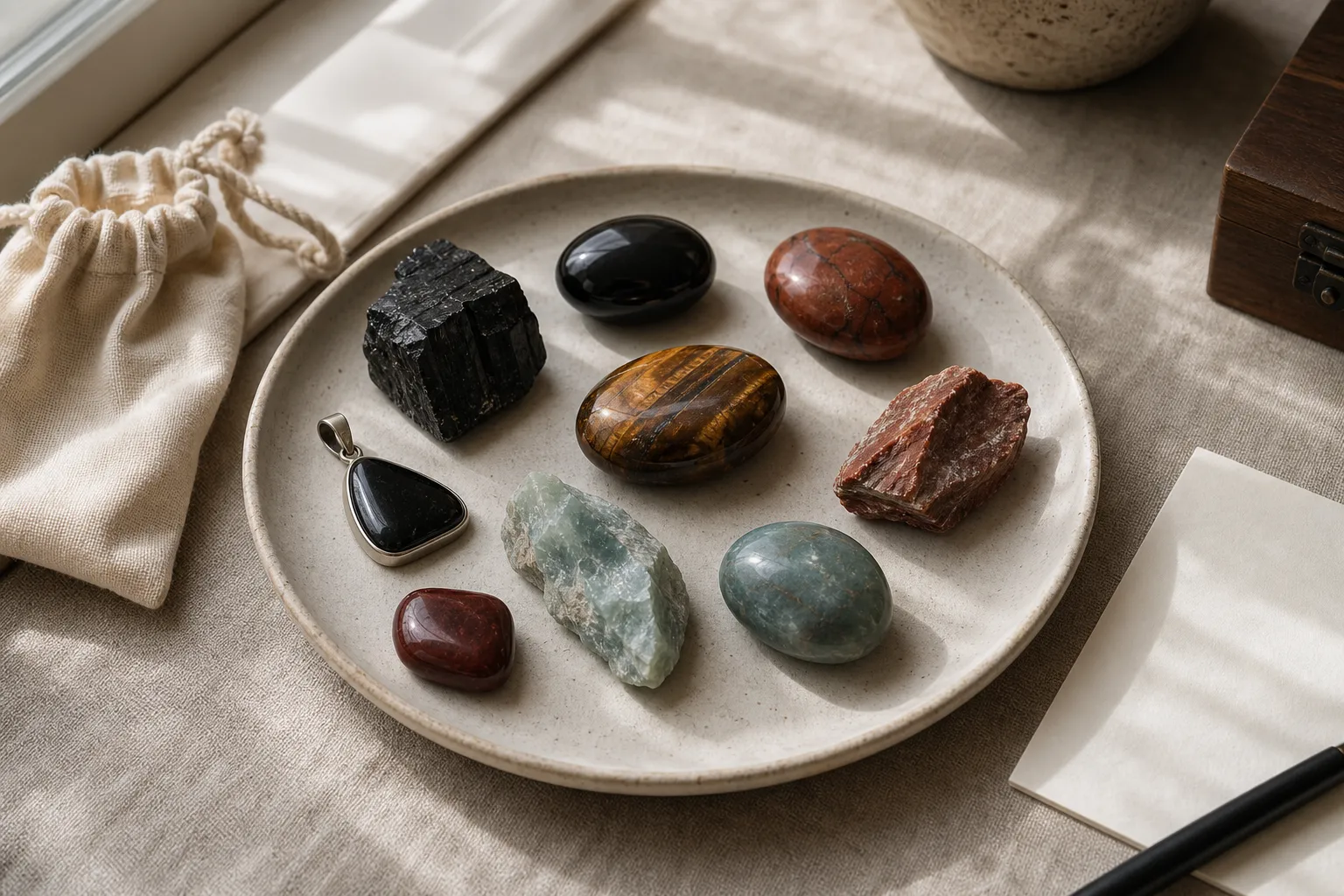
A Simple Framework for Choosing Root Chakra Stones
Choosing crystals becomes easier when you separate three layers that often get mixed together in shops and online descriptions.
| Choosing layer | What to compare | Why it matters |
|---|---|---|
| Visible qualities | Color, markings, polish, shape, texture, size | Helps you judge the actual piece before symbolic meaning enters the decision |
| Practical fit | Pocket comfort, display use, jewelry wear, storage, handling | Helps you choose a stone you will actually keep, see, carry, or use |
| Symbolic meaning | Chakra association, personal intention, ritual setting | Helps you decide whether the stone fits your private practice |
A black polished stone, a red tumbled piece, a brown raw fragment, and a blue-green crystal can all be approached with the same questions: What does it look like? How would I use it? What meaning am I assigning to it?
Root chakra crystal buying guide language can sound unusually certain, especially when it ranks stones as if one were universally better than the others. Treat those rankings as suggestions, not rules. For beginners, visible stone qualities and practical handling usually offer a clearer starting point than dramatic wording.
Before comparing names, ask:
- Where will the stone live: pocket, desk, bowl, pouch, jewelry, shelf, or altar?
- How will you handle it: often, rarely, privately, or mostly as display?
- Does the size suit the setting?
- Do you prefer a smooth surface, a natural texture, a bead, a palm stone, or a flat piece?
- Can you explain the meaning you are bringing to it without relying on a strong promise?
Those questions keep the choice grounded. They also make it easier to notice when a listing gives you more symbolic language than useful object detail.
What “Root Chakra Stone” Means Here
A root chakra stone is best understood as a stone someone uses in a root chakra-themed personal practice. The label does not mean the stone has a verified effect. It means the piece is being chosen, carried, displayed, held, or arranged within a symbolic frame connected to root chakra ideas.
In many crystal and chakra communities, root chakra practice is described through themes such as foundation, belonging, the physical world, steadiness, and everyday presence. Those themes can help someone create a personal ritual or visual reminder, but they should stay separate from scientific or high-stakes guidance.
This distinction matters because beginners often meet root chakra stones through retail wording. A product title may combine crystal name, color, chakra label, and a large promise in one sentence. A more useful approach keeps the concrete parts—the stone, the appearance, the form, the intended use—and leaves the promise-making aside.
| Information type | Examples | How to treat it |
|---|---|---|
| Observable information | Dark red, black, brown, blue-green, speckled, banded, glossy, matte, rough, rounded, carved | Compare it directly |
| Handling information | Small enough to carry, smooth enough for a pocket, large enough to display, shaped for jewelry | Match it to your use |
| Belief-based use | Associated by practitioners with root chakra symbolism, personal steadiness, ritual focus, or intention | Treat it as personal meaning |
A thoughtful choice can include all three, as long as each one stays in its proper place.
Choosing Root Chakra Stones by Color
Color is often the first sorting tool because it is visible, quick, and beginner-friendly. It is not the whole decision, but it gives you a practical way to narrow a tray, shop page, or small collection.
In root chakra-themed crystal practice, many readers begin with darker, earthier, or warmer-looking stones. Some also include selected blue and blue-green stones when their personal practice connects root symbolism with calm presence, voice, water imagery, or a wider symbolic system. Since this site discusses lapis lazuli, aquamarine, and amazonite in root chakra contexts, color is treated here as a flexible entry point rather than a rigid rule.
| Color family | What to compare visually | How it may fit a personal root practice |
|---|---|---|
| Red | Deep red, brick red, rusty red, red-brown tones | Often chosen for a warm, earthy visual cue |
| Black | Glossy black, matte black, gray-black, reflective surfaces | Often chosen for a simple, weighty, minimal look |
| Brown | Chocolate, tan, smoky, woodlike, soil-colored tones | Often chosen for natural, earth-colored display |
| Dark gray | Charcoal, smoky, metallic-looking, or muted gray tones | Often chosen when black feels too stark |
| Blue or blue-green | Deep blue, pale blue, sea-green, green-blue, cloudy or mottled color | Sometimes chosen when a reader includes broader personal symbolism |
Choosing root chakra stones by color works best when you treat color as a first filter, not a rulebook. If you like darker stones, begin there. If a red-brown piece looks earthy to you, that preference matters. If you prefer blue-green crystals and want to include them in a root-themed layout, be clear that the connection is interpretive.
A red stone is not automatically better than a black one. A blue-green stone is not automatically out of place. The useful question is whether the color helps you remember the meaning you are assigning to the practice.
Where Blue-Green Stones Fit
Lapis lazuli, aquamarine, and amazonite are not the most obvious choices if someone expects only red, black, and brown stones. Still, some readers consider them because personal ritual systems are not always limited to one color chart.
For a beginner, the best way to include these stones is to compare appearance and personal symbolism first.
| Stone | Visible starting point | Why a reader might include it |
|---|---|---|
| Lapis lazuli | Deep blue appearance; some pieces may show lighter or golden-looking flecks | A darker blue focus point in a grounded layout |
| Aquamarine | Pale blue to blue-green appearance; often visually soft | A lighter color note beside darker root stones |
| Amazonite | Green-blue or blue-green color; sometimes cloudy or streaked | An earth-and-water color bridge in a personal set |
You do not need to force a blue-green crystal to belong by making a large claim. If the color, shape, and meaning fit your practice, it can be part of your set.
Tumbled and Raw Stones: Form Changes the Experience
Tumbled and raw stones are two of the most common forms beginners encounter. The choice is not about which form is more powerful. It is about how the object feels, looks, stores, and fits into your routine.
| Form | What it usually feels like | Good fit for | Watch for |
|---|---|---|---|
| Tumbled | Smooth, rounded, easy to hold | Pockets, bowls, beginner sets, quiet practice | Very small pieces can be easy to misplace |
| Raw | Uneven, textured, more natural-looking | Display, shelf arrangements, collectors who like rough surfaces | Sharp edges or shedding grains may be impractical |
| Polished shape | Smooth but structured, such as palm stones or carved forms | Desk use, repeated handling, display | Shape may matter more than stone name |
| Beads or jewelry | Wearable, visible, often used as reminder objects | Bracelets, necklaces, daily wear | Comfort, cord quality, and bead size matter |
| Flat or worry-style pieces | Easy to rest in the hand | Pocket carry, tactile focus, short personal ritual | Surface wear may become visible over time |
The phrase “tumbled vs raw root chakra stones” can make the decision sound like a contest. It is more useful to see it as a form choice.
Choose a tumbled stone if you want something easy to carry, easy to store, and comfortable in the hand. Smooth stones are often beginner-friendly because you do not need to think much about edges, dust, or display stability.
Choose a raw stone if natural outline, uneven surface, or stronger visual texture matters to you. Raw pieces can be appealing on a shelf or altar because they look less processed. They may not be as comfortable in a pocket or pouch.
Neither form has a deeper symbolic rank by default. The form simply changes how you interact with the piece.
Size, Weight, and Everyday Use
A stone can look beautiful online and still be awkward for your intended use. Before choosing, imagine the real setting.
- A tiny stone may be good for a pouch but easy to lose.
- A large stone may display well but feel too bulky to carry.
- A heavy piece may feel satisfying on a desk but inconvenient in a pocket.
- A narrow point or delicate shape may need more careful storage.
- A bead bracelet may be more visible than a pocket stone, but less private.
For personal chakra practice, the object should support the setting you have in mind. A stone that stays in a drawer because it is inconvenient is not a good practical match, even if the name sounds right.
How to Compare Common Root Chakra Crystals
Many beginners search for how to compare common root chakra crystals because they want a clear answer: which one should I choose first? The more honest answer is that you can compare stones without declaring one universally best.
Names commonly associated with root chakra-themed practice often include dark, red, brown, smoky, or earthy-looking stones. Because this page is a root-level guide, the goal is not to build a complete stone encyclopedia. The goal is to give you a way to judge pieces before you buy or use them.
| Comparison point | Ask yourself | Why it helps |
|---|---|---|
| Color | Do I want red, black, brown, gray, smoky, blue, or blue-green? | Color is the quickest visible filter |
| Finish | Do I prefer glossy, matte, rough, cloudy, speckled, or banded? | Surface style affects both look and handling |
| Form | Tumbled, raw, bead, palm stone, point, flat stone, or small carving? | Form decides how the stone fits into daily use |
| Setting | Pocket, table, shelf, pouch, jewelry, or personal ritual layout? | The use case prevents overbuying |
| Symbolic fit | Does the meaning feel clear without needing a dramatic promise? | Keeps the practice personal and modest |
| Care and storage | Can I store it without scratching, chipping, or losing it? | Practical care protects the piece |
Compare by use case before comparing by reputation.
A pocket stone
Look for smooth edges, a size you will not lose, and a surface that feels comfortable.
A desk or shelf piece
Look for a stone that rests well and looks good from the angle you will see most often.
A small ritual layout
Look for colors and forms that make visual sense together.
Jewelry
Look for comfortable bead size, sound stringing, secure clasp style, and ordinary wearability.
A learning set
Look for one or two stones you can identify and explain, not a large bundle with overlapping meanings.
Stone names are useful, but they can become shortcuts. A label does not tell you whether a specific piece is comfortable, well-shaped, clearly photographed, fairly described, or personally meaningful to you.
When two stones both seem relevant, compare the actual pieces:
- Which one do you keep looking at?
- Which one has the more useful size?
- Which one fits your planned setting?
- Which one has a description that stays within reasonable language?
- Which one feels like a clear first choice rather than an impulse purchase?
Personal preference in crystals is not a weak reason. For a belief-based practice, preference is part of the point. The stone is not only an item on a list; it is an object you will see, touch, store, and assign meaning to.
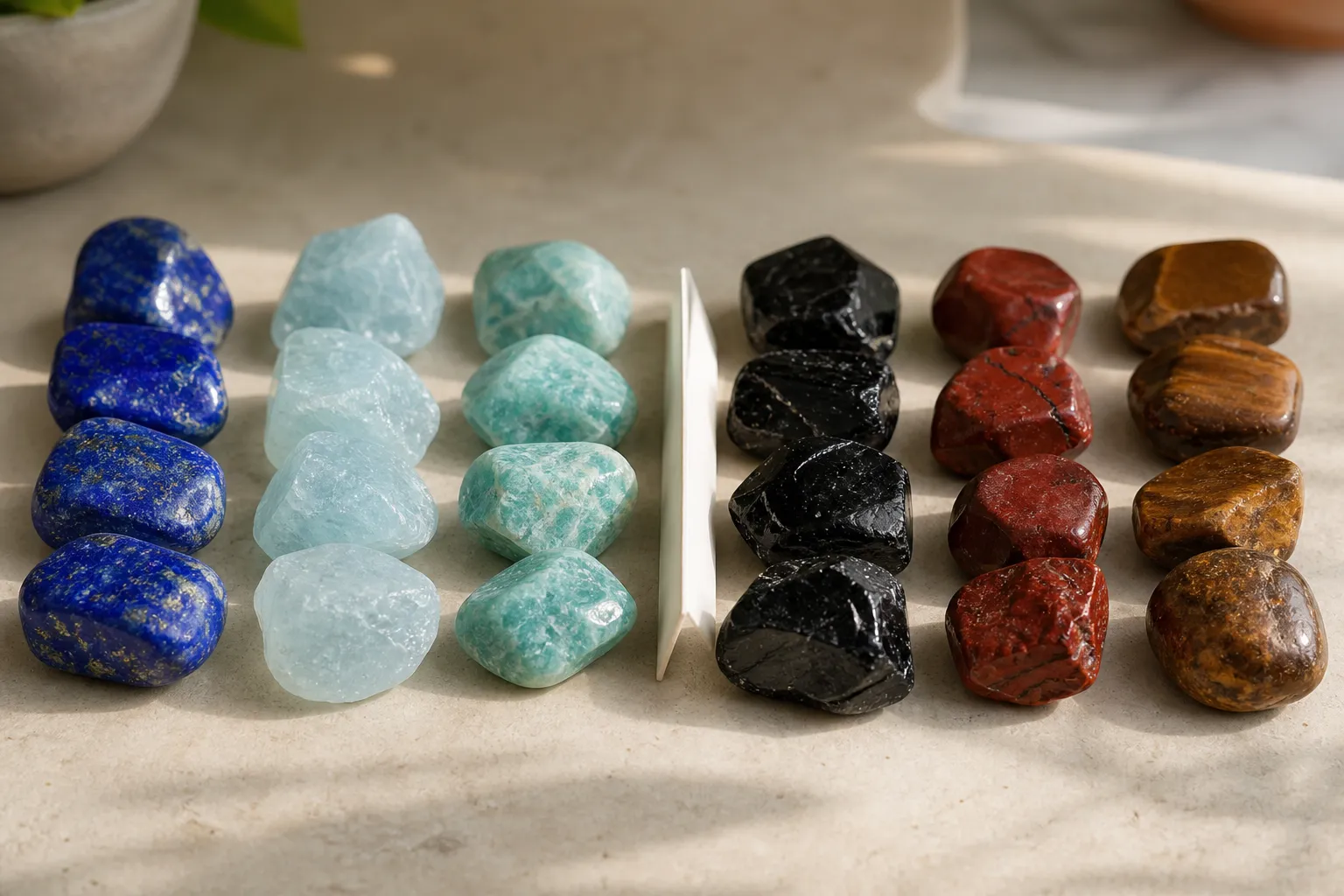
Lapis Lazuli, Aquamarine, and Amazonite in a Root Chakra Context
Some readers arrive at root chakra stones expecting only red, black, and brown crystals. Others are specifically comparing lapis lazuli, aquamarine, and amazonite because they are drawn to blue or blue-green stones and want to know whether those can belong in a root chakra-themed practice.
They can belong if your practice uses them symbolically and you are clear about why you are choosing them. Their role is not a universal rule. It is a personal or tradition-shaped choice.
For lapis lazuli, start with depth of blue, visible flecks or variation, polish, shape, and visual weight. A small deep-blue tumbled stone will feel very different from a larger display piece. In a root-themed layout, some readers may use lapis lazuli as a contrast stone: not red or black, but still visually substantial.
Aquamarine and amazonite can overlap visually for beginners because both may appear in blue or blue-green territory. The choice often comes down to tone, opacity, pattern, and the feeling of the individual piece. Aquamarine may appeal if you want a lighter blue note. Amazonite may appeal if you prefer green-blue color and a softer, earthier look.
A small mixed set might include:
- One dark stone for visual weight.
- One red or brown stone for warmth.
- One blue or blue-green stone if that color has meaning in your practice.
- One smooth piece for handling.
- One display piece if you keep a shelf, bowl, or altar.
The point is not to cover every possible meaning. The point is to build a set you understand. If you cannot explain why a stone is in the set, pause before adding more.
What to Look for When Buying Root Chakra Stones
Buying root chakra stones is easier when you slow down the decision. You do not need a perfect piece. You need a piece that is described plainly, photographed clearly, sized appropriately, and suited to your use.
| What to check | What to look for |
|---|---|
| Name | The listing clearly states the stone name being sold |
| Photos | Images show color, shape, size, and surface from useful angles |
| Size | Measurements are clear enough to imagine the piece in your hand or space |
| Form | The listing says whether it is tumbled, raw, polished, bead, carved, or another shape |
| Surface | You can see whether it is glossy, matte, rough, chipped, cloudy, or patterned |
| Quantity | You know whether you are buying one piece, a set, a scoop, a bracelet, or a random selection |
| Wording | The description focuses on appearance, form, and symbolic use rather than big outcome claims |
| Practical fit | The stone works for your intended setting, not just the product photo |
A listing can be vague in several ways. It may use a broad crystal name without showing the actual piece. It may show a group photo while selling one random item. It may use strong symbolic language but give little information about size or finish. It may combine many chakra labels in a way that leaves the beginner more confused than informed.
When a listing gives you more promise than detail, slow down. Clear photos, plain measurements, and honest form descriptions are more useful than dramatic wording.
In person, you can compare weight, surface, and scale directly. You can notice whether a stone feels too sharp, too small, too slippery, or more appealing than the photo suggested.
Online, prioritize:
- Clear size measurements.
- Photos of the actual item when possible.
- Plain language about form and quantity.
- Return or exchange information if that matters to you.
- Descriptions that do not depend on high-stakes promises.
For beginners, online buying is often where overbuying happens. A small, clear first purchase is usually more useful than a large bundle of stones you cannot identify or explain.
A Beginner Path for Choosing Your First Stone
If you are starting from zero, use a short path instead of trying to learn every association at once.
| Step | Decision | How to think about it |
|---|---|---|
| 1 | Choose the setting | Pocket, desk, bedside bowl, shelf, altar, jewelry, or short personal ritual |
| 2 | Choose the color family | Dark, red-brown, earthy brown, smoky gray, or blue-green as a personal addition |
| 3 | Choose the form | Tumbled, raw, polished, bead, flat, palm stone, or display piece |
| 4 | Read the description calmly | Look for object details first; treat symbolic language as secondary |
| 5 | Start with one clear choice | Choose the piece you can describe in one sentence |
Pocket carry favors smooth and small. Display can handle larger or rougher pieces. Jewelry needs comfort and durability in ordinary wear. A personal ritual layout may benefit from a few stones that are visually distinct.
Do not worry about making the color system perfect. You are choosing a visual anchor, not taking an exam.
If you are unsure about form, a small tumbled stone is often the easiest to understand because it is simple to handle and store. If you are more drawn to natural texture, a raw piece may feel more visually interesting.
A useful description tells you what the item is, what it looks like, how large it is, and what form you will receive. Symbolic language can be part of the listing, but it should not replace basic object information.
A first stone should be easy to remember and easy to use. Choose the piece you can describe plainly:
- “A smooth black tumbled stone for my pocket.”
- “A red-brown polished piece for my desk.”
- “A deep blue lapis lazuli stone for a small root-themed layout.”
- “A blue-green amazonite piece that I use as a personal color bridge.”
If the sentence feels clear, your choice is probably clear enough.
Keeping the Practice Grounded
A root chakra stone practice can be simple: placing a stone on a desk, holding it during a quiet moment, arranging a small bowl of stones, or choosing a piece as a reminder of a personal intention. The practice does not need elaborate language to be meaningful.
A stone can be a symbol, a tactile object, a visual cue, or part of a ritual. It should not be treated as a substitute for higher-stakes support or as an object with verified powers.
If you want a low-pressure way to use a stone, try a simple structure:
- Place the stone where you can see it.
- Notice its color, weight, texture, and shape.
- Name the personal meaning you are assigning to it.
- Keep the practice brief and ordinary.
- Store the stone where it will not be damaged or lost.
This kind of ritual uses the stone as a focus object. It does not require claims beyond your own interpretation.
Everyday care also matters. Stones can chip, scratch, collect dust, or get lost. Jewelry can snag. Small pieces can disappear in bags. Raw edges can catch on fabric. Polished surfaces can show wear.
Use ordinary object-care habits:
- Keep small stones in a pouch, tray, bowl, or labeled box.
- Separate pieces that might scratch each other.
- Avoid dropping stones on hard surfaces.
- Keep fragile shapes away from crowded drawers.
- Use display spaces that are stable and easy to dust.
These habits help preserve the stone as a physical item, whatever symbolic meaning you give it.
Common Beginner Mistakes
Most beginner mistakes come from rushing, overbuying, or letting symbolic language replace observation.
| Mistake | Better approach |
|---|---|
| Buying a large set before you know your preferences | Start with one or two stones you can identify, compare, and use |
| Treating color charts as absolute rules | Use color charts as learning tools, not final authority |
| Ignoring the actual piece | Return to size, shape, finish, texture, and real-use setting |
| Letting symbolic language become object fact | Keep tradition-based meaning separate from visible features |
| Choosing for someone else’s aesthetic | Pick the stone you can live with, understand, and use without forcing it |
Large sets can look convenient, but they often overwhelm beginners. A smaller start teaches you more: one smooth dark stone, one warm-toned stone, or one blue-green piece with a clear personal reason.
A stone name can sound appealing while the actual piece is too small, too rough, too dull in the photo, or poorly suited to your setting. Always return to visible stone qualities.
Your stone does not need to look like a social media display. If you prefer a plain black tumbled piece, choose that. If you like a soft blue-green stone in a simple bowl, choose that. The best beginner choice is usually the one you can explain and use without effort.
Reader Paths Into Deeper Topics
This page gives the main map for how to choose root chakra stones. If you want to go deeper, the next step depends on the decision you are trying to make.
| If your question is… | Read next for… |
|---|---|
| “Which colors should I start with?” | Choosing root chakra stones by color, with visible color families and beginner-friendly sorting |
| “Should I get a smooth or rough stone?” | Tumbled vs raw root chakra stones, with feel, display, handling comfort, and storage |
| “How do I compare common root chakra crystals?” | A practical comparison framework without ranking every stone |
| “Can I use lapis lazuli, aquamarine, or amazonite?” | Appearance, symbolism, and personal fit for blue and blue-green stones |
| “What should I check before buying?” | Photos, size, labels, forms, quantity, and plain descriptions |
These are entry points, not requirements. A beginner can make a good first choice with only the framework in this guide.
Final Checklist
Before you choose, pause over these questions:
- Can I describe what the stone looks like without relying only on its name?
- Do I know whether it is tumbled, raw, polished, beaded, carved, or shaped?
- Does the size fit my real use?
- Am I choosing a color I actually want to see regularly?
- Is the symbolic meaning personal and clearly framed as belief-based?
- Does the listing give enough practical detail?
- Am I focusing on the object itself rather than a large promise?
- Would one clear stone serve me better than a large set?
Root chakra stones are easiest to approach when you treat them as real objects first and symbolic objects second. Look at the color, form, finish, size, and setting. Then decide whether the meaning fits your personal chakra practice. A thoughtful choice does not need to be dramatic. It only needs to be clear, usable, and honest about the difference between what the stone visibly is and what you choose it to represent.