
Red and Black Root Chakra Stones and What Their Colors Mean
People often look up red and black root chakra stones after noticing an apparent mismatch: root chakra color charts usually show red, while crystal lists often include black tourmaline, obsidian, hematite, and other dark stones.
The short version is this: red is the classic root chakra color family in many modern chakra explanations, while black stones are commonly added in crystal practice for symbolic ideas such as steadiness, weight, containment, and feeling anchored. The color is observable. The meaning is interpretive.
upward
Start with the broader guide
Use the broader guide first if you need the full scope before this page.
Red vs Black Root Chakra Stones: The Basic Color Difference
Red and black stones sit in the same root chakra conversation, but they do not get there in the same way.
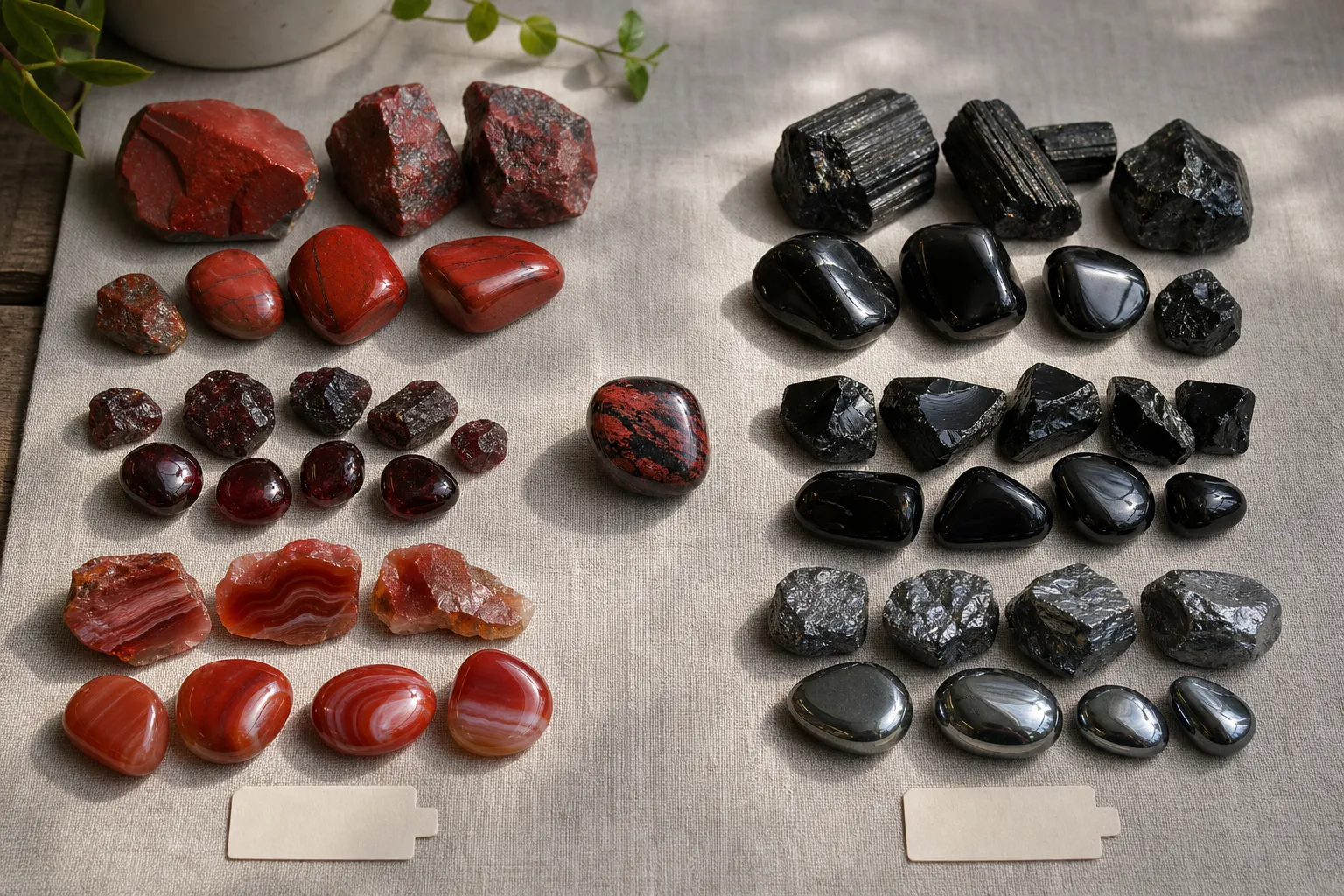
Red stones usually enter through color correspondence. In many contemporary chakra charts, the root chakra, also called Muladhara in yoga and spiritual-practice language, is represented with red. That makes red jasper, garnet, red agate, carnelian, and similar stones easy for beginners to understand: their color already reads as “root” within that system.
Black stones enter through visual symbolism. They do not match the red chart color, but dark stones can suggest soil, depth, stillness, weight, and a boundary line. That is why black tourmaline, black obsidian, hematite, smoky quartz, and sometimes black agate appear in root chakra sets.
Red stones
What you can observe: warm red, brick, burgundy, rust, orange-red, red-brown.
Common symbolic reading: classic root color, earthiness, physical presence, warmth.
Typical use: a direct root chakra color match.
Black stones
What you can observe: black, charcoal, dark brown-black, metallic gray-black.
Common symbolic reading: steadiness, containment, boundary imagery, quiet focus.
Typical use: a darker anchor or contrast stone.
Mixed red-black stones
What you can observe: red areas with black veins, spots, bands, or inclusions.
Common symbolic reading: red root color plus darker weight or boundary symbolism.
Typical use: one piece with both visual cues.
The useful distinction is not that one color is “right” and the other is “wrong.” In belief-based crystal practice, the choice is usually about what kind of symbol a person wants to work with or display.
What Red Root Chakra Stones Usually Mean in Crystal Traditions
Red root chakra stone meanings tend to follow the color itself. Red is warm, visible, earthy, and body-adjacent as a visual cue, especially when it appears as brick red, rust red, blood red, or red-brown. In modern chakra practice, many people connect that color with the root chakra because the root is commonly described as the base or first chakra.
That does not make the stone a scientific tool. It means the color is being used as a reminder inside a personal, spiritual, or symbolic framework. A red stone might sit on a desk, be carried in a pocket, worn as jewelry, or used during meditation because its owner wants a visible object tied to root-related themes.
Red Jasper
Red jasper is one of the most familiar root chakra stones because it is opaque, earthy, and often red to red-brown. Mineralogical descriptions place jasper among siliceous stones related to chalcedony and quartz-family materials, with color often influenced by included minerals. Red tones in jasper and related stones are commonly associated with iron-bearing minerals such as hematite.
For a beginner, the practical point is simpler: red jasper often looks grounded before any symbolic meaning is added. It is not glassy like obsidian or metallic like hematite. It tends to have a solid, matte, stone-like presence. That visible quality is part of why retail and chakra language so often describes red jasper as earthy.
A careful way to phrase its meaning is: many crystal practitioners associate red jasper with root chakra themes because its opaque red appearance fits the classic root color family.
Garnet
Garnet is not one single look. The pieces most often brought into root chakra color language are deep red, wine red, reddish brown, or purplish red. Compared with red jasper, garnet may look more gem-like, sometimes translucent or faceted depending on the piece.
In crystal-practice language, garnet is usually grouped with red root chakra stones because its darker red color feels visually concentrated. Someone choosing garnet for symbolic root work is often choosing a richer, deeper red rather than the earthy opacity of jasper.
That visible difference matters. A polished red jasper palm stone and a small garnet bead may both be called root chakra stones, but they do not create the same impression. Jasper reads as solid and matte. Garnet reads as dense, dark, and more jewel-like.
Red Agate
Red agate and red-banded agate can be more complicated because agate often shows bands, translucency, and color variation. Mineralogy sources describe agate as a form of chalcedony with layered structure and varied colors influenced by formation conditions, inclusions, and mineral content. Red and orange-red tones in agate and related chalcedony are often linked with iron oxides.
For readers, the important point is that “red agate” can mean several appearances in shops: bright red, natural-looking red-orange, brownish red, banded red-white, or red with darker markings. Some agates in the broader gemstone market are also color-enhanced, so a product name does not always explain how the stone came to look that way.
In root chakra practice, red agate is usually interpreted through its red color and layered appearance. It may appeal to someone who wants a root chakra stone that feels more patterned or decorative than red jasper.
What Black Root Chakra Stones Usually Mean in Grounding Practices
Black root chakra stone meanings are less about matching the classic root chakra color and more about the visual language of darkness, weight, and containment.
Many crystal practitioners describe black stones as grounding stones, boundary stones, or objects for a quieter personal ritual. The meaningful part is often the stone’s role as a reminder: a dark stone on a nightstand, a black bead bracelet, or a smooth palm stone held during reflection.
Mineral science can describe composition, color, hardness, formation, and care. It does not establish chakra meaning. That separation keeps the article honest: blackness is visible; “grounding” is a symbolic reading in this context.
Black Tourmaline
Black tourmaline is one of the most common black stones in root chakra and grounding crystal lists. It may appear as a dark, vertically striated crystal, a rough chunk, a tumbled piece, or jewelry. Its black color and ridged texture give it a very different presence from red jasper or red agate.
Many crystal practitioners choose black tourmaline when they want a symbolic reminder of steadiness or personal boundaries. Some commercial descriptions go much further than that, but those stronger statements should be read as belief or marketing language rather than established outcomes.
For care, tourmaline should not be treated as indestructible. Gemological care guidance generally favors gentle cleaning and stone-specific handling rather than assuming every piece can be soaked, heated, or scrubbed aggressively.
Obsidian
Obsidian stands apart because it is natural volcanic glass. Black obsidian is often glossy, smooth, and reflective when polished. Snowflake obsidian adds pale gray-white markings, while mahogany obsidian can show reddish-brown patches.
In root chakra color language, black obsidian is often chosen for its mirror-like darkness and strong contrast. Some people interpret that appearance as a symbol of directness, inward attention, or containment. A polished obsidian palm stone can feel visually sharper and more reflective than black tourmaline, even though both may be placed under black grounding crystal colors.
Because obsidian is glassy, it can chip or form sharp edges if broken. That is an ordinary handling point, not a spiritual warning. If you plan to carry obsidian or keep it in a bag, choose a smooth finish and check the edges over time.
Hematite
Hematite is usually recognized by its metallic gray to black appearance and noticeable weight for its size. It does not look like black tourmaline or obsidian. It has a dense, reflective quality that makes it visually compelling in root chakra sets.
In crystal-practice language, hematite is often interpreted through that weight and metallic sheen. It is commonly used as a symbolic grounding stone because it feels physically substantial in the hand. The physical impression is real; the meaning added to it is personal or tradition-based.
Hematite also shows why black root chakra stone meanings are not only about color. Texture, density, shine, and shape all influence how a stone is read. A hematite bead bracelet, a rough black tourmaline point, and a glossy obsidian palm stone may all be dark, but they do not feel interchangeable.
Why Are Black Stones Used If the Root Chakra Color Is Red?
This is the main source of confusion. If root chakra colors are usually shown as red, why do so many lists include black stones?
There are three common reasons.
- Modern crystal practice often goes beyond strict color matching. A stone may be chosen because it matches a chakra color, or because its broader symbolic language fits the theme. Red stones match the root color family. Black stones match the grounding and boundary vocabulary that many people attach to root chakra practice.
- “Root” is an earthy metaphor. Roots go downward into soil. Black, brown, red-brown, and dark gray all fit that visual field. Even though red is the chart color, black stones can feel visually related to earth, weight, depth, and stillness.
- Commercial crystal sets often mix color systems with popular stone categories. Black tourmaline, obsidian, smoky quartz, and hematite are widely recognized dark stones. Shoppers already associate them with a dark, anchoring look, so they appear often in grounding crystal color lists.
This does not make black the “real” root chakra color, and it does not make red irrelevant. It explains the modern blend of two systems: color correspondence and symbolic use.
How to Read Color Names on Red and Black Root Chakra Stones
Stone color names are helpful, but they are not exact labels. A listing that says “red agate,” “black tourmaline,” or “hematite” may identify the broad category, but it may not tell you enough about shade, finish, color enhancement, or care.
When comparing red and black root chakra stones, look at the actual stone before relying on the name.
Check the shade
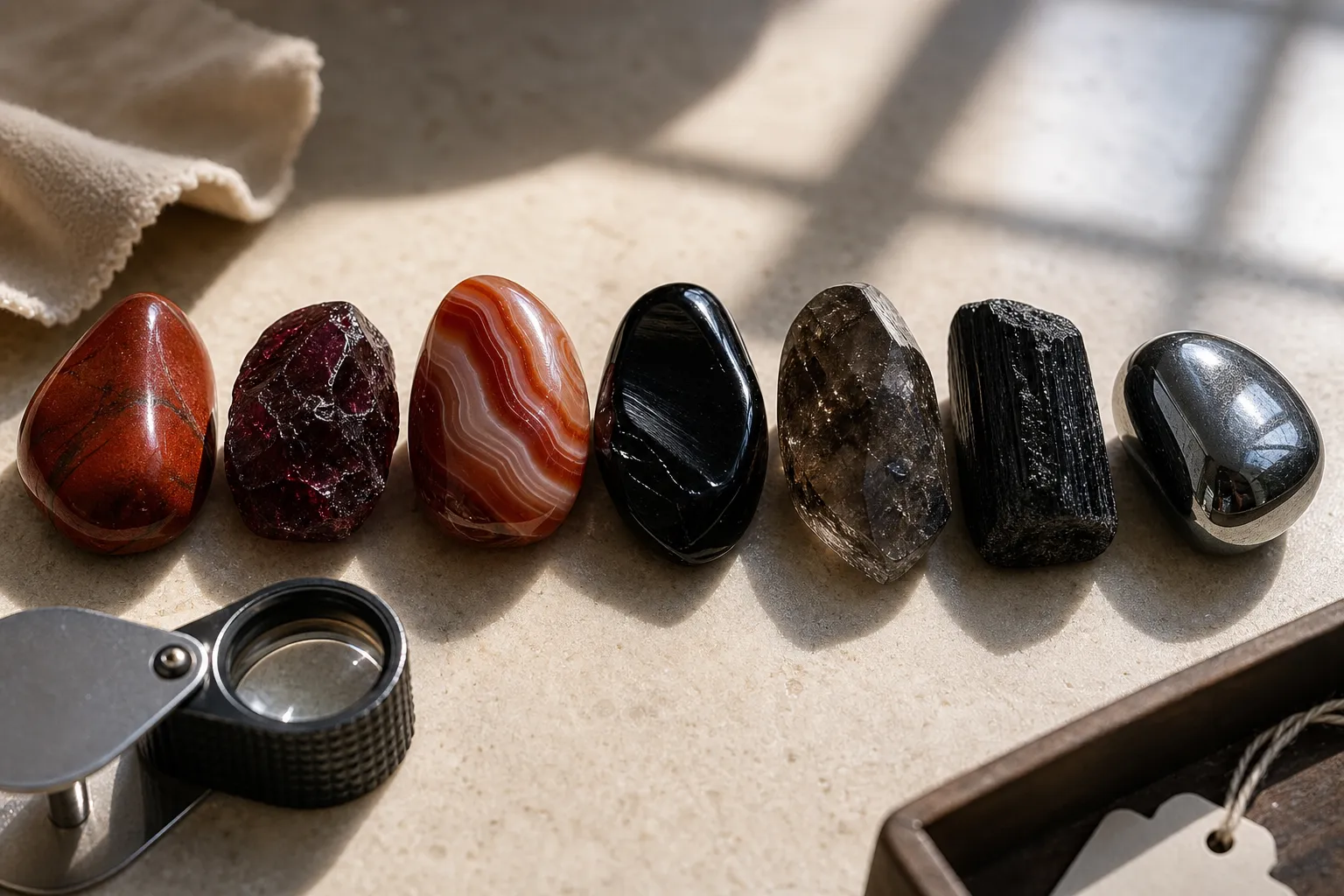
“Red” may mean brick, rust, orange-red, burgundy, brown-red, or bright red. “Black” may mean matte black, glossy black, charcoal, smoky brown-black, metallic gray, or black with white or red markings.
Shade changes the impression. A soft red-brown jasper may feel earthy and quiet. A deep garnet may feel richer and more intense. A glossy black obsidian piece may feel visually sharper than a matte black tourmaline chunk.
Notice pattern and opacity
Opaque stones tend to look solid and dense. Translucent stones let light through. Banded agate may feel layered. Speckled, veined, or included stones may look more complex than single-color pieces.
These visible traits influence how people interpret mixed red and black stones. A red jasper with black veining might be read as combining root color with darker boundary symbolism. A black stone with red patches may be chosen because it feels both earthy and intense.
Be careful with perfect color
Very bright, uniform red agate may be appealing, but agate is also a stone category with a long history of color alteration. Mineralogical studies of agate and ancient beads discuss staining, heating, and carbon-based darkening as ways color can be changed or intensified.
That does not automatically make a stone unsuitable for personal use. It simply means color names deserve a closer look. If natural color matters to you, look for sellers who describe enhancement clearly. If symbolic color matters more than geological origin, be honest about what you are choosing: a meaningful color object, not a scientific instrument.
Do Red and Black Root Chakra Stones Mean the Same Thing?
They overlap, but they do not mean exactly the same thing in common crystal language.
Red root chakra stone meanings usually begin with the classic color correspondence. The stone is red, the root chakra is commonly shown as red, and the symbolism follows from that match. Red stones are often described with words such as earthy, warm, physical, active, and body-oriented in modern practice settings.
Black root chakra stone meanings usually begin with grounding imagery. The stone is dark, dense-looking, reflective, or heavy, and the symbolism follows from that visual impression. Black stones are often described with words such as steady, quiet, boundary-oriented, or anchoring.
Mixed red and black stones sit between those categories. A black-and-red agate, mahogany obsidian, red jasper with dark markings, or garnet with nearly black depth may be interpreted as carrying both cues: red for classic root color, black for weight and containment imagery.
A simple decision frame
- Choose a red stone if you want a classic root chakra color match.
- Choose a black stone if you want a darker visual anchor for quiet focus or boundary symbolism.
- Choose a mixed red-black stone if you like both meanings in one object.
- Choose by material and care needs if you plan to wear it daily, carry it, or keep it near water.
- Choose by appearance, not only by a product title, because color names are broad.
Common Misunderstandings About Red and Black Grounding Crystal Colors
Color meaning is not a mineral property
Red and black colors can be observed. Their root chakra meanings come from chakra and crystal interpretation. A gemological source can help explain why a stone looks red, black, metallic, banded, or glassy; it does not confirm the symbolic meaning.
All black stones are not interchangeable
Black tourmaline, obsidian, hematite, smoky quartz, and black agate may all appear in grounding crystal color lists, but they differ in material identity and feel. Tourmaline may be rough and striated. Obsidian is glassy. Hematite is metallic and weighty. Smoky quartz is usually translucent brown-gray to dark smoky. Those differences may matter more than a generic “black stone” label.
Not every root chakra stone must be red or black
Red and black are the most common color families in this context, but modern crystal practice also includes brown, smoky, deep gray, red-brown, and earthy multicolor stones. The reason is symbolic fit rather than one fixed rule.
Natural does not always mean simple to use
Some stones dislike harsh cleaning, some may scratch or chip, and some should not be placed in drinking water or used for gemstone-water practices. If you do not know the exact material and finish, keep use simple: display it, hold it, wear it in normal jewelry settings, or place it near a meditation space without soaking or ingestion.
A Practical Way to Choose Between Red and Black Root Chakra Stones
For a beginner, the most useful choice is the one you can describe clearly without borrowing exaggerated language.
Try this three-part check:
- Name the visible cue.
Is the stone red, black, metallic, smoky, banded, glassy, opaque, or mixed? - Name the symbolic role.
Are you choosing it as a classic red root chakra color, a darker grounding symbol, a boundary reminder, or a decorative stone for a personal ritual space? - Name the practical setting.
Will it sit on a shelf, be carried in a pocket, worn as jewelry, used during meditation, or arranged with other stones?
This keeps the stone in the real world while leaving room for personal meaning. A red jasper palm stone can be chosen because it is earthy, opaque, and traditionally root-colored. A black tourmaline piece can be chosen because its dark texture feels like a strong visual anchor. A hematite bracelet can be chosen because its weight and metallic look make it a steady reminder during the day.
Red and black root chakra stones are best understood as two related color languages. Red points to the classic root chakra color family. Black points to grounding, boundary, and weight symbolism in modern crystal practice. Once you separate what the stone visibly is from what people symbolically associate with it, the choice becomes much easier to make.