
Why Blue-Green Crystals Appear in Root Chakra Stone Practices
If you have seen lapis lazuli, aquamarine, or amazonite placed near root chakra stones, the color can seem out of place. Modern chakra charts usually show root chakra stone colors as red, brown, black, smoky, or otherwise earthy. Blue-green stones are more often linked with heart, throat, or upper-chakra symbolism in popular crystal language.
So why do blue green crystals in root chakra practice appear at all?
Usually, they are not replacing the familiar root-color convention. They are being used as a companion stone, a blended symbol, a visual contrast, a jewelry or set choice, or part of a multi-chakra arrangement. The useful distinction is simple: color charts are a common organizing tool, not a universal rulebook.
upward
Read the full overview first
Use the broader guide first if you need the full scope before this page.
The color tension: earthy root stones beside blue-green stones
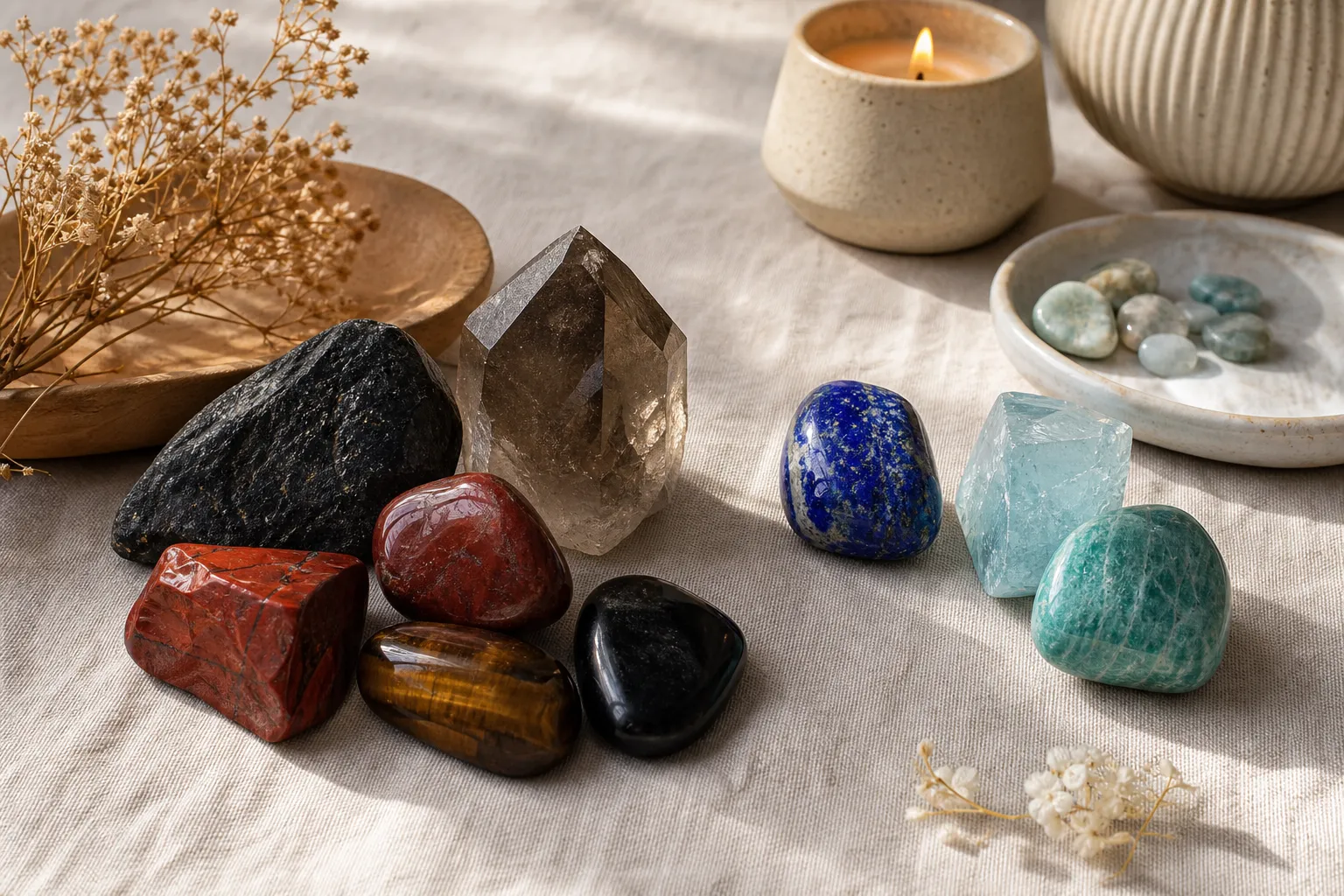
In popular crystal-retail and modern chakra language, the root chakra is commonly described through red, brown, black, and dense-looking colors. Stones such as red jasper, garnet, hematite, black tourmaline, obsidian, smoky quartz, black onyx, and bloodstone often appear in that category. They fit the visual shorthand many beginners learn first: dark, warm, earthy, or weighty-looking stones are treated as “root” stones.
Blue-green crystals send a different visual signal.
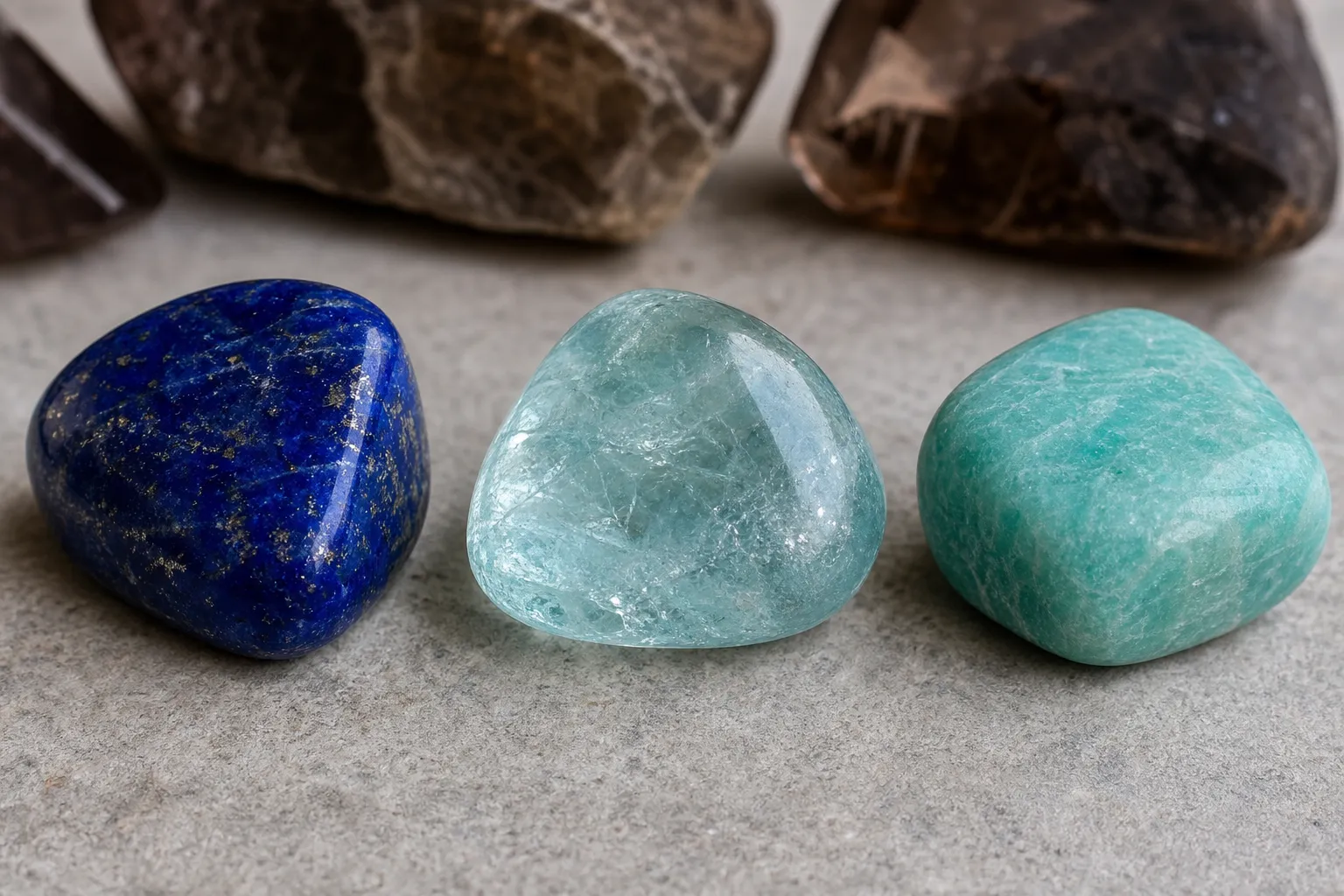
Aquamarine is a blue to blue-green variety of beryl. Lapis lazuli is known for its deep blue body color, often with visible mineral variation such as white calcite or metallic-looking pyrite in some pieces. Amazonite is a blue-green to green-blue feldspar variety. None of these stones visually resembles the usual red, brown, black, or smoky root chakra color family.
That is why the phrase “blue green root chakra stones” can be misleading if it suggests blue-green is the default root color. A better reading is that blue-green stones sometimes appear within root chakra-themed practice, not necessarily as the standard root chakra color category.
For beginners, this resolves much of the contradiction. A blue stone for root chakra use is usually contextual. It may be part of a layout, a pairing, a necklace, a mixed set, or a personal symbolic practice. It does not mean every color chart has changed, or that lapis lazuli, aquamarine, and amazonite must be classified only one way.
Why blue-green crystals are used in root chakra practice
Blue-green crystals usually show up near root stones for ordinary reasons: people combine symbolic systems, shops compress meanings into products, and personal layouts often care about color, contrast, and feeling as much as strict categories.
Multi-chakra layouts mix color families on purpose
Many people do not use only one stone at a time. A multi-chakra crystal layout may include one stone for each chakra point, a cluster of stones around a seated practice space, or a small group arranged by intention, color, or meaning.
In that setting, a blue-green stone may appear close to root stones because the layout is not only about the root chakra. A person might place a dark stone such as hematite or smoky quartz at the base of an arrangement and add amazonite, aquamarine, or lapis lazuli nearby to represent another symbolic theme.
This is a common source of confusion. A photo or shop listing may show all the stones together, but the grouping may not mean each stone is assigned to the root chakra. It may be a mixed symbolic layout.
Blue-green stones are often paired with darker stones
In modern crystal-practice language, pairing stones is common. You might see grounding stones with aquamarine, amazonite beside black tourmaline, or lapis lazuli placed near obsidian. The blue-green stone is not always being labeled as the root stone. It may be used as a companion.
Black or brown stone + aquamarine
Earthy visual anchor with a pale blue-green reflective cue.
Hematite or smoky quartz + amazonite
Darker root-style color beside a softer green-blue stone.
Obsidian or black onyx + lapis lazuli
Strong dark contrast with a deep blue focal stone.
Red jasper + amazonite
Warm root-color convention paired with blue-green contrast.
These pairings are best understood as symbolic combinations. They are not universal chakra rules, and they should not be treated as evidence that a stone produces a fixed result.
Blue-green can soften a heavy root-color display
Color contrast matters in displays, altars, meditation corners, and jewelry. A row of only black, brown, and red stones can feel visually heavy. A blue-green crystal can soften the arrangement or give the eye a focal point.
This is a practical design reason, not a hidden doctrine. Amazonite beside red jasper stands out. Aquamarine beside smoky quartz looks lighter. Lapis lazuli beside black stones creates a clear dark-blue accent. In personal ritual settings, visual cues often matter because the stone is being used as an object of attention.
If the question is “Can a blue stone be used for the root chakra?” the practical answer is: it can be included in a root-themed setting, especially as a companion or reminder, but it is not the usual root-color cue.
Ready-made sets and jewelry compress meanings
Crystal shops, bead sellers, and chakra jewelry listings often package stones into sets. A bracelet may include one bead for each chakra. A pouch may include stones chosen by color, availability, price, or seller preference. A display box may use broad labels because the product has to be simple enough for beginners.
This creates mixed messages. A blue-green stone might appear in a “grounding” set because the seller is blending meanings, because the set covers several chakra themes, or because the stone’s color works well with the rest of the collection. That does not make the set a universal reference.
Context checks for shop language
- Is the blue-green stone named as the main root stone?
- Is it paired with darker stones?
- Is the set actually a full seven-chakra set?
- Is the wording about personal reflection rather than strict color matching?
- Is the listing using broad marketing language rather than careful classification?
Those details change the answer.
Lapis lazuli, aquamarine, and amazonite in root chakra-themed practice
The three stones most likely to raise this question are lapis lazuli, aquamarine, and amazonite. They are not interchangeable, even when they all appear in blue or blue-green searches.
Does lapis lazuli belong in root chakra stone practices?
Lapis lazuli is visually a blue stone, not a red, brown, or black root-color stone. Gemological and mineralogical sources describe lapis lazuli as a rock made of multiple minerals, with lazurite contributing much of the blue appearance. Some pieces also show calcite or pyrite. Its long history as a valued blue material is separate from modern chakra meanings.
In popular crystal language, lapis lazuli is more often connected with upper-chakra symbolism than with the root chakra. So when you see “lapis lazuli root chakra” wording, read carefully. It may mean one of three things:
- Lapis lazuli is being used in a full-body or multi-chakra arrangement.
- It is being paired with darker root-color stones.
- The writer or seller is using a broad, personal interpretation rather than the common root color convention.
A cautious way to include lapis lazuli in a root chakra-themed layout is to treat it as a secondary stone: place it beside, not instead of, the earthy root-color stone if you want to preserve the familiar color structure.
Why aquamarine and amazonite may appear near root work
Aquamarine is a blue to blue-green variety of beryl. Gemological literature connects aquamarine’s color to trace elements and the structure of beryl, but that mineral-color explanation does not create a chakra meaning by itself. In modern crystal language, aquamarine is usually discussed in blue or blue-green symbolic categories rather than root-color categories.
Amazonite is recognized for its green-blue to blue-green appearance. Mineralogical writing treats amazonite as a potassium feldspar variety noted for its distinctive color. As with aquamarine, the physical color and the symbolic meaning are separate layers.
So why would aquamarine or amazonite appear near root work?
Often, because the person is not thinking in a single-color system. They may be combining earthy stones with a blue-green stone to suggest steadiness plus expression, grounding plus softness, or a lower-chakra focus plus a heart/throat-style color. Those are personal symbolic associations, not measurable outcomes.
Lapis lazuli vs amazonite for root chakra-themed practice
If you are deciding between lapis lazuli vs amazonite for a root chakra-themed practice, the more useful question is not “Which one is the true root stone?” A better question is: “What role will the blue or blue-green stone play in the arrangement?”
Lapis lazuli gives a deep blue visual note. It can look formal, dense, and high-contrast beside black or red stones. Amazonite gives a softer green-blue note and may feel visually lighter in a layout.
Choose lapis lazuli if you want a stronger dark-blue focal point beside earthy stones. Choose amazonite if you want a gentler color bridge between green, blue, and earth-toned stones. That is a selection choice based on appearance and symbolic preference, not a promise of a result.
Aquamarine vs amazonite for chakra meaning and everyday use
Aquamarine vs amazonite is often a question of appearance, durability expectations, cost, and format. Aquamarine is a beryl variety and is commonly valued as a transparent to translucent blue or blue-green gem material. Amazonite is typically more opaque and often appears in beads, palm stones, carvings, and display pieces.
For everyday use, think practically:
- Do you want a transparent or glassier-looking stone? Aquamarine may fit that preference.
- Do you want a more opaque blue-green stone with a softer visual presence? Amazonite may suit that better.
- Are you building a pocket-stone set, a bracelet, or a display layout? Shape and finish may matter more than the label.
- Are you trying to keep the root color convention clear? Pair either stone with a darker root-color stone.
This keeps the choice grounded in what the stone looks like and how you plan to use it.
What changes the interpretation of blue-green root chakra stones
A blue-green crystal in a root chakra context can mean different things depending on placement, wording, and surrounding stones. The same amazonite bead can read differently in a bracelet, a seven-stone chakra row, a desk display, or a photo labeled as a grounding set.
The surrounding stones matter
If amazonite appears beside black tourmaline, hematite, red jasper, or smoky quartz, it may be part of a blended root-themed pairing. If it appears beside rose quartz, blue lace agate, or clear quartz, the arrangement may not be specifically root-focused at all.
Always interpret the group, not just the single stone.
The format matters
A palm stone used during seated reflection has a different context from a pendant, a shelf display, or a retail set. Jewelry often compresses several meanings into one wearable object. A pouch set may include stones for several symbolic themes. A body-layout photo may place stones near different areas for visual storytelling.
The more compact the format, the more likely the meanings have been simplified.
The wording matters
Phrases such as “root chakra stone,” “grounding set,” “chakra bracelet,” and “seven-chakra crystal kit” do not all mean the same thing.
A “root chakra stone” label suggests a direct assignment. A “grounding set” may be broader. A “chakra bracelet” usually includes several color categories. A “crystal kit” may be organized by seller convention rather than a consistent tradition.
When a label sounds broad, treat it as broad.
Personal symbolism matters, but it has limits
Some people choose stones because a color, texture, or memory feels meaningful to them. That can be a valid personal-practice reason. It is also different from saying the stone has a universal role or an authoritative chakra placement.
A person might choose aquamarine because its pale blue-green color feels spacious in a reflective setting. Another might choose amazonite because it visually softens a dark stone grouping. Another might choose lapis lazuli because deep blue creates a strong focal point. These are personal interpretations, not fixed classifications.
Common misunderstandings about blue-green stones and the root chakra
The confusion around blue-green crystal meanings usually comes from treating simplified charts as if they were complete systems.
One misunderstanding is that every root chakra stone must be red, brown, or black. Those colors are the common modern convention, but real-world practice often includes pairings, mixed layouts, and personal choices.
Another is that a blue-green stone can only belong to heart or throat symbolism. Many guides do place blue-green stones there, but people often combine categories when building a practice object or layout.
A third is that ready-made sets define universal chakra rules. They do not. They reflect retail choices, simplified teaching tools, and sometimes broad symbolic language.
A fourth is that color matching proves something beyond symbolism. In this article’s frame, color is a visual and personal organizing method. It helps people sort stones and build meaning, but it should not be presented as scientific, clinical, or outcome-based evidence.
The cleanest interpretation is this: blue-green crystals appear in root chakra practice when someone is blending color symbolism, using a multi-stone layout, or choosing a stone for personal meaning rather than following the strictest root-color convention.
How to place blue-green crystals in a root chakra-themed layout
If you want to include a blue-green stone while keeping the root chakra theme clear, use placement to show its role.
Start with a primary root-color stone: a red, brown, black, or smoky stone commonly used in root chakra-themed retail language. Then add the blue-green stone as a companion. This preserves the familiar color convention while leaving room for personal interpretation.
Beginner-friendly layout ideas
- Place a dark stone at the center and set amazonite beside it as a color contrast.
- Use red jasper or garnet as the root-color anchor and aquamarine as a lighter secondary stone.
- Put lapis lazuli slightly above or beside the root-color stone in a multi-chakra arrangement.
- Keep blue-green stones on the edge of the layout if you want them to support the theme without visually taking over.
- Use one blue-green bead in a bracelet dominated by earthier colors if you want a subtle mixed-symbolism piece.
Care and handling note
For care and handling, avoid one-size-fits-all routines. Different stones respond differently to water, salt, bright sunlight, impact, and rough storage. If a piece is valuable, delicate, porous, dyed, composite, or set in jewelry, use conservative handling: keep it dry unless you know the material tolerates water, store it separately from harder stones, and clean it gently.
A grounded way to judge the meaning
When you see lapis lazuli, aquamarine, or amazonite in a root chakra setting, ask three questions.
- Question oneIs the blue-green crystal the main root stone, or is it a companion? If it is beside darker stones, the layout is probably blended.
- Question twoIs the source using a strict chakra color chart or a broad retail set? A seven-stone bracelet and a root-only stone list should not be read the same way.
- Question threeIs the meaning being presented as personal symbolism or as a promised result? The more a description moves away from color, appearance, and reflective use, the more carefully it should be read.
Blue-green crystals do not need to “break” the root chakra color convention. They usually show that the practice is layered: earthy stones provide the familiar root-color cue, while blue-green stones add contrast, personal meaning, or another chakra association within the same arrangement. For beginners, that is the most stable way to understand the mix without turning a flexible symbolic practice into a rigid rule.