Grounding Crystals: Common Meanings and Practical Differences
If you are comparing grounding crystals, the hard part is rarely the list of stone names. The confusion comes from everything attached to those names: dark color, weight in the hand, root chakra language, shop phrases such as “stability” or “protection,” and stronger wellness-style promises that do not belong in a careful beginner guide.
This page looks at grounding crystals meanings in a practical way. It separates what you can observe — color, shine, texture, shape, and common formats — from the symbolic meanings many crystal practitioners attach to those stones. The goal is not to name the “strongest” crystal. It is to help you choose a stone whose appearance, symbolism, and use fit your own personal ritual, jewelry, display, or meditation setting.
upward
Start with the broader guide
Use the broader guide first if you need the full scope before this page.
What “grounding” usually means in crystal practices
In modern crystal language, “grounding” is usually symbolic. It points toward ideas such as steadiness, presence, simplicity, physical-world focus, and feeling less scattered in personal ritual language. Many practitioners use the word for stones that look dark, earthy, dense, metallic, smoky, or connected with lower-body and root chakra symbolism.
That is different from mineral identity. Hematite is an iron oxide mineral. Quartz is a mineral group. Smoky quartz is a smoky brown to gray variety of quartz. Mineral references can describe things like color, luster, hardness, opacity, fracture, and classification. They do not show that a stone changes health, emotions, energy fields, sleep, or life circumstances.
It is also different from chakra terminology. In chakra traditions, the root chakra, often called Muladhara, belongs to a cultural and spiritual vocabulary. Modern crystal communities often connect root chakra crystal meanings with stability, security, and earth connection. Those are belief-based associations, not anatomical descriptions.
Which stone’s look, feel, symbolism, and format match the way I want to use it?
That question is more useful than asking which crystal is “best,” because grounding language changes with the tradition, the shop description, the stone form, and the person using it.
Grounding crystals vs root chakra crystals
Grounding crystals and root chakra crystals overlap, but they are not identical categories.
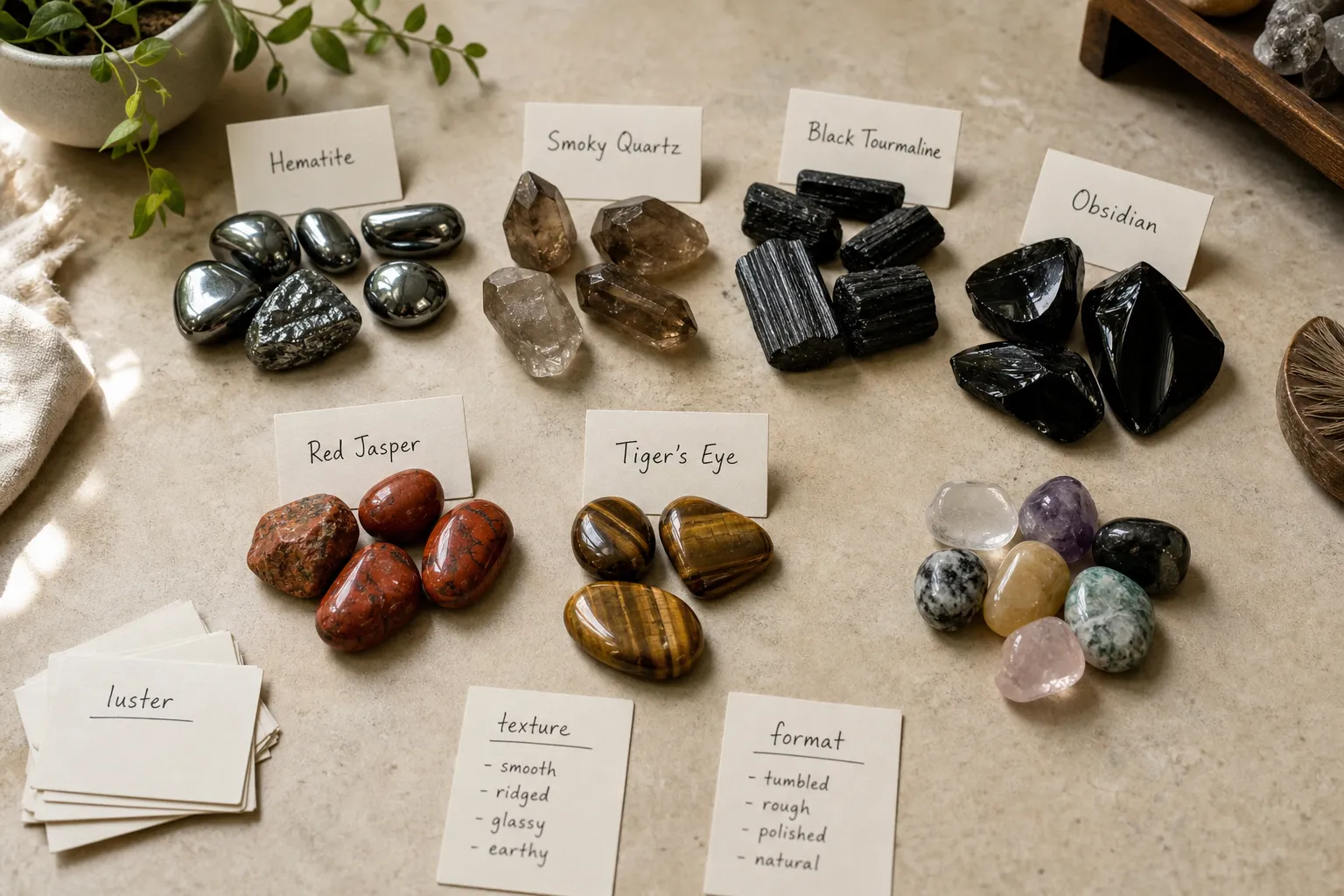
Root chakra crystals are usually chosen because they match a chakra theme. In many modern lists, red, dark red, black, brown, and earthy stones are linked with the root chakra. Red jasper, garnet, red carnelian, hematite, black tourmaline, smoky quartz, obsidian, onyx, and tiger’s eye often appear in that group.
Grounding crystals are broader. A stone may be called grounding because it is dark, heavy-looking, opaque, iron-rich in appearance, smoky, earthy, or commonly described as steadying in practitioner and retail language. Some grounding stones are also called protection stones. Some appear in root chakra layouts. Some are simply carried because the owner likes their weight, color, or tactile presence.
Root chakra crystals
Common reasoning in crystal communities: linked with root chakra color language and themes such as stability or physical presence.
Practical examples: red jasper, garnet, red carnelian, hematite, black tourmaline.
Grounding crystals
Common reasoning in crystal communities: associated with steadiness, weight, earthiness, or a “settling” symbolic role.
Practical examples: hematite, smoky quartz, black tourmaline, obsidian, tiger’s eye.
Protection-style crystals
Common reasoning in crystal communities: described around symbolic boundaries, shielding language, or separation from unwanted influence.
Practical examples: black tourmaline, obsidian, onyx, smoky quartz.
Display or focus stones
Common reasoning in crystal communities: chosen as visual reminders for desks, shelves, altars, journals, or meditation spaces.
Practical examples: tumbled smoky quartz, raw black tourmaline, polished hematite, jasper palm stone.
The same stone can appear in more than one column. That does not make these categories scientific classifications. It shows how flexible, layered, and often retail-shaped modern crystal language can be.
Common grounding stones and how their meanings differ
The clearest comparison starts with what you can actually see and handle: color, shine, transparency, density impression, polish, edges, and setting. Meaning is then added as interpretation.
Hematite: metallic, dark, and often linked with steadiness
Hematite is commonly identified as an iron oxide mineral. In crystal shops, polished hematite often appears dark gray to black with a metallic shine. It can look visually weighty, even in small beads or palm stones.
That appearance helps explain why hematite grounding meaning is often described with words such as steadiness, focus, or grounded attention in modern crystal communities. The mineral identity supports the description of the object — dark, metallic, iron-related — while the grounding meaning remains symbolic.
The practical difference is finish. Polished hematite beads, bracelets, worry stones, and small desk pieces look sleek and reflective. A hematite bracelet may appeal to someone who wants a grounding crystal jewelry meaning that feels understated rather than colorful.
Smoky quartz: glassy, brown-gray, and softer in mood
Quartz is a well-known mineral group, and smoky quartz is a brown, gray, or smoky-looking variety. Depending on the piece, it may be transparent, translucent, or quite dark. Compared with hematite, smoky quartz usually feels lighter visually: glassier, more spacious, and less metallic.
Smoky quartz grounding meaning is often described in retail and practitioner language as earthy, settling, or useful for quiet intention work. Read that as symbolism. The visible part is easier to verify: smoky quartz often has brown-gray tones that people connect with soil, smoke, shadow, and stillness.
Smoky quartz is helpful for beginners because it shows that grounding does not always mean black or red. A smoky quartz point on a desk has a different mood from a raw black tourmaline piece or a hematite bead bracelet. It may suit someone who wants a grounding symbol that still lets light pass through.
Black tourmaline: dark, ridged, and often placed between grounding and protection
Black tourmaline is widely used in crystal-shop language as both a grounding stone and a protection-style stone. Listings often emphasize boundaries, steadiness, and a strong dark-stone presence. Its physical look supports that association: black tourmaline is often sold as raw or semi-raw pieces with vertical striations, ridges, and a matte to slightly shiny surface.
When comparing black tourmaline vs smoky quartz, the difference is not only meaning. It is also form and mood. Black tourmaline often looks rugged, opaque, and structural. Smoky quartz usually looks glassier, softer, and more transparent. For a shelf, entry table, or desk corner, black tourmaline may read more like a boundary marker. For a stone to hold during quiet reflection, smoky quartz may feel less visually severe.
Those are aesthetic and symbolic differences, not evidence of different outcomes.
Obsidian and onyx: both dark, but not the same material
Obsidian and onyx are often grouped into grounding or protection-style lists because they are dark stones. They should not be treated as interchangeable.
Obsidian is volcanic glass and is often glossy, black, and sharp-looking when raw or broken. Onyx is commonly presented in the gem trade as black chalcedony or black banded material, though shop labeling can vary. For a beginner, the practical point is simple: check the shop description instead of assuming every black polished stone has the same identity.
In meaning language, both may be associated with boundaries, seriousness, or inward reflection. In use, their finishes matter. Glossy obsidian can show fingerprints and scratches more readily than a matte rough stone. Polished onyx beads may be easier to wear discreetly.
Red jasper, garnet, and red carnelian: root chakra color language
Red and reddish-brown stones are often linked with root chakra crystal meanings because many modern chakra color systems associate the root with red.
Red jasper is usually described as earthy, opaque, and steady in tone.
Garnet may appear deep red, wine-red, or nearly blackish, especially in jewelry.
Red carnelian is often warmer, brighter, and more orange-red, so it can feel more active than heavy.
If your personal grounding practice is about quiet steadiness, red jasper may fit better than a bright orange-red stone. If you want a darker jewelry stone, garnet may feel more suitable. If you want warmth and visibility, carnelian may still feel root-adjacent through color symbolism, even if it does not read as a classic dark grounding stone.
Tiger’s eye, bronzite, bloodstone, and mahogany obsidian: earthy but mixed in meaning
Some crystals for grounding are not simply black, red, or smoky. Tiger’s eye has golden-brown bands and a reflective chatoyancy. Bronzite is commonly brown to bronze-looking. Bloodstone is usually dark green with red markings. Mahogany obsidian combines black and reddish-brown patches.
These stones are often included because their colors feel earthy, practical, or body-connected in crystal-shop language. Their meanings are more mixed. Tiger’s eye may be associated with direction or confidence as well as grounding. Bloodstone may be framed with vitality language as much as root chakra language. Mahogany obsidian often sits between red-earth and black-stone symbolism.
You do not need to force one meaning onto a stone. One crystal can carry more than one symbolic association.
Grounding crystals vs protection crystals
Grounding and protection are often blended in shop descriptions, especially for black stones. That is why the terms can start to feel interchangeable.
In common crystal language:
Grounding
Usually points to steadiness, presence, rootedness, or practical focus.
Protection
Usually points to symbolic boundaries, shielding imagery, or keeping unwanted influence at a distance.
Centering
Usually means returning attention to a chosen intention, breath, prayer, mantra, or quiet moment.
Stability
Usually refers to steadiness in personal symbolism, not a measurable result.
A black tourmaline listing may use all four words. A smoky quartz listing may combine grounding with “clearing” language. A hematite bracelet may be described as grounding, centering, and stabilizing. The overlap is common, but the words are not identical.
A simple way to separate them:
Choose grounding language when you want a stone to represent steadiness or earth connection.
Choose protection-style language when your practice is about boundaries or symbolic separation.
Choose centering language when the stone is mainly a reminder to return to attention.
Choose root chakra language when your practice specifically uses chakra symbolism.
That distinction helps you read crystal shop grounding terms without treating every label as a precise category.
Hematite vs black tourmaline vs smoky quartz
Hematite, black tourmaline, and smoky quartz sit near the center of many modern grounding crystal lists. They are often compared because they all carry grounding language, but they look and behave differently in daily use.
Hematite
Visible character: dark metallic shine; polished pieces often look sleek and dense.
Common symbolic association: steadiness, focus, grounded attention.
Practical fit: bracelets, beads, pocket stones, small desk objects.
Black tourmaline
Visible character: opaque black; often ridged or rough-looking.
Common symbolic association: grounding plus symbolic boundaries.
Practical fit: raw display pieces, desk corners, shelves, altar settings.
Smoky quartz
Visible character: brown-gray to smoky; glassy, translucent to darker.
Common symbolic association: earthiness, quiet reflection, softer grounding symbolism.
Practical fit: points, tumbled stones, palm stones, jewelry, meditation objects.
The better choice changes with use.
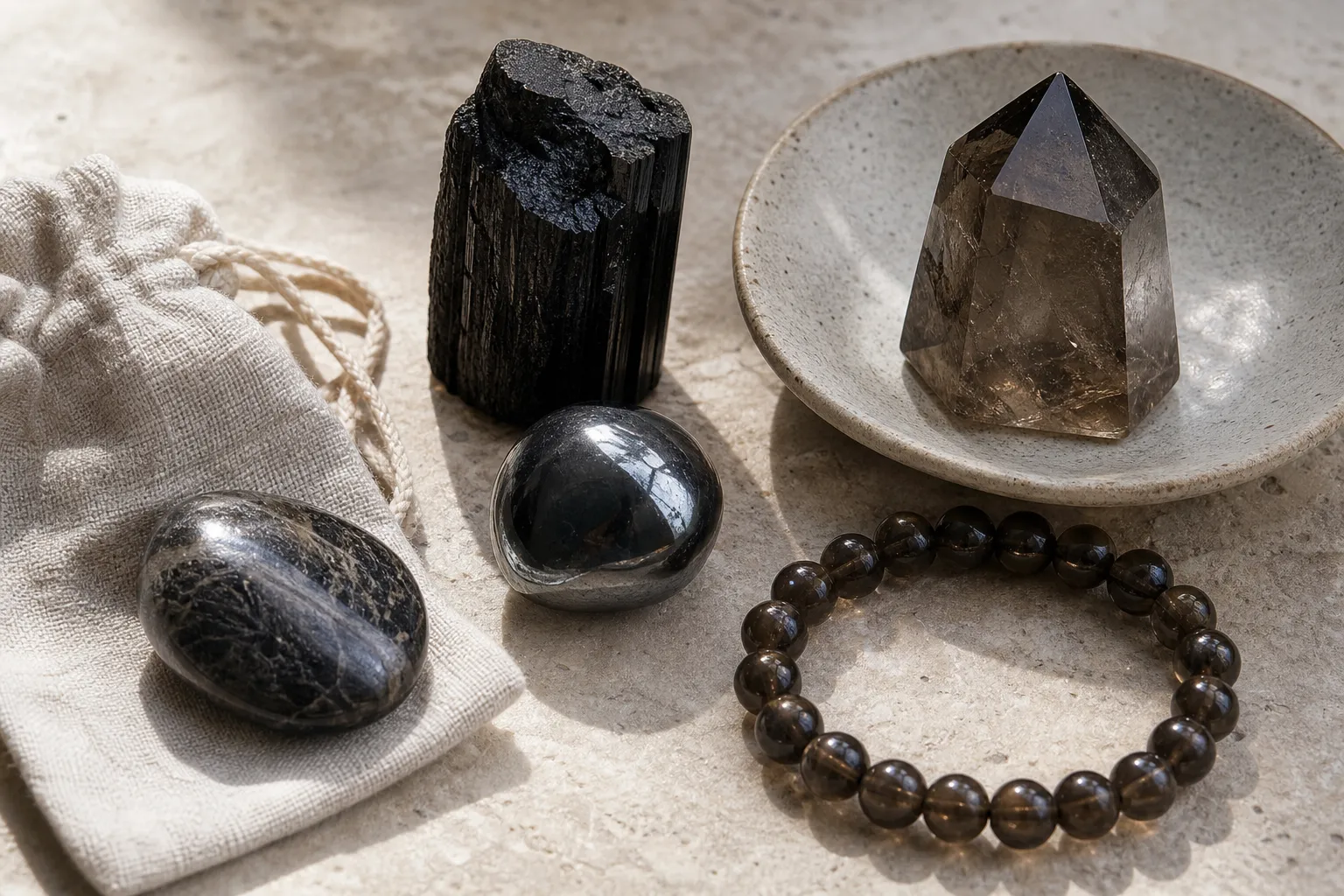
For jewelry, hematite and smoky quartz are easy to imagine in beads, pendants, or polished settings. Black tourmaline can also be worn, but raw pieces may be uneven or more vulnerable depending on the setting.
For pocket carry, a tumbled stone is usually more comfortable than a sharp raw point. Hematite, smoky quartz, jasper, onyx, or tiger’s eye may work better as smooth pocket grounding crystals than brittle or jagged pieces.
For desk display, raw black tourmaline, smoky quartz points, obsidian, or jasper palm stones can act as visual reminders. The desk does not make the meaning stronger; it simply keeps the stone visible in a daily routine.
For personal meditation, texture matters. Some people prefer a smooth palm stone. Others like a natural point, bead strand, or small object placed nearby. If a stone is sharp, awkward, too cold, or distracting, it may not suit that setting even if its meaning sounds right.
Raw vs tumbled grounding crystals
Raw vs tumbled grounding crystals are sometimes described as if the shape completely changes the meaning. A more practical reading is that the handling experience changes first, and the symbolism may feel different because of that.
Raw stones may look natural, angular, rugged, or closer to their original specimen form. A raw black tourmaline piece can feel visually strong because of its dark ridges and irregular shape. Raw stones are often chosen for shelves, altar layouts, or room display.
Tumbled stones are smoother and easier to carry. They fit pockets, pouches, jewelry designs, and palm-holding practices. A tumbled smoky quartz or red jasper may feel more approachable for daily handling than a rough specimen.
Polished shapes such as palm stones, spheres, towers, and beads add another layer. These forms are shaped for touch, display, or style. The symbolism may feel calmer, more formal, or more decorative, but that is interpretation, not a rule.
Care is where the practical difference matters most. Physical cleaning is not the same as ritual care. Some people use smoke, sound, moonlight, intention, or other symbolic methods as part of personal practice. Physical cleaning depends on the material, polish, setting, and durability. Do not assume every stone should be soaked, salted, scrubbed, or exposed to the same conditions. Jewelry findings, coatings, fractures, porosity, and glued settings can matter as much as the stone name.
Pocket, jewelry, or display: do grounding crystal meanings change?
The basic meaning people attach to a stone usually stays similar, but the format changes how the meaning is encountered.
A pocket grounding crystal is private and tactile. It can serve as a small reminder object during the day. Smoothness, size, and durability matter more than dramatic appearance.
A grounding crystal bracelet makes the symbol visible and wearable. Hematite, onyx, smoky quartz, tiger’s eye, garnet, and jasper are common bracelet materials in retail settings. Grounding crystal jewelry meanings often come from repetition and presence: the stone is worn, seen, and felt often. That makes the reminder more continuous, not more measurable.
A display stone works differently. A raw black tourmaline piece near a workspace, a smoky quartz point on a shelf, or a jasper palm stone beside a journal can act as a visual anchor in a room. It may be part of an altar, a decorative arrangement, or a quiet personal ritual.
A meditation stone is chosen for handling. Size, temperature, texture, and comfort become important. If a stone feels too sharp or distracting, a smoother form may be better even if the raw version looks more dramatic.
The meaning does not need to change. The way you meet the meaning changes.
Grounding crystals and earthing are not the same thing
The word “grounding” has more than one online meaning. In crystal pages, it usually refers to symbolic grounding: steadiness, earth connection, root chakra themes, and personal intention. In some wellness discussions, “grounding” or “earthing” refers to direct physical contact with the earth or conductive systems connected to it.
Those are separate topics. Earthing discussions are about the body and contact with the ground. Grounding crystal meanings are about stones, symbolism, personal practice, and modern crystal language. Mixing the two can make a simple stone comparison sound like a health-outcome discussion, which is not what this page is doing.
Here, “grounding” means the crystal-practice use of the word.
A practical way to choose among crystals for grounding
Instead of asking for the single best grounding stone, choose through three filters: symbolic language, visible traits, and format.
1. Decide which meaning style fits your practice
Root chakra symbolism.
Earth connection.
Steadiness or focus.
Boundary or protection-style symbolism.
Quiet reflection.
A simple daily reminder.
2. Match that language to visible traits
Red or reddish-brown stones for root chakra color language.
Black stones for grounding and protection-style associations.
Brown, smoky, or bronze stones for earthy symbolism.
Metallic-looking stones for weight and steadiness imagery.
Smooth stones for handling.
Raw pieces for display.
3. Match the stone to use
Bracelet or pendant if you want a wearable reminder.
Tumbled stone if you want pocket carry.
Palm stone if you want something to hold.
Raw or shaped display piece if you want a desk or shelf object.
Beads if you prefer repetition, touch, or quiet counting.
This keeps the choice grounded in the ordinary sense: you are selecting a material object with a look, feel, label, and symbolic role. You do not have to accept every claim attached to a shop description.
Common misreadings to avoid
One common mistake is treating crystal meanings as fixed facts. A stone can be hematite as a mineral fact and “grounding” as a modern symbolic association. Those are different kinds of statements.
Another mistake is assuming all black stones mean the same thing. Black tourmaline, obsidian, onyx, and hematite differ in material identity, surface, shine, common forms, and handling. Their meanings overlap because of color symbolism, not because they are identical.
A third mistake is turning root chakra language into a personal condition label. Chakra terms belong to cultural, spiritual, and personal-practice contexts. They should not be used to explain someone’s health or emotional state.
It is also easy to confuse ritual care with physical care. A person may choose a symbolic method because it fits their practice, but physical cleaning should consider the actual stone, polish, setting, and durability.
The most balanced reading is simple: grounding crystals are meaningful objects for people who use crystal symbolism, meditation, jewelry, display, or intention-setting. Their visible traits are real. Their mineral identities can be described carefully. Their grounding meanings belong to tradition, interpretation, and personal use rather than verified outcomes.
Brief answers to beginner questions
Can one crystal have more than one grounding meaning?
Yes. A stone can be described as grounding, protection-style, root-chakra-related, quiet in tone, or useful for intention work within modern crystal language. Those meanings overlap because practitioners and shops use different symbolic frameworks.
Are crystals for grounding always black?
No. Black stones are common in grounding and protection-style language, but red, brown, smoky, metallic, and earthy-looking stones are also widely included. Red jasper, smoky quartz, hematite, garnet, tiger’s eye, and mahogany obsidian are examples.
Is a raw grounding crystal better than a tumbled one?
Not automatically. Raw stones may feel more natural or visually strong. Tumbled stones are usually easier to carry and hold. The better choice depends on use, comfort, care needs, and the symbolism you prefer.
What should I trust in a crystal shop description?
Trust observable details first: stone name, color, size, finish, shape, setting, and care notes. Read grounding, stability, centering, root chakra, and protection language as symbolic or practitioner-based wording, not as a promise of specific results.