Meaning boundary
Root Chakra Stone Meanings vs Health Claims: What Is the Difference
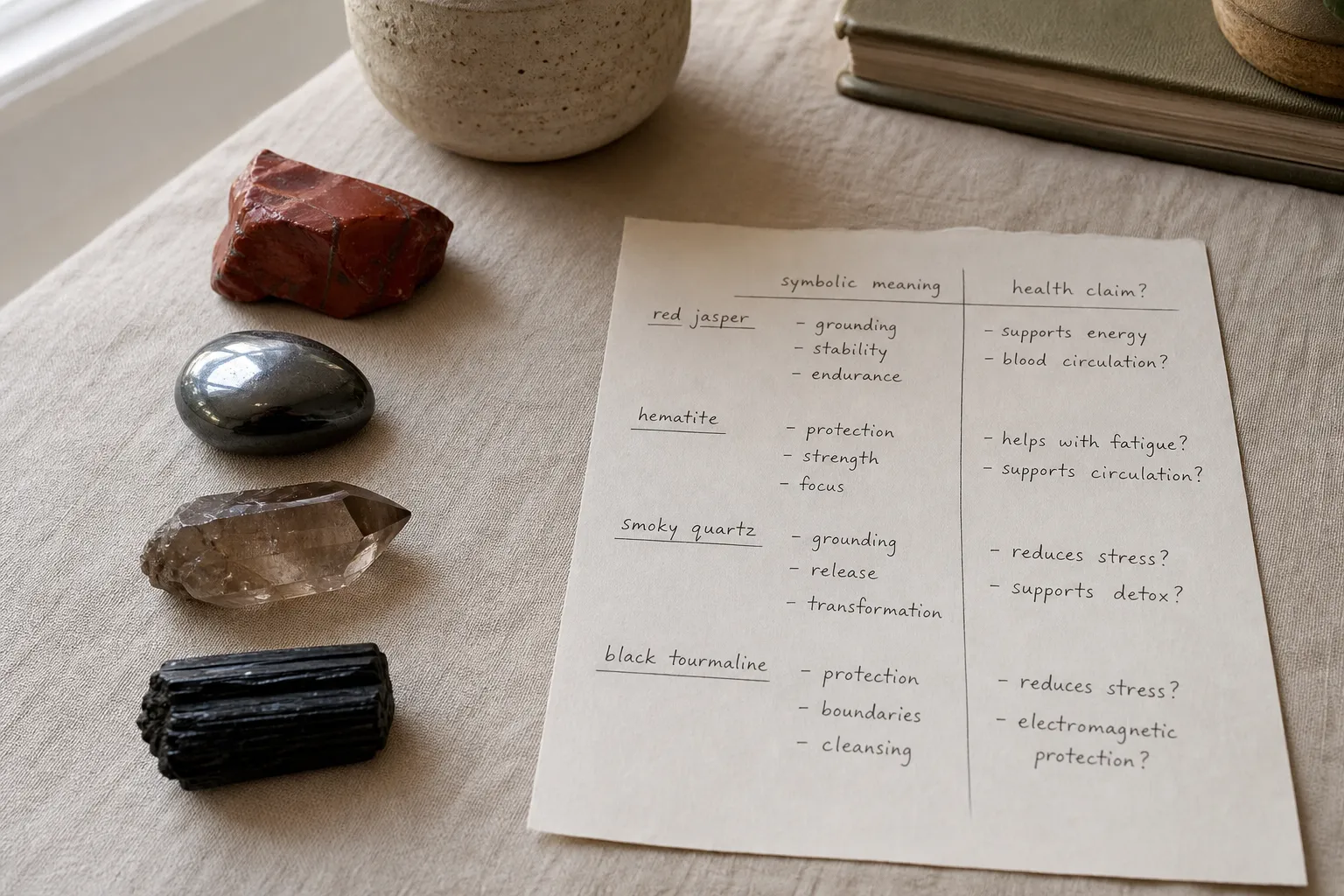
The difference is this: root chakra stone meanings describe symbolic associations used in chakra and crystal traditions. Health claims suggest that a stone can identify, change, or reliably improve a physical or emotional condition.
So, “many crystal practitioners associate black or red stones with grounding symbolism” is meaning language. “This stone changes a health outcome” is a different type of statement and needs a much stronger standard of support.
That is the heart of root chakra stone meanings vs health claims. A beginner can respect chakra symbolism, use stones for personal reflection, and enjoy crystal-shop language without accepting unsupported promises about the body, mood, sleep, organs, or illness.
upward
Start with the broader guide
Use the broader guide first if you need the full scope before this page.
Meaning language stays in the realm of symbolism
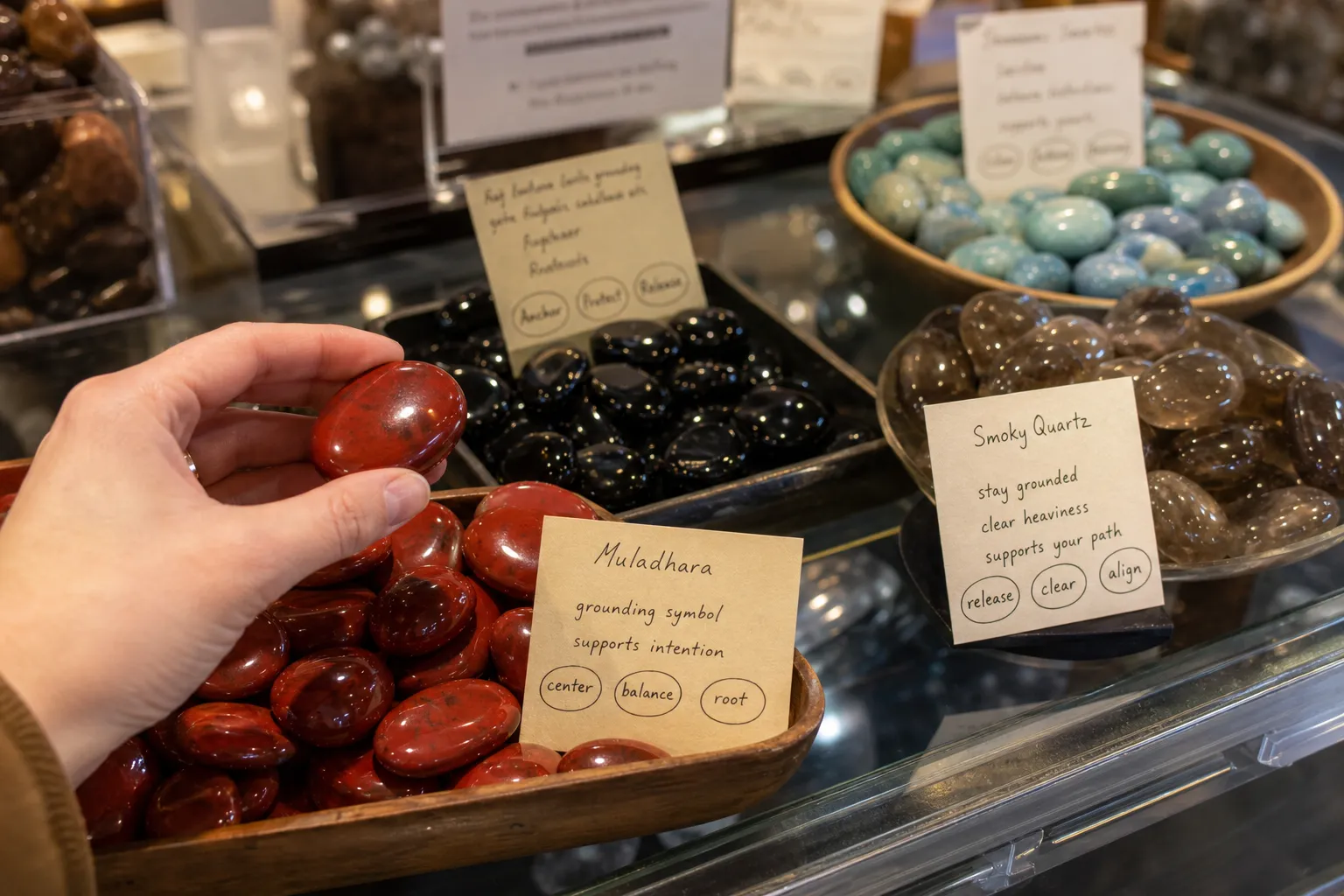
In chakra traditions, the root chakra is commonly called Muladhara. Chakras are generally described in spiritual and yogic traditions as subtle centers or points, not as ordinary visible body structures.
When crystal shops, books, or practitioners discuss Muladhara stone meanings, they often use words such as:
- grounding
- stability
- safety
- security
- survival
- Earth connection
- protection symbolism
- personal intention
- material-world focus
Those words are not automatically health claims. They can be symbolic descriptions, much like saying a red stone feels bold in a design setting or a dark stone looks steady on a desk.
Clear meaning language usually sounds attributed and interpretive:
- “Many crystal practitioners associate hematite with grounding symbolism.”
- “Some shops describe smoky quartz as a root chakra stone.”
- “A person may use a red or black stone as a personal reminder of steadiness.”
- “In chakra traditions, Muladhara is often linked with themes of foundation and security.”
None of those sentences promises a body result or a reliable emotional outcome. They describe how a stone is commonly interpreted in a belief-based or personal-use setting.
One important caution: common in crystal shops does not mean verified by an authority. A stone may appear again and again in retail lists without that list carrying scientific, clinical, or regulatory weight.
Health-claim language changes the standard
Health-claim language is different because it implies that a product can affect a condition, symptom, body system, or measurable outcome. That type of statement cannot be supported by popularity, tradition, color symbolism, or a seller’s confidence.
The U.S. Federal Trade Commission explains that health-related advertising needs appropriate support. The FDA also warns consumers about products promoted with unsupported health promises. Those sources are not about root chakra stones specifically; they are useful here because they show why health-outcome language is held to a different standard than symbolic meaning language.
For a reader comparing crystal meanings and claims, the practical test is simple:
Usually symbolic, personal, or retail language
- “Associated with grounding in chakra traditions”
- “Used as a personal ritual cue for stability”
- “Commonly described as a root chakra stone in shops”
- “Linked with red, brown, or black root chakra themes”
Usually health-claim language
- “Changes a health condition or symptom”
- “A blocked chakra explains a physical or emotional problem”
- “A stone can reliably produce a body or mood result”
The first group can be discussed as belief, symbolism, and personal interpretation. The second group should not be presented as stone fact.
Why root chakra wording gets confusing
Root chakra stone pages often mix several ideas in one paragraph: chakra location, color, symbolic meaning, emotional language, body-location language, and product promises. That blend is why beginners can have trouble telling where the meaning ends and the health-like statement begins.
A typical retail-style description may mention Muladhara, the base of the spine, red or black stones, grounding, protection, survival, and safety. Then it may slide into stronger wording about fear, sleep, body systems, or “blocked chakra” problems.
The symbolic part and the health-outcome part may appear side by side, but they are not the same kind of statement.
Common root chakra stones named in crystal-shop wording include:
- garnet
- smoky quartz
- obsidian
- black tourmaline
- bloodstone
- tiger’s eye
- hematite
- agate
For this page, those examples should be read as common retail or practitioner associations, not as an authoritative root chakra stone chart. The strongest available material for specific stone correspondences is often commercial or SEO-oriented, so it can show what readers are likely to encounter, but it cannot establish verified effects.
A careful way to talk about these stones is:
- “Black tourmaline is often described in crystal shops as a root chakra stone.”
- “Garnet is commonly connected with red root chakra symbolism.”
- “Hematite’s metallic gray-black appearance makes it a frequent choice in grounding-themed crystal displays.”
- “Some practitioners use smoky quartz as a personal intention stone for steadiness.”
A less careful way is to imply that the stone can identify the cause of a problem, change a health condition, or stand in for appropriate support. That is where root chakra health claims become risky.
A quick wording check for beginners
If you are reading a crystal page, shopping label, social caption, or chakra chart, pause over the verbs. The verbs usually reveal whether the sentence is symbolic or outcome-driven.
1. Does it describe a meaning or promise a result?
Meaning language usually sounds interpretive:
- “associated with”
- “symbolizes”
- “used by some practitioners”
- “connected with”
- “chosen as a reminder”
- “part of a personal ritual”
Outcome language is stronger:
- “will change”
- “works for”
- “solves”
- “addresses a condition”
- “explains your symptoms”
- “restores the body”
- “guarantees emotional results”
The more the wording sounds like a promised change in health, the more it has moved away from symbolic meaning.
2. Is “blocked root chakra” being used like a checklist?
Chakra blockage claims are one of the easiest places to confuse belief language with health information. In some crystal and chakra content, a blocked root chakra may be linked with fear, instability, fatigue, sleep problems, body discomfort, eating concerns, or other serious issues.
For a beginner, the cleaner reading is this: “blocked root chakra” is a belief-based phrase inside a chakra framework. It should not be used as a checklist for identifying health problems. If a page turns a chakra term into an explanation for symptoms, it has crossed into a different category of claim.
3. Is the stone described as a support object or as a health product?
There is a meaningful difference between:
- placing a stone on a shelf as a reminder to slow down before starting the day;
- carrying a stone because its color and texture feel personally meaningful;
- using a stone in a private meditation or journaling routine;
and:
- presenting the stone as a product that changes a health outcome.
The first set is about stones and personal intention. The second set needs stronger support than tradition, belief, or retail repetition can provide.
How to keep root chakra stone wording grounded
If you want to discuss root chakra stones without medical claims, choose wording that stays close to observation, tradition, and personal meaning.
Better wording:
- “This dark stone is commonly associated with grounding symbolism.”
- “In chakra traditions, Muladhara is often connected with foundation and stability.”
- “A practitioner may choose red, brown, or black stones for root chakra-themed reflection.”
- “The stone can serve as a personal reminder during journaling, display, or quiet ritual.”
- “Some shops group hematite, smoky quartz, and garnet with root chakra stones and crystals.”
Wording to question:
- “This stone changes a health condition.”
- “This crystal explains why you feel unwell.”
- “A blocked root chakra is the cause of a physical problem.”
- “This stone reliably produces a specific emotional result.”
- “The crystal can replace ordinary support or professional guidance.”
This is not about dismissing symbolic practice. It is about keeping each kind of statement in its proper lane. A person can value a stone’s color, texture, cultural symbolism, and ritual meaning without turning that meaning into a health promise.
The clean distinction
Root chakra stone meanings are belief-based, symbolic, and interpretive. They may involve color, tradition, personal intention, and common crystal-shop wording.
Health claims imply that a stone changes, identifies, or reliably improves a physical or emotional condition.
That difference should shape how beginners read root chakra content. If the wording says “associated with grounding,” it is symbolic language. If it says a stone produces a health result, it is no longer just a crystal meaning.
A grounded approach keeps the stone visible and real first: its color, pattern, weight, polish, and setting. Then it keeps the meaning clearly attributed: “in chakra traditions,” “many crystal practitioners associate,” or “some shops describe.” That leaves room for personal ritual while avoiding unsupported health promises.