
Color comparison
Red vs Black Root Chakra Stones: What Is the Color Difference
Red root chakra stones match the classic red color used for the root chakra, or Muladhara, in many modern chakra charts. Black root chakra stones do not match that chart color, but they are still commonly grouped with root chakra stones because contemporary crystal practice often treats dark stones as earthy, weighty, or protective in a symbolic sense.
So the practical answer to red vs black root chakra stones is simple: red stones connect more directly to the traditional root chakra color, while black stones belong to the same root-themed category through modern crystal-shop and practitioner language. The difference is mainly visual and interpretive, not a confirmed difference in personal outcomes.
upward
Start with the broader guide
Use the broader guide first if you need the full scope before this page.
The visible difference: warm red vs dark neutral
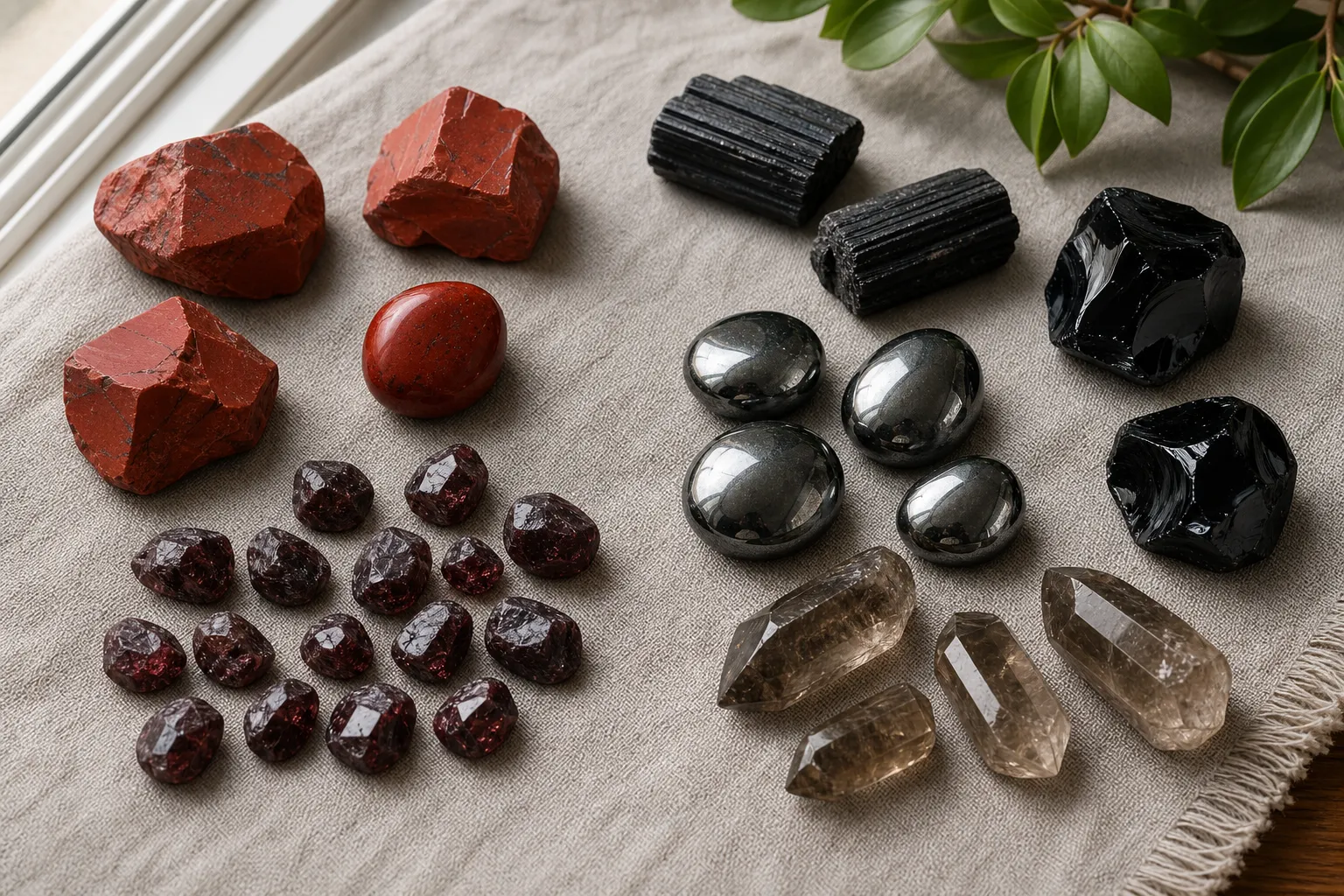
Red root chakra stones usually stand out because they are warm, saturated, and easy to connect with red chakra diagrams. Depending on the stone and finish, they may look brick red, rusty red, wine red, reddish brown, orange-red, or deep garnet red.
Common red root chakra stone examples include:
- Red jasper, often opaque, earthy red, or reddish brown
- Red garnet or hessonite garnet, usually deep red, reddish orange, or brownish red
- Red agate or fire agate, often banded, translucent, or patterned
- Bloodstone, usually dark green with red markings rather than fully red
- Red spinel, commonly shown as bright to deep red gem material
Black root chakra stones look different at a glance. They are dark, neutral, and less directly tied to a red chakra chart. Their surfaces may be glossy, metallic, glassy, matte, smoky, or banded.
Common black or dark root chakra examples include:
- Black tourmaline, often ridged, opaque, and deep black
- Black obsidian, usually glassy and smooth when polished
- Black onyx, often polished into beads, palm stones, or simple jewelry
- Hematite, typically metallic gray to black rather than flat black
- Smoky quartz, a brown, gray-brown, or nearly black bridge stone
- Black kyanite, black sapphire, or tourmalated quartz, depending on the seller’s category
This is where beginners often get stuck. A chakra chart may show the root chakra as red, while a shop display may place red jasper next to black tourmaline, obsidian, hematite, and smoky quartz. Those stones are not the same color family, but they are often placed under the same root chakra theme.
Why red is the classic root chakra color
In many modern chakra charts, the root chakra is shown as red. The Sanskrit name often used for it is Muladhara, and English-language chakra guides also call it the base chakra. Within that framework, red is the color most beginners first learn.
That makes red stones the most visually straightforward choice. If you are building a small root chakra display, following a seven-color chart, or choosing a stone because you want it to resemble the red root chakra symbol you have seen, red jasper or deep red garnet will usually make more immediate sense than a black stone.
The red connection is easy to see in simple arrangements:
- A red stone beside a root chakra card or diagram
- A red bead bracelet labeled for root chakra practice
- A red jasper palm stone used as a color reminder in a personal ritual
- A red agate or garnet placed at the base of a seven-color crystal layout
That does not make red stones more authoritative for the root chakra. It only means they line up more directly with the familiar red color convention. Broader research on color associations suggests that people often connect colors with feelings, ideas, and cultural meanings, but those associations can shift with context, culture, brightness, saturation, and wording. That is a useful caution here: color symbolism can matter to a person without becoming proof that a stone produces a specific result.
Why black stones are also sold as root chakra stones
Black stones appear in root chakra categories because modern crystal language often connects dark colors with earthiness, weight, stillness, grounding imagery, and protective symbolism. Those words are common in shops and practitioner descriptions, but they should be read as symbolic or belief-based language.
Black stones are not usually included because they match the traditional red root chakra color. They are included because they fit a different kind of root symbolism: dark, dense, quiet, and visually close to soil, shadow, iron, volcanic glass, or polished black surfaces.
A few comparisons make the distinction clearer:
Red jasper vs black tourmaline
Red jasper gives the classic red root color; black tourmaline gives the darker, earthier root-stone look often used in modern crystal displays.
Red garnet vs black obsidian
Garnet reads as deep red and vivid; obsidian reads as glossy black and minimal.
Fire agate vs hematite
Fire agate brings red-orange movement and pattern; hematite brings a metallic gray-black finish.
Red agate vs black onyx
Red agate may look warm and banded; black onyx often looks clean, simple, and polished.
Smoky quartz as a bridge
Smoky quartz is not red, but it may look brown, gray, or almost black, so it often sits near the dark-stone category.
This is why root chakra stone colors in retail settings often expand beyond red into brown, black, gray-black, and other dark tones. The red color comes from the classic chakra chart. The black color comes from contemporary crystal symbolism and product grouping.
Choosing red or black crystals without overthinking it
For a beginner, the better question is not “Which color is stronger?” It is: Which color matches the way I want to use or display the stone?
Choose a red root chakra stone if you want:
- A stone that clearly matches the traditional red root chakra color
- A warmer, brighter accent in a layout
- A piece that fits easily into a seven-chakra color set
- A stone such as red jasper, red garnet, red agate, or fire agate
- A visual reminder of the root chakra color rather than a dark neutral stone
Choose a black root chakra stone if you want:
- A darker, more minimal-looking stone
- A piece that pairs easily with black clothing, simple jewelry, or neutral display trays
- A stone often described in modern crystal practice with earthy or protective symbolism
- A dark base for a mixed root chakra arrangement
- A stone such as black tourmaline, black obsidian, black onyx, hematite, or smoky quartz
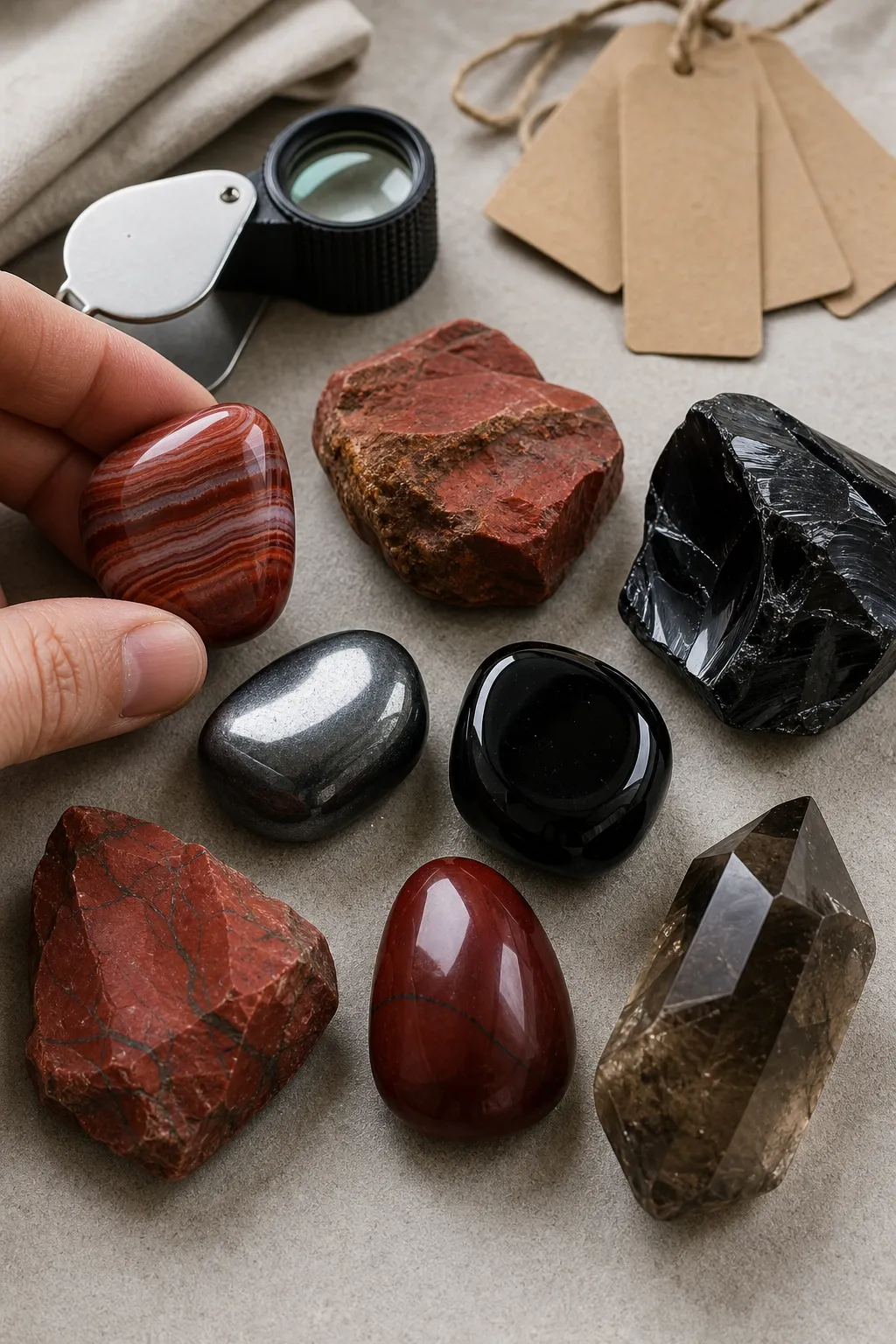
You can also use both. Red and black crystals are not competing categories in many modern root chakra displays. A small pairing of red jasper and black tourmaline, or garnet and obsidian, shows the two ideas clearly: one stone carries the classic red visual cue, while the other brings the dark, earthy look often used in root-themed crystal practice.
If you are buying online, look closely at the photos and descriptions. “Red” can mean bright red, rusty red, brick red, burgundy, or brownish red. “Black” can mean true black, gray-black, metallic, smoky brown, or included quartz. The label alone does not always tell you how the stone will look in person.
Common confusion: black is not a mismatch, and red is not automatically better
The biggest misunderstanding is that root chakra stones must be red because many charts show the root chakra in red. That is understandable, but it does not match how crystal shops and many modern chakra practitioners group stones. In practice, red, brown, black, and very dark stones may all appear under the root chakra category.
Another misunderstanding goes the other way: black stones may be marketed with intense protective language, which can make them sound more serious or more powerful. It is better to read that wording as symbolic language. Black stones are often chosen because their color, weight, and surface feel visually quiet, dense, or earth-like.
Mixed-color stones add one more wrinkle. Bloodstone may be listed with root chakra crystals because of its red markings, but it is not simply a red stone. Smoky quartz may be grouped with black root chakra stones even when it is brown-gray or translucent. Hematite may look metallic silver-gray rather than black. These examples show why the root chakra color difference is not always a clean red-versus-black split.
The simplest rule is: look at the stone first, then read the meaning. If the visible color, texture, and size already fit your purpose, the symbolic language can be a secondary layer rather than the whole reason for choosing it.
A simple way to decide
Use this quick check before buying or arranging red and black root chakra stones:
-
Do I want the classic root chakra color?
Choose red jasper, red garnet, red agate, fire agate, or another visibly red stone.
-
Do I want a darker root-themed look?
Choose black tourmaline, black obsidian, black onyx, hematite, smoky quartz, or another dark stone that fits the arrangement.
-
Do I care more about symbolism or appearance?
If symbolism matters most, treat shop wording as personal-practice language. If appearance matters most, trust the color, texture, size, and finish you actually like.
-
Will I carry it, wear it, or display it?
Polished black onyx may suit simple jewelry. Red jasper may stand out better in a chakra layout. Hematite may look visually heavier because of its metallic finish. Obsidian may show a glassy shine. These are ordinary design and handling differences.
-
Is the listing making strong outcome promises?
Be cautious with listings that turn a stone into a promised result. A clearer listing shows the stone’s name, color, size, finish, and photos without leaning on extreme claims.
Red vs black root chakra stones are easiest to understand when you separate three layers: the visible stone, the chakra color convention, and the symbolic language around it. Red stones match the traditional root chakra color more directly. Black stones are included because modern crystal practice often uses dark stones for root-themed symbolism. Either can be a reasonable choice for a personal display, color set, jewelry piece, or quiet ritual object, as long as the meaning stays personal.