
Grounding symbolism
What Do Black Root Chakra Stones Mean for Grounding Practices
Black root chakra stones are usually read, in modern crystal-practice language, as symbols of anchoring, steadiness, earth connection, personal boundaries, and protection-style imagery. The black root chakra stones meaning is not based on one fixed rule. It comes from how practitioners often interpret dark stones: opaque color, visual weight, cool touch, density in the hand, and strong contrast against lighter objects.
That matters because the root chakra, or Muladhara, is most often linked with red in modern chakra color charts. Black stones are not the standard color symbol for the root chakra. They are included in grounding-style practices because their darkness and material presence make them useful visual anchors for ideas like “stay here,” “return to basics,” or “feel supported.”
upward
Start with the broader guide
Use the broader guide first if you need the full scope before this page.
Why black stones are linked with grounding
In many chakra traditions, Muladhara is described as the root or base chakra. Its language tends to gather around foundation, earth, support, steadiness, and the base of the body. That background helps explain why black stones are often placed in root chakra practice, even when they do not match the classic red root chakra color.
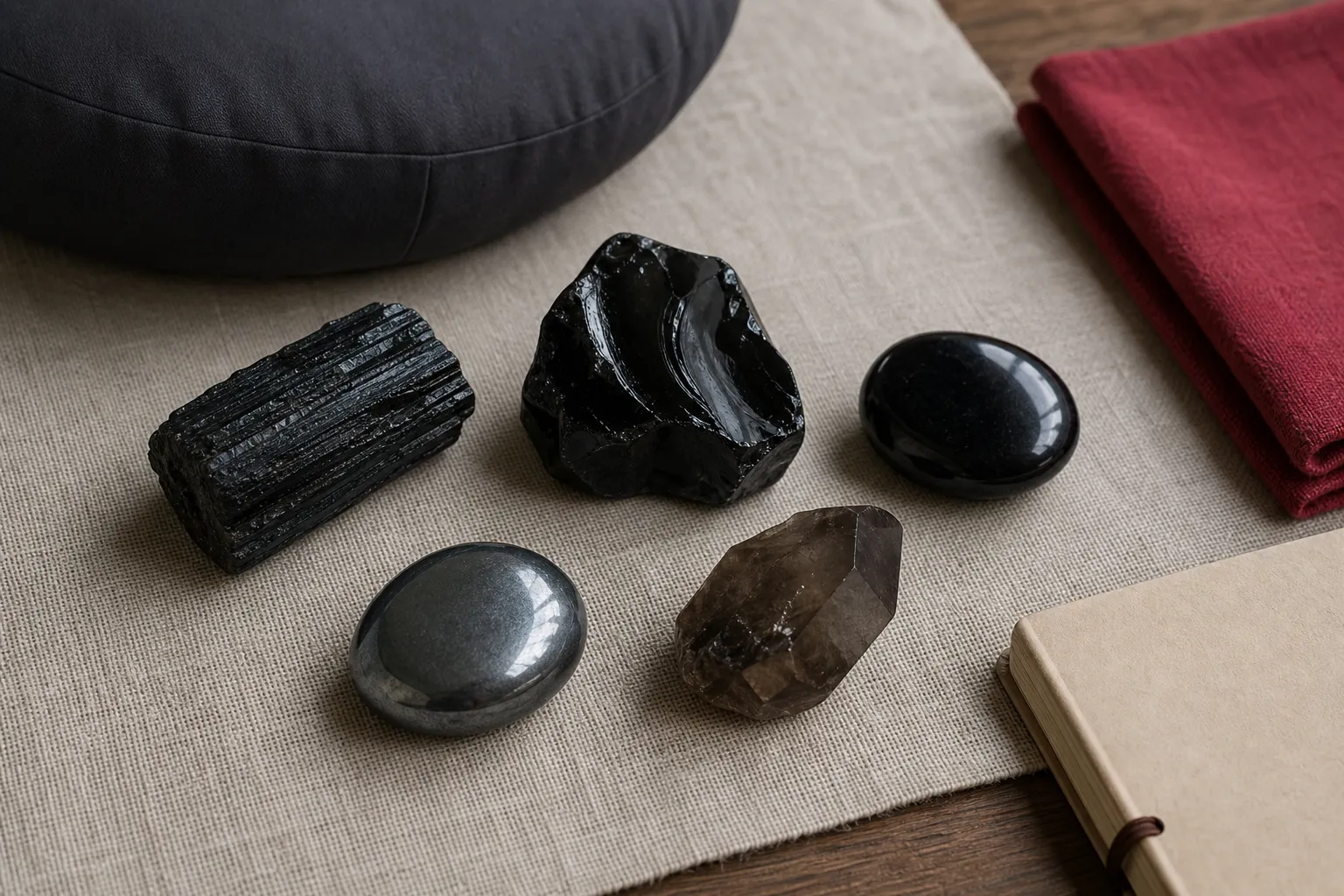
The link is also visual and tactile. A rough black tourmaline piece, a glossy obsidian palm stone, a dark onyx bead, a metallic hematite tumble, or a deep smoky quartz point can all feel compact, weighty, and earth-bound. Some look volcanic or iron-rich. Some are mirror-like. Some are matte, ridged, or dense in the hand.
Those qualities make black stones easy to use as symbols for weight, stillness, contact, and steadiness. This is personal and spiritual symbolism, not a measured physical effect. For many beginners, the stone works more like a tactile reminder: something to hold, place nearby, or look at while choosing a slower, steadier pace.
Black stones versus the red root chakra color
The common confusion is simple: if the root chakra is red, why are black stones used for root chakra grounding?
The answer is that two symbolic systems are being blended.
Red is the more traditional root chakra color in many modern chakra charts. It is often associated with foundation, embodiment, and the first chakra’s position at the base of the system. If someone is following a strict color-based chakra layout, red jasper, garnet, or another red stone may feel more aligned with that framework.
Black stones enter through a different route. In crystal communities and retail descriptions, black crystal meaning is often connected with grounding, boundary imagery, depth, shadow, absorption, earthiness, and protection-style symbolism. Those ideas overlap with root chakra foundation symbolism, so black stones are commonly grouped with root chakra stones even though they are not the usual Muladhara color.
Red stones
Commonly read as foundation, embodiment, and base energy. This is closer to traditional root chakra color symbolism.
Black stones
Commonly read as anchoring, boundary, depth, and protection-style imagery. This is common in crystal-practice grounding language.
Dark smoky or gray stones
Often read as quiet, heavy, and inward-facing. They may be used as a softer version of black grounding crystals.
Metallic dark stones
Often suggest density, structure, and earth-mineral imagery. They can feel especially solid as a tactile cue.
One is not automatically more “correct” than the other. A strict chakra color chart points to red. A grounding-style crystal ritual may include black.
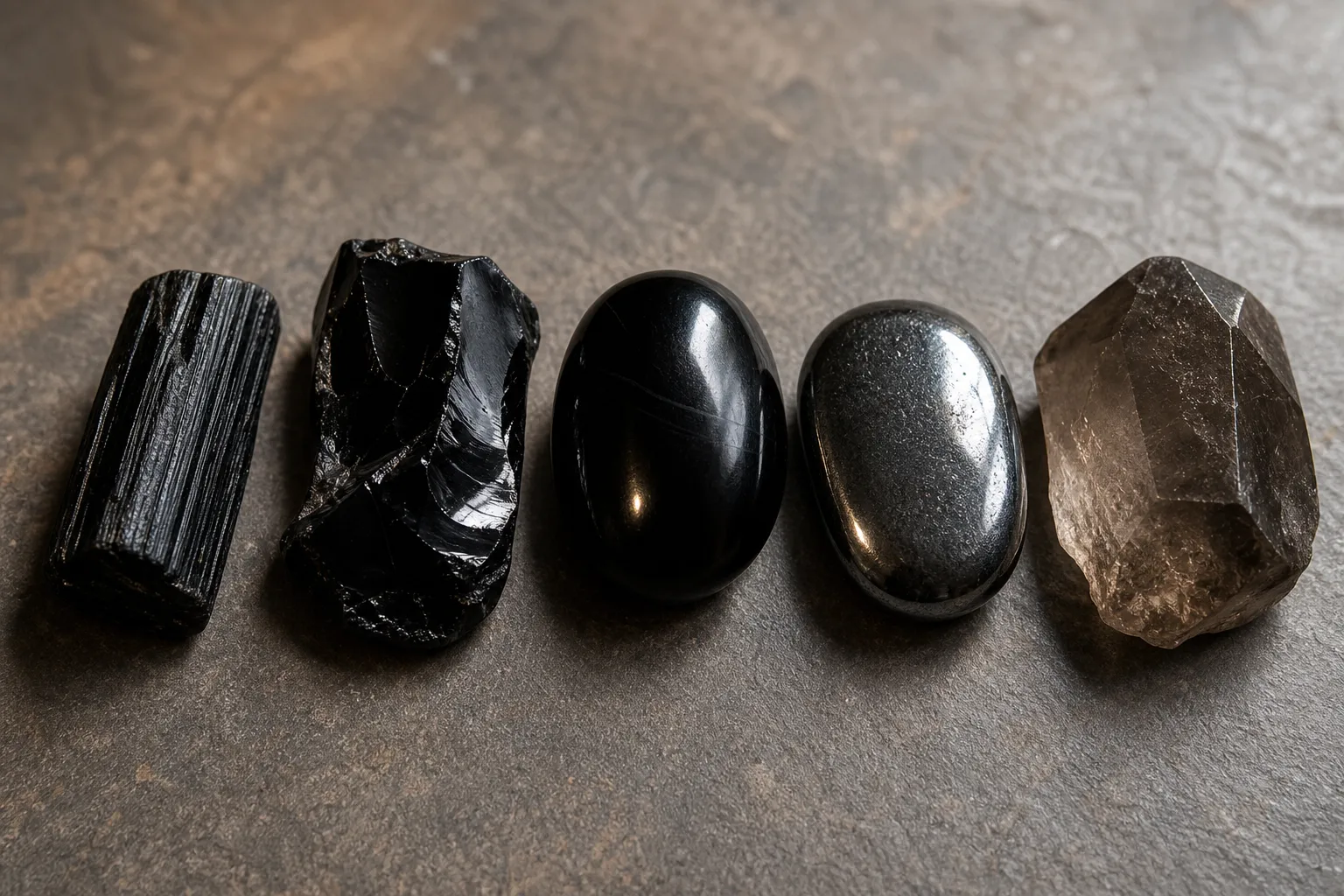
Common black stones used as root chakra symbols
These stones often appear in black stones for grounding lists. Their meanings are best read as practitioner associations, not universal facts.
Black tourmaline
Black tourmaline is frequently described in crystal communities as a grounding and protection-style stone. Natural pieces often appear deep black with ridges, lines, or rough column-like forms. That texture gives it an earthy, sturdy look, which is one reason beginners often connect it with anchoring symbolism.
For root chakra use, black tourmaline is usually chosen when someone wants a strong-looking stone for a desk, entryway, pocket, or meditation corner. Its meaning comes less from color-chart accuracy and more from its dark, grounded presence.
Obsidian
Obsidian is volcanic glass, and many pieces are glossy black, dark brown-black, or slightly translucent at thin edges. Its mirror-like surface often gives it a reflective or shadow-oriented meaning in crystal language. Some practitioners associate it with looking inward, cutting through distraction, or marking a clear personal boundary.
In grounding practices, obsidian is often chosen by people who want a dark stone that feels direct and visually intense. Raw or chipped obsidian can have sharp edges, so polished pieces are usually more comfortable for holding.
Onyx
Black onyx is commonly seen as polished beads, cabochons, and smooth pocket stones. It has a clean, even look, so its symbolism is often more restrained: structure, composure, and steadiness.
In a personal ritual, onyx can serve as a simple visual anchor. Its smooth surface and dark color make it easy to place on a cloth, hold during a short pause, or keep near a notebook without drawing too much attention.
Hematite
Hematite is often dark gray to black with a metallic sheen, and it can feel noticeably weighty for its size. That physical heaviness is one of the clearest reasons it appears in grounding conversations. Even without adding larger claims, a dense-feeling stone can work well as a tactile cue for “weight,” “contact,” and “settling.”
Some hematite sold in jewelry or small tumbled pieces may be magnetic or marketed with dramatic wording. For a beginner, the steadier approach is to choose it for appearance and hand-feel rather than for big promises.
Smoky quartz
Smoky quartz is not always black. It can range from pale gray-brown to deep smoky brown, and thicker pieces may look almost black. Its place among black grounding crystals is therefore looser.
For root chakra symbolism, smoky quartz can suit someone who wants a darker stone without the visual intensity of black obsidian or black tourmaline. Its transparency can make the symbolism feel quieter and less heavy.
How to use a black stone in a simple grounding ritual
A grounding ritual with black stones does not need to be elaborate. Since the meaning is symbolic and personal, the most useful approach is to make the stone part of a small, repeatable cue.
You might place a black stone on the floor beside your seat, hold one in your palm for a few quiet breaths, or set it near a candle, journal, or meditation space. The point is not that the object forces a result. The point is that it gives your attention a concrete place to return to.
A simple sequence can be enough
- Choose one black stone with a shape and texture you like holding.
- Sit or stand somewhere steady and uncomplicated.
- Notice the stone’s temperature, surface, weight, and color.
- Use a plain word such as “foundation,” “steady,” or “here.”
- Put the stone down deliberately when the pause is complete.
If a mantra such as LAM is part of your chakra tradition, you can include it as a personal practice choice. It is not required for understanding black stones and root chakra symbolism.
What changes the meaning from stone to stone
Black stones are not interchangeable just because they share a root chakra label. Their meaning changes with appearance, handling, setting, and the tradition or personal story brought to them.
A rough black tourmaline chunk may suggest earth, grit, and boundary imagery. A glossy obsidian palm stone may feel more reflective and inward. A polished onyx bracelet may feel composed and orderly. A heavy hematite tumble may make the grounding idea feel more literal through weight. A smoky quartz point may bring a softer, dimmer quality rather than a fully black one.
Setting matters too. On a desk, a black stone may act as a reminder to slow down before starting work. Near a door, it may be read through protection-style symbolism. In meditation, it may become a cue for attention and posture. In jewelry, it may be more about carrying a private symbol through the day.
That is why broad lists of “black grounding crystals” can be misleading when they sound too absolute. The more useful question is: what visible quality are you responding to, and what meaning are you assigning to it?
Common misunderstandings
Black is not usually the traditional root chakra color
In many chakra systems, red is the standard root chakra color. Black stones are a common crystal-community association because their look and feel match grounding language.
Every black crystal does not have the same meaning
Black crystal meaning is a category, not a single definition. Glassy, metallic, matte, banded, translucent, and rough stones all carry different impressions.
Grounding language does not prove an outcome
In this context, grounding is best read as a symbolic or personal-practice word. A black stone can be meaningful as a reminder, ritual object, or visual anchor without being presented as a mechanism that changes the body or life circumstances.
Stronger retail language does not make a stone more important
A calmer reading is usually more useful: look at the stone, name the symbolism, use it in a way that fits your practice, and avoid turning symbolic language into a promise.
A careful way to choose one
If you are choosing a black root chakra stone, start with the object rather than the slogan. Look at the color, opacity, shine, surface, edge quality, and weight. Ask whether it feels grounding to you because it looks dark and still, because it is heavy, because it has an earthy texture, or because its common meaning already resonates with you.
For holding, choose a smooth piece without sharp points. For display, a rougher specimen can work if it will not be handled often. For jewelry, consider comfort, durability, and whether the finish may scratch or change with wear.
Keep cleaning simple. Wipe with a soft dry or lightly damp cloth unless you know the stone and finish can handle more. Avoid harsh cleaners and long soaking when you are unsure.
The best choice is not the stone with the loudest description. It is the one whose visible qualities match the meaning you want to remember.
Bottom line
Black root chakra stones usually mean grounding, steadiness, earth connection, boundary-setting, and protection-style symbolism in modern crystal-practice language. They are not the classic red root chakra color, but they are commonly used with Muladhara because their darkness, opacity, weight, and earthy appearance make them strong visual anchors.
Read the meaning as symbolic and personal. A black stone can belong in a quiet grounding-style ritual as an object of attention, but its value comes from the meaning you give it, the way you use it, and the care you take not to turn symbolic language into a promised result.