Misconception guide
Common Misconceptions About Blue-Green Stones and the Root Chakra
Blue-green stones can be confusing in root chakra discussions because two ideas often get blended: the familiar chakra color chart and a person’s own crystal practice. In many popular charts, the root chakra, or Muladhara, is linked with red, black, earth tones, and the base of the spine. Blue-green stones are more often described in beginner and retail materials with blue, green, throat, or heart-style symbolism.
That does not make a blue-green stone “wrong” in every root chakra setting. It does mean it should not be treated as a standard red root chakra stone without explanation. The core of blue green stones root chakra misconceptions is simple: color charts are symbolic teaching tools, stone color is an observable feature, retail labels are interpretation, and personal use remains belief-based.
upward
Start with the broader guide
Use the broader guide first if you need the full scope before this page.
Why Blue-Green Stones Feel Out of Place
Most beginner confusion starts with a visual shortcut: root chakra equals red. Many seven-chakra charts move from red at the root to orange, yellow, green, blue, indigo, and violet or white. In that map, blue-green stones naturally look as if they belong somewhere else.
That shortcut can be useful, but it is not the same as a fixed rule for every crystal practice. Chakra language varies across traditions, teachers, modern books, shops, and personal routines. Some people follow color charts closely. Others choose stones by texture, memory, pairing, or the feeling of a ritual space.
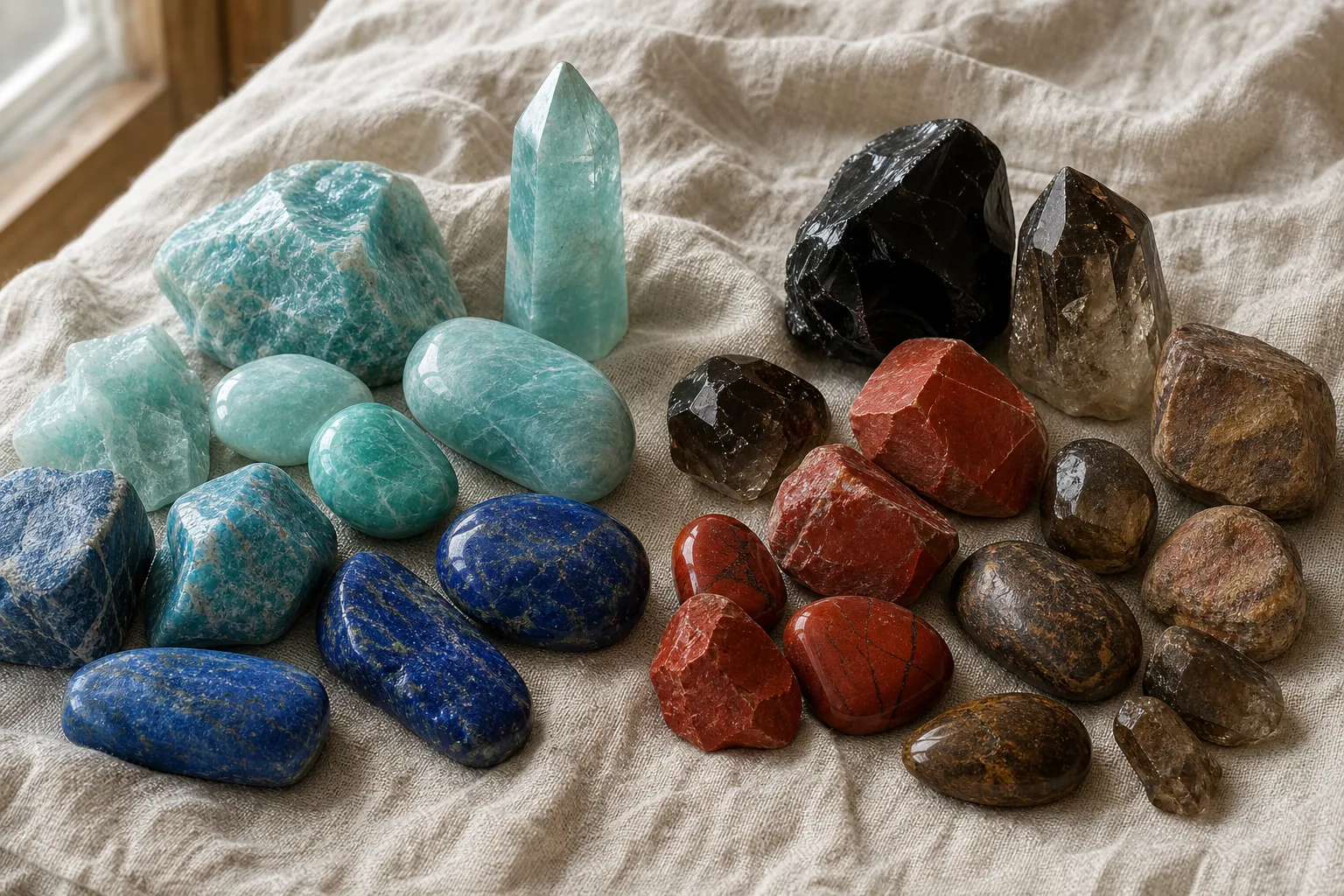
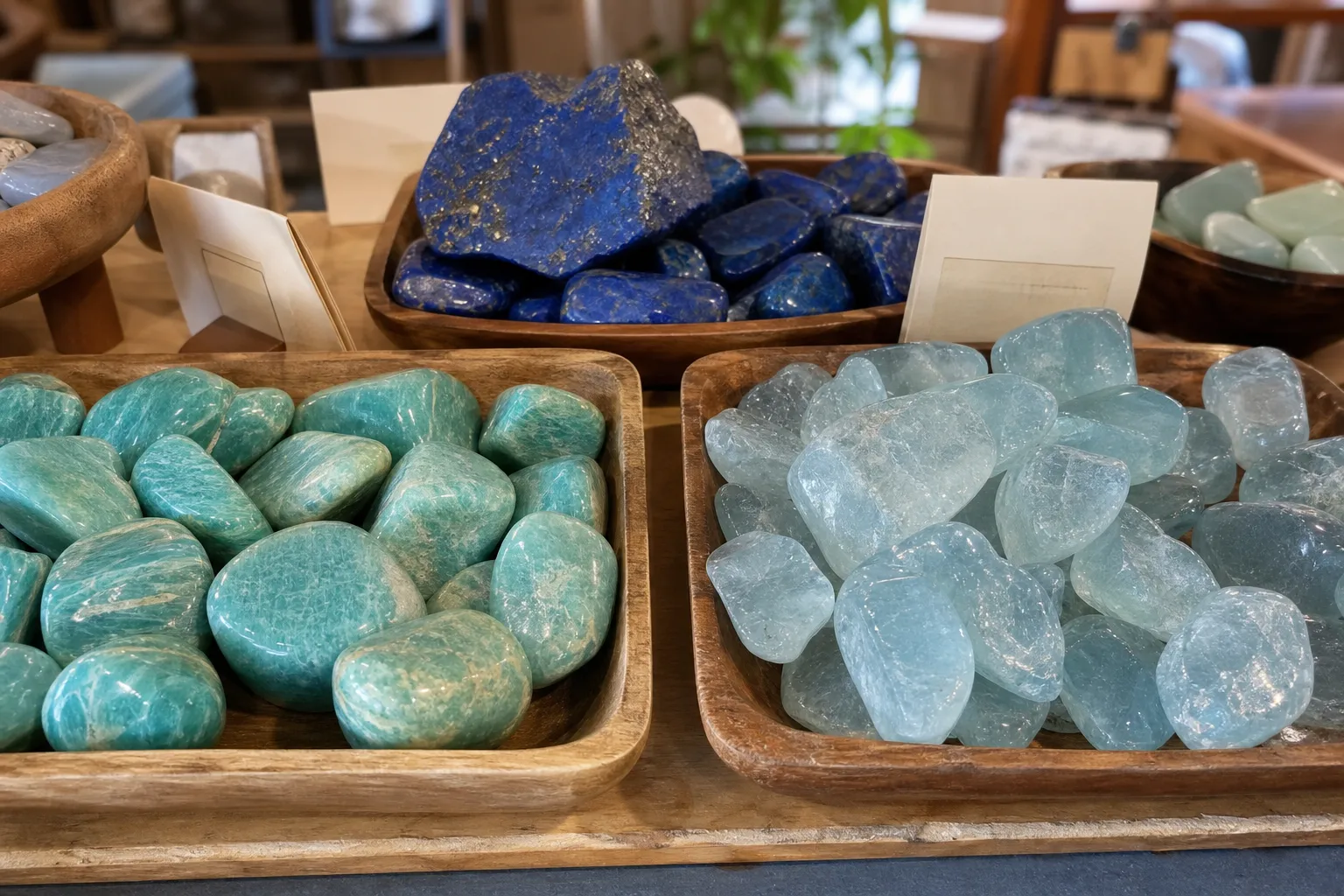
A stone’s color also exists before any symbolic meaning is added to it. Aquamarine may look pale blue to blue-green. Amazonite is often described as greenish blue or blue-green. Lapis lazuli is usually deep blue, often with white calcite and golden pyrite flecks. Those visible traits come from the material itself: mineral identity, inclusions, structure, and the way light interacts with the stone.
So the mismatch is real. Blue-green stones do not visually match the most common root chakra color association. The mistake is assuming that the mismatch has only one answer.
Misconception 1: “Root Chakra Stones Must Always Be Red”
Red is the most familiar root chakra color in many popular charts. Black and dark earth-toned stones also appear often because many practitioners connect the root chakra symbolically with ground, weight, stability, and the lower body.
But “commonly associated” is not the same as “always required.” Modern root chakra stone lists vary. Some lean red, some lean black, and some include non-red stones because the writer is using a broader symbolic frame.
A clearer way to read the idea
- Red stones fit the common root chakra color chart.
- Black and earth-toned stones fit many grounding-style symbolic descriptions.
- Non-red stones may appear when a practitioner or seller is using a wider interpretation.
- Blue-green stones need extra context because their color points away from the usual root chakra palette.
If you want a traditional-looking root chakra setup, blue-green stones probably will not be your first match. If you are building a personal ritual around a stone’s look, memory, texture, or contrast with red or black stones, a blue-green piece may still have a place as a personal symbol.
Misconception 2: “A Shop Label Decides the Chakra Meaning”
Retail chakra labels are one of the biggest sources of confusion. A shop set may place stones into seven compartments. A bracelet description may connect several colors to several chakras. A product page may use broad language around energy, grounding, or alignment. These labels tell you how the seller is presenting the item, not what everyone must believe about it.
A label may reflect
- the seller’s own chart;
- a common color association;
- a crystal-market convention;
- a mixed-stone set made for visual variety;
- a personal ritual suggestion.
Blue-green stones are especially prone to this because their color sits between categories. A seller may call the same general look blue, green, teal, turquoise-colored, sea-toned, or blue-green depending on lighting, polish, photography, and market wording. In gem and mineral language, color names are often descriptive rather than exact.
That matters because “blue-green” describes appearance. “Root chakra” describes a symbolic or practitioner association. When those labels appear together, read them as a presentation choice, not as a universal rule.
A better shopping question is not, “Does the label make this a root chakra stone?” It is: “Why is this stone being placed in a root chakra context, and does that explanation match the way I use chakra symbolism?”
Misconception 3: “Blue-Green Means the Same Thing in Every Chakra Chart”
Blue-green is not one fixed chakra category. In many beginner charts, blue is connected with throat symbolism, while green is connected with heart symbolism. A blue-green stone may be described differently depending on whether the writer sees it as more blue, more green, or somewhere between.
That is why one source may call aquamarine blue, another may call it blue-green, and another may group it with communication-style symbolism. Amazonite may be described as green, blue-green, turquoise-like, or sea-colored. Lapis lazuli is usually blue rather than blue-green, yet beginners may compare it with other blue or blue-green stones because of its strong color.
The color can be observed. The meaning attached to that color is interpretive. Mineral and gem references can help explain what a stone is and why it looks the way it does. They do not assign a chakra meaning.
For beginners, this distinction helps. A stone can genuinely look blue-green and still not be a standard root chakra match in a color-chart system. Likewise, someone can include a blue-green stone in a personal root chakra ritual without turning it into a universal root chakra stone.
Misconception 4: “Using a Blue-Green Stone for the Root Chakra Is Automatically Wrong”
If you are following a strict color-chart approach, blue-green stones may feel out of place for the root chakra. That is a reasonable conclusion within that system. But many personal crystal practices are not strict color-matching exercises.
These are personal-use explanations, not universal instructions. A crystal ritual may be meaningful as reflection, decoration, meditation support, or symbolic routine, but the stone should not be presented as creating health outcomes.
The middle ground is the most useful one: blue-green stones are not the typical root chakra color association, but they are not forbidden objects. The meaning depends on the system you are using and how clearly you separate symbolic practice from factual claims.
Misconception 5: “Chakra Color Charts Are Fixed Rules”
Chakra color charts are often taught in a neat, memorable way. For beginners, that can help. A simple chart gives people a quick way to remember the order of the chakras and the common color language around each one.
The problem starts when the chart is treated as more than a teaching tool. A red square on a root chakra chart does not mean all root chakra stones must be red. A blue-green stone in a shop’s chakra set does not mean there is tradition-wide agreement about that placement.
It helps to keep three layers separate:
Once those layers are separate, the confusion becomes easier to manage.
How to Read Blue-Green Stones in a Root Chakra Context
When you see blue-green stones in chakra practice, pause before accepting or rejecting the label. Look for the reason behind the association.
If the explanation is only “this stone is in a root chakra set,” that is thin context. If the explanation says the stone is being paired with red or black stones, used as a personal reminder, or chosen for symbolic contrast, the meaning is clearer. You can still decide whether that approach fits your own practice.
A simple decision path
- Start with the color system you trust. If you want the common root chakra color association, look first at red, black, and earth-toned stones.
- Notice the stone’s visible identity. Is it actually blue-green, mostly blue, mostly green, or mixed? Photos and shop names can blur these differences.
- Read the label as interpretation. A chakra label tells you how the stone is being framed.
- Use personal meaning carefully. It is fine to choose a stone because it feels symbolically useful to you, as long as you do not turn that feeling into a rule for everyone.
- Avoid symptom-based conclusions. Do not use chakra language to explain physical or mental health concerns.
This leaves room for personal ritual without falling into either extreme: “only red stones count” or “any seller label must be accepted.”
The Short Answer
Blue-green stones are not usually the first color match for the root chakra in popular chakra color charts. The root chakra is more commonly associated with red, black, and earth-toned symbolism. However, some practitioners or sellers may include blue-green stones through personal symbolism, pairings, mixed-stone layouts, or broader interpretations.
The main mistake is treating one layer as if it controls all the others. Color charts are symbolic maps. Stone color is a visible feature. Retail chakra labels are presentation and interpretation. Personal practice is personal practice.
If you want a traditional-looking root chakra setup, blue-green stones are usually secondary or optional. If you use them, the clearest framing is: “This is my personal symbolic addition,” not “This is a standard root chakra rule.”