
What Crystal Shops Mean by Blue-Green Root Chakra Stones
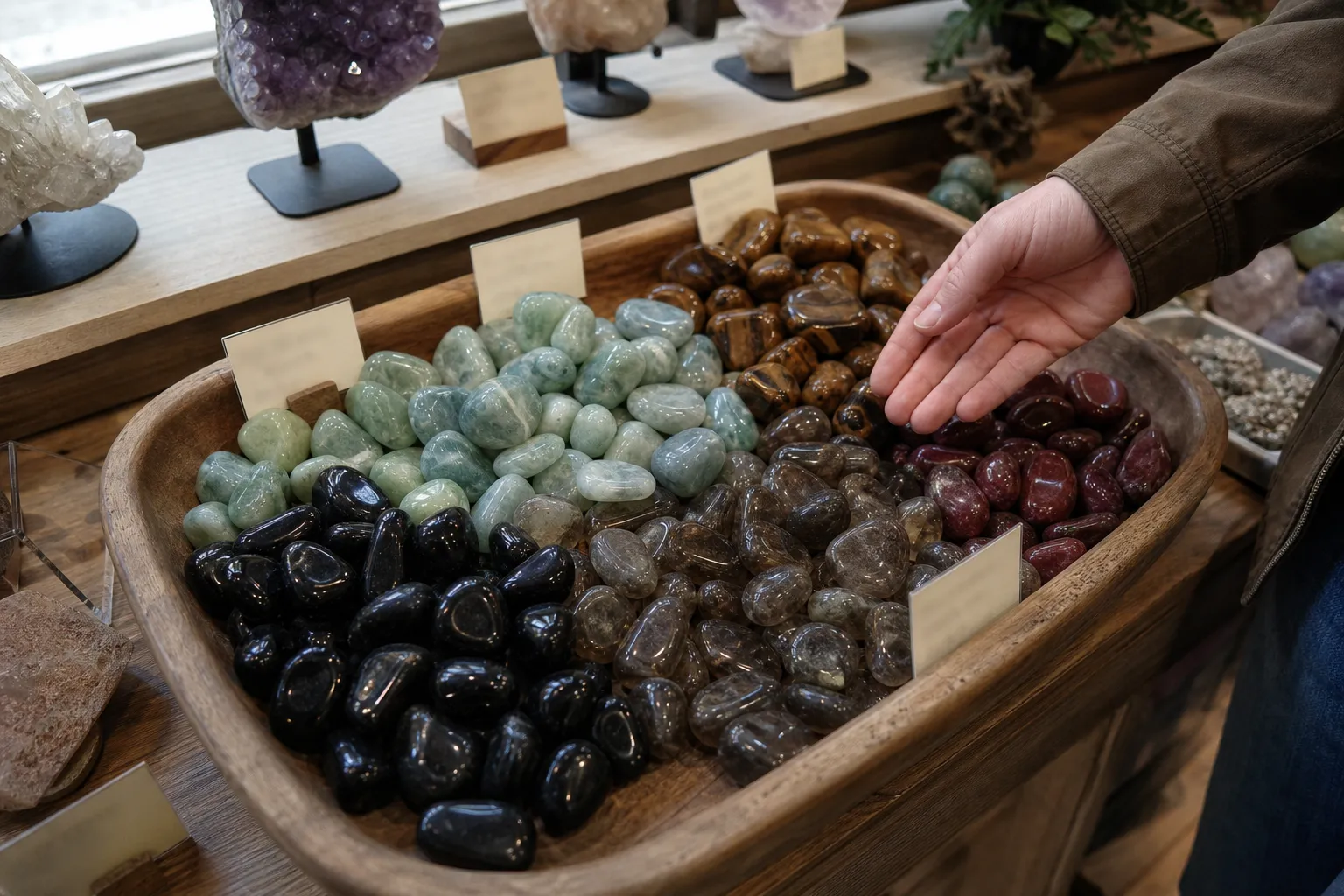
When a shop uses the phrase blue green root chakra stones, it usually is not saying that blue-green is the standard root chakra color. In many crystal shop chakra labels, root chakra language leans red, black, smoky, brown, dark, or earth-toned. Blue and green stones are more often placed near throat or heart chakra categories.
So what does the label mean? Most of the time, it is retail shorthand. The shop may be selling a blue-green stone for a grounding intention, placing it inside a root-themed set, responding to dark matrix or earthy inclusions, pairing it with darker stones, or using a loose multi-chakra description.
The cleanest distinction is this: blue-green is a visible feature of the stone; “root chakra” is a symbolic, practitioner, or retail interpretation.
upward
Read the full overview first
Use the broader guide first if you need the full scope before this page.
Why the label feels mismatched
The confusion starts with chakra color correspondence charts. In many contemporary crystal-shop charts, the root chakra, also called Muladhara in some chakra descriptions, is commonly linked with dark red, black, smoky, brown, or earthy stones. Those colors are often used in symbolic crystal practice to suggest steadiness, earth connection, or physical presence.
Blue and green usually sit elsewhere in shop-style charts. Blue is often used for throat chakra wording, while green is often used for heart chakra wording. That is why a blue-green stone in a root chakra section can feel inconsistent at first glance.
But the mismatch does not always mean the shop has made a mineral mistake. It may simply mean the shop is not labeling by color alone. A product description may be mixing several ideas at once:
- the stone’s visible color;
- the stone name or variety;
- the shop’s symbolic meaning for that stone;
- the stone’s place in a chakra set;
- grounding language used in the shop’s own system;
- dark veining, brown host rock, black specks, opacity, or other earthy visual cues.
For a beginner, the better question is not “Can blue-green be a root chakra color?” but “What is this shop using the root chakra label to signal?”
What a shop may mean by “blue-green root chakra”
A blue-green root chakra label becomes easier to read when you treat it as a shop description rather than a strict color rule.
The shop is labeling by intention, not color
Some shops group stones by the mood, ritual theme, or intention they want to suggest. A blue-green stone may be described with root chakra language even if its color would normally point toward throat or heart categories in a simple chart.
In that case, “root chakra” is being used as a symbolic use label. The product page may mention groundedness, stability, home, security, or presence. Those are belief-based associations in contemporary crystal practice, not properties that can be confirmed from the stone’s color.
This kind of label is common because shoppers often browse by theme, not only by mineral family.
The stone looks earthy despite being blue-green
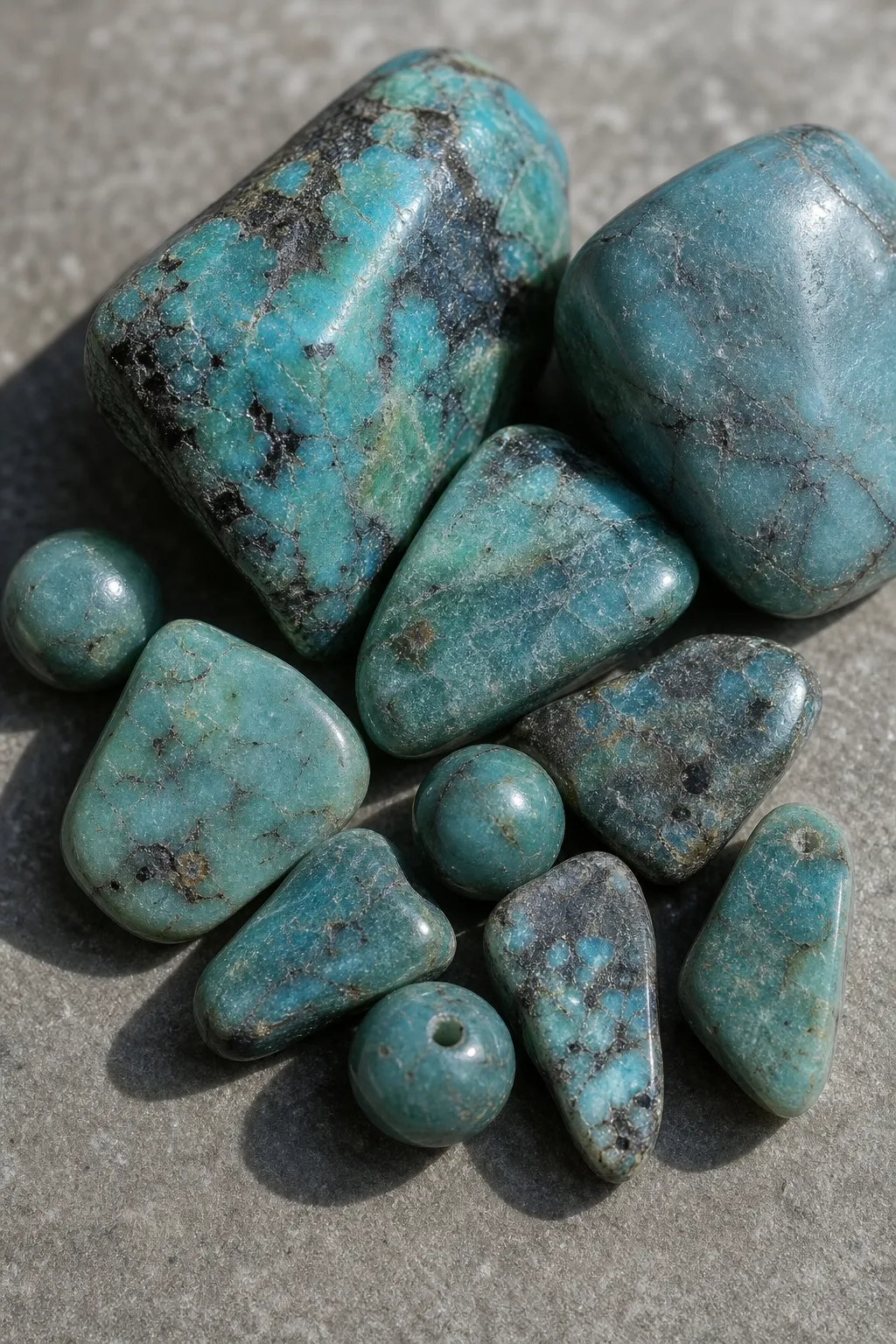
A stone may be blue-green overall but still have a heavy, muted, or earthy appearance. Turquoise-like stones, blue-green chalcedony materials, amazonite-like stones, jasper blends, jadeite, and tourmaline can appear with dark veining, brown host rock, black specks, gray areas, white bands, or opaque texture.
Those visible details can affect the way a seller frames the piece. A bright, translucent aqua stone may be placed in a throat or communication-themed section. A muted blue-green stone with dark matrix may be placed in a root-themed section because it looks more grounded or mineral-heavy in a visual sense.
That is a retail judgment, not a universal rule. Two shops may describe very similar stones differently.
The stone is part of a multi-chakra set
Blue-green stones often appear in mixed chakra sets. A bundle may include one stone for each chakra, or it may include several stones described as supporting more than one symbolic theme. In a set, the title can blur the role of each piece.
For example, a product title might say “root chakra grounding stones” while the photos show black, red, brown, blue, and green stones together. The blue-green piece may not be the main root stone at all. It may be a companion stone, a heart-or-throat stone inside the same bundle, or simply part of the set’s color range.
If the listing does not clearly say which stone is assigned to which chakra, read it as a mixed retail bundle rather than a precise chakra classification.
The seller is using a multi-chakra overlap idea
Some crystal practitioners describe a stone as relating to more than one chakra. A blue-green stone might be presented as heart-and-throat by color, then also linked to root chakra language because of its dark inclusions, earthy look, pairing with black stones, or the seller’s personal tradition.
This is where blue-green crystal confusion often comes from. One label may combine color symbolism, personal ritual language, and a shop’s own meaning system. That does not make the label useless, but it does make it less exact.
For a clearer purchase decision, look for phrases such as:
- “root only”;
- “heart and throat”;
- “root and heart”;
- “grounding set”;
- “multi-chakra”;
- “included with root chakra stones.”
Those details tell you whether the shop is making a narrow assignment or a broad one.
The title may simply be loose merchandising
Not every product title is written carefully. Some root chakra retail descriptions are built for browsing and search. A blue-green stone may be tagged with “root chakra,” “grounding,” “chakra set,” and several other phrases because the seller wants the listing to appear in more searches.
You cannot verify that from the title alone. If the label matters to you, read the full description, check the stone name, and ask what the shop means by the chakra assignment.
Separate visible stone facts from chakra wording
A blue-green stone’s color can have a material basis. Mineral and gem studies describe blue-green coloration through composition, trace elements, structure, light absorption, and scattering. For example, blue-green beryl, chalcedony, turquoise, tourmaline, and jadeite can all get their color through different mineralogical conditions.
That helps explain why a stone looks blue-green. It does not establish the root chakra meaning.
A mineral reference can help with identification, color, composition, and visible features. It cannot confirm a shop’s grounding intention, chakra placement, or personal symbolic meaning.
You can often observe or check
- Blue, green, teal, aqua, gray-green, or muted color
- Opacity, polish, veining, matrix, inclusions
- Stone name, when clearly identified
- Bracelet, tumble, palm stone, bead, or display form
- Whether the listing gives a specific material
This remains symbolic or retail-based
- Root chakra association
- Grounding intention language
- Chakra placement in a set
- Personal meaning assigned by a seller or practitioner
- Whether the stone “belongs” to one chakra
This separation keeps the label useful without asking it to carry more certainty than it can. A stone can be visually interesting and personally meaningful while the chakra language remains interpretive.
How to read the product page before buying
First, identify the stone as plainly as possible
Is it called amazonite, aquamarine, turquoise, chrysoprase, blue-green chalcedony, jasper, jadeite, tourmaline, or something vague like “blue-green crystal”? A clear stone name is more useful than a long symbolic paragraph.
Next, look at the visible cues
Is the stone bright and translucent, or muted and opaque? Does it show brown, black, gray, or white matrix? Is it a polished tumble, a carved point, a bracelet bead, or part of a set? These details often explain why a shop may call a blue-green stone earthy.
Then read the chakra wording closely
A careful listing might say the stone is associated with heart and throat symbolism but included in a grounding set. A looser listing may stack many labels together without explaining them.
Finally, notice the use frame
Notice whether the shop frames the stone as part of personal ritual, meditation, display, or symbolic use. Chakra meanings are cultural, spiritual, and personal interpretations. They are not professional health guidance, and a product label should not be treated as evidence of a physical or emotional outcome.
Questions that make the label clearer
Before accepting the phrase at face value, ask:
- Is the stone truly blue-green, or could the color be affected by lighting and editing? Teal, aqua, gray-green, and green can shift across photos and screens.
- Is the root chakra label based on color, intention, set placement, or pairing? The description should ideally make that clear.
- Does the stone have dark matrix or earthy inclusions? That may explain the root chakra wording.
- Is it sold alone or inside a multi-chakra set? A bundle title may not describe each stone’s individual role.
- Does the listing name the actual material? “Blue-green crystal” is less useful than a specific stone name.
- Is the language symbolic, or is it promising a result? Symbolic crystal use is a personal practice frame; promises of outcomes are a different kind of marketing.
- Would you still want the stone if the chakra label were removed? If yes, your choice is probably based on appearance, personal meaning, and preference rather than the shop’s wording alone.
These questions are especially helpful with earthy blue-green stones, where the visual impression sits between common color-chart categories.
The practical reading
The most grounded reading is this: “blue-green root chakra stones” means blue-green stones that a shop has placed in root chakra language for symbolic, visual, set-based, or merchandising reasons.
It does not mean blue-green is the standard root chakra color across chakra color correspondence charts.
If you like the stone, the label can still be useful. It may show how the shop expects buyers to use or interpret it in personal ritual, jewelry, pocket carry, meditation space, or display. Just keep the two layers separate:
- the stone’s color, texture, and material identity are observable;
- the root chakra meaning is belief-based or retail wording;
- the exact assignment can vary from shop to shop.
That is the simplest way to handle the root chakra color mismatch without dismissing the symbolic language entirely. Read the label as a clue, check the visible details, and choose the stone for reasons that remain clear even after the marketing language is stripped away.