
Direct answer
Can a Blue Stone Be Used for the Root Chakra
Yes, a blue stone can be used for the root chakra in a personal, symbolic practice. It is not the usual first choice in modern chakra color charts, though. If you want a conventional blue stone for root chakra answer, blue is normally linked with throat-chakra themes, while root chakra stones are more often described as red, black, or brown.
The useful distinction is this: a blue stone can fit if you are using it as a personal focus object, a memory piece, a visual exception, or part of a paired arrangement. It should not be presented as a fixed rule or as a measurable effect.
upward
Read the full overview first
Use the broader guide first if you need the full scope before this page.
The usual color map: blue is more often linked with the throat chakra
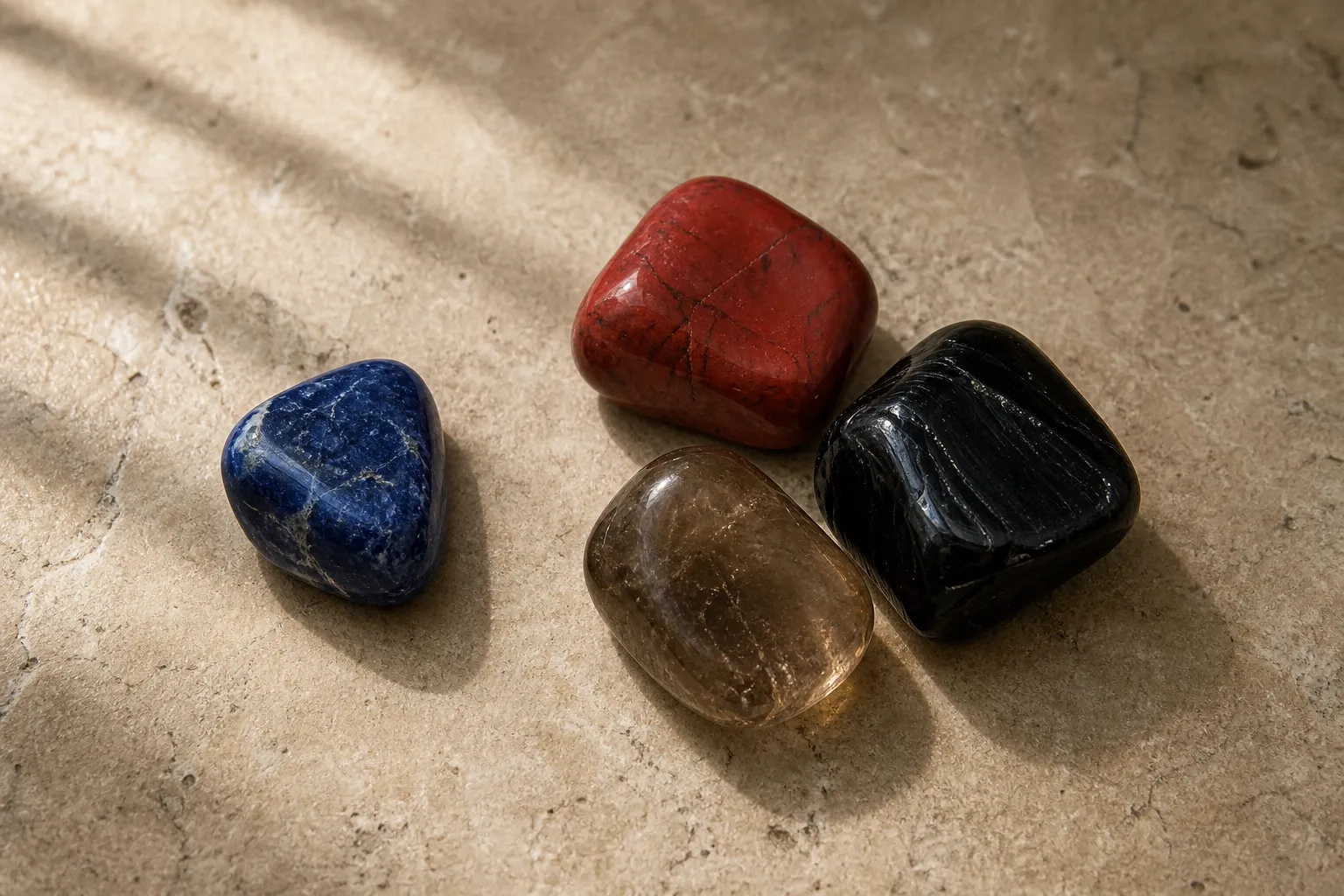
In many modern chakra charts, the root chakra is associated with red. Crystal shops and practitioners often widen that root palette to include black and brown stones because those colors are commonly read as earthy, dense, or foundation-like in symbolic practice.
Blue stones usually appear elsewhere. Lapis lazuli, aquamarine, blue lace agate, and many blue-green stones are commonly described in throat-chakra language instead.
That does not make a blue crystal “wrong” for a root-chakra-themed ritual. It means the choice is an exception to the common color convention.
Question
Common modern convention
Flexible personal use
What colors are usually linked with the root chakra?
Red, often black or brown
Any color may be used symbolically if the person gives it that role
Are blue stones usually listed for the root chakra?
Not usually
Sometimes, as a personal exception or pairing
Is lapis lazuli usually described as a root stone?
More often linked with throat-chakra themes
It may still be used personally if its look or meaning fits
Are chakra color charts fixed rules?
They are common modern systems
They are not universal laws
So the practical answer is not “blue equals root.” It is closer to: blue is not the standard root-chakra color, but a blue stone can be used in root-chakra-themed practice when the choice is symbolic rather than chart-based.
Why root chakra stones are not always red
This question comes up because root chakra color language is already more flexible than many beginners expect. Red is the most visible root color in many charts, but black stones and brown stones are also common in root-chakra retail categories.
That is why a person may see red jasper, black tourmaline, smoky quartz, and other dark or earthy stones described in root-chakra language even though they are not the same color. This does not verify any effect from the stones. It simply shows that modern crystal categories often mix color, texture, tradition, and symbolism.
A blue stone is a bigger step away from the usual root palette, but it can still make sense in a few situations:
- a dark navy stone may feel visually heavier than a pale sky-blue stone;
- a blue-black stone may sit closer to a root-chakra mood than a bright turquoise piece;
- a blue stone with gold, gray, white, or earthy matrix may feel less airy than a clear light-blue crystal;
- a stone with personal history may matter more to the user than its retail category.
These are aesthetic and symbolic reasons, not technical rules.
When a blue stone makes sense for root-chakra practice
A blue stone works best as a root chakra color exception when the reason for choosing it is clear. Without that reason, a red, black, or brown stone will usually be simpler.
You are choosing by personal meaning
Some people use stones as memory objects. A blue stone inherited from a family member, found in a meaningful place, or bought during an important life change may carry a personal association with home, steadiness, or belonging.
In that case, the stone’s role comes from the user’s relationship with it. The chakra label is secondary.
The stone looks dark, dense, or earthy
Not every blue stone has the same visual character. Lapis lazuli, for example, is known for strong blue coloring and may show golden pyrite flecks or pale calcite areas. Mineral references can support that kind of appearance description: deep blue, sometimes with visible variation, inclusions, or mixed tones.
They do not support chakra-effect claims. But they can help you describe what you are actually seeing.
A dark blue stone may feel more suitable for a root-themed altar than a pale, watery blue stone if your practice is built around visual mood.
You are blending root and throat symbolism
A blue stone may also be chosen when the ritual is about linking two symbolic themes. In modern chakra language, blue is often associated with the throat chakra, while root-chakra colors tend to be red, black, brown, and earth-toned.
Someone might place a blue stone beside a red or black stone to represent a bridge between expression and foundation. That is a reflective arrangement, not a claim that the stones perform a measurable action.
You prefer a personal system over a strict chart
Some people like chakra color charts because they make stone selection easy. Others treat them as starting points. If you are in the second group, a blue crystal as a root stone can be reasonable as long as you can say plainly: “This is my symbolic choice, not the standard assignment.”
That clarity helps when you compare books, shops, online guides, or teacher-led practices.
When a traditional root-color stone is the better choice
A blue stone is probably not the cleanest option if your goal is to follow common root chakra color convention closely. In that case, red, black, or brown stones will be easier to understand and easier to match with most modern root-chakra descriptions.
Choose a more traditional root-color stone when:
- you are new and want a simple starting point;
- you are following a guide or class that specifies root chakra stone colors;
- you want a stone set to match common chakra color charts;
- you are buying a gift for someone who expects standard root-chakra colors;
- you do not have a personal reason for choosing blue.
This is where the blue vs red chakra stones question becomes practical. Red stones match the visual convention immediately. Black and brown stones also fit many root-chakra categories. A blue stone asks for an explanation: personal meaning, dark appearance, a pairing idea, or deliberate contrast.
If you do not want to explain the exception, choose the conventional color.
Blue stones that often create this question
The question usually comes up because blue stones are attractive, familiar, and widely sold, but they are not usually placed in root-chakra categories.
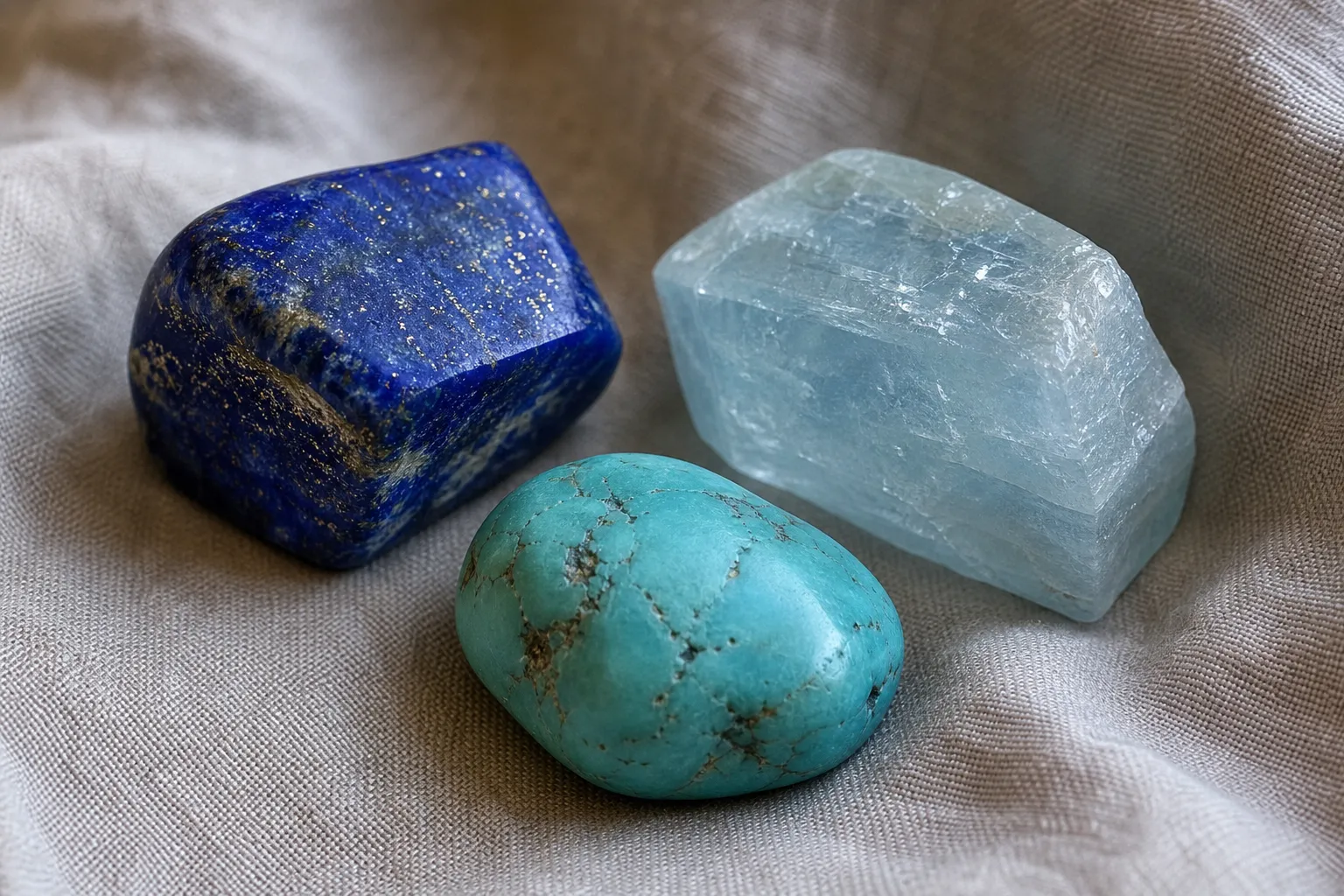
Lapis lazuli is a common example. It is visibly blue and is often described in modern crystal language as a throat-chakra stone. Mineral literature describes lapis lazuli as a rock made of several minerals, with lazurite contributing much of the blue color and pyrite or calcite sometimes present. That supports the appearance description, not the spiritual label.
Aquamarine and blue-green beryl can also create confusion. Their blue to blue-green range is an observable gem feature, and mineral studies discuss how trace elements can influence those tones. In chakra-shop language, though, these stones are usually placed closer to throat or heart-throat themes than root themes.
Turquoise and other blue-green stones may feel earthier to some people because of opacity, matrix, or cultural associations. Still, in common modern chakra color language, they are not the most straightforward root-chakra choice.
So if the question is “What stone is normally used for the root chakra?” the answer usually points toward red, black, or brown stones. If the question is “Can my blue stone be part of my root-chakra practice?” the answer can be yes, with personal-exception framing.
A quick way to decide
Before assigning a blue stone to root-chakra practice, ask:
- Do I care about standard color matching? If yes, choose red, black, or brown. If no, a blue stone may still work as a personal symbol.
- Does the stone look deep or earthy? Dark blue, blue-black, or blue with visible mineral flecks may feel closer to root themes than a very pale blue stone.
- Do I have a personal reason for choosing it? A memory, place, person, or repeated association can make the stone meaningful in your own practice.
- Would pairing make the meaning clearer? You can place a blue stone beside a conventional root stone such as red jasper, black tourmaline, or smoky quartz if you want both the exception and the familiar root-color cue.
- Am I creating a symbol rather than making a result claim? Keep the choice in the realm of reflection, display, journaling, meditation focus, or personal ritual.
FAQ
Is a blue stone a normal root chakra stone?
Not usually. In many modern chakra color charts, blue is more often linked with the throat chakra. Root chakra stones are commonly described as red, black, or brown.
Can lapis lazuli be used for the root chakra?
It can be used personally, especially if its dark blue appearance or personal meaning fits your practice. Conventionally, lapis lazuli is more often labeled for throat-chakra themes.
Are non-red root chakra stones common?
Yes. Black and brown stones are often included in root-chakra retail and practitioner language. A blue stone is a larger exception than black or brown, so it usually needs a clearer personal reason.
Should beginners choose blue or red for root chakra practice?
For a beginner who wants the simplest match, red, black, or brown is usually easier. A blue stone is better when you are comfortable using it as a personal symbolic exception.
Bottom line
A blue stone can be used for the root chakra if you are treating it as a personal symbolic exception. It is not the usual color match. In modern chakra-crystal language, root chakra stone colors are most often red, black, and brown, while blue stones are more commonly linked with the throat chakra.
For a beginner, the cleanest choice is a traditional root-color stone. For someone with a strong personal reason, a dark or meaningful blue stone can still have a place in a root-chakra-themed practice, especially when paired with a more conventional root stone and described honestly as personal symbolism rather than a fixed rule.