Are Root Chakra Imbalance Claims the Same as Stone Meanings
No. Root chakra imbalance claims and stone meanings often appear together in crystal-shop wording, but they are not the same kind of statement.
A stone meaning is a symbolic association attached to a stone: what a crystal community, shop, or practitioner says the stone represents in personal practice. A root chakra imbalance claim is language about a person’s interpreted state, such as being “blocked,” “unstable,” “underactive,” or “needing balance.”
That difference matters. One is about a stone’s assigned symbolism. The other can start to sound like an assessment of the reader. This page treats both as belief-based chakra language, not as clinical, scientific, or guaranteed-result language.
upward
Read the full overview first
Use the broader guide first if you need the full scope before this page.
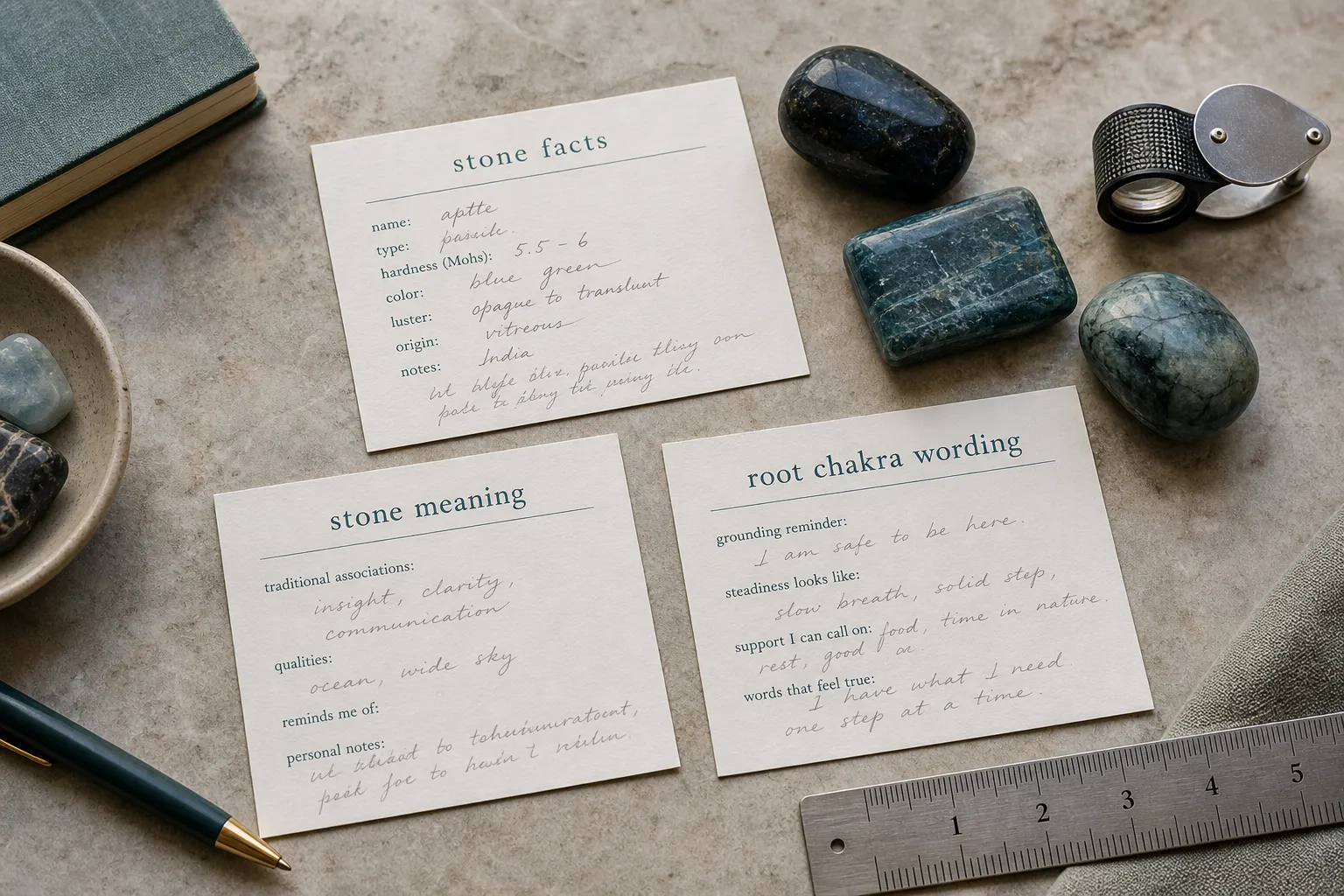
The clean distinction: stone fact, stone meaning, imbalance wording
A useful way to read chakra and crystal overlap is to separate three layers.
Observable stone facts
The stone’s visible or material qualities.
Read as checkable description.
Symbolic stone associations
What a stone is said to represent.
Read as belief-based or cultural meaning.
Root chakra imbalance claims
A person’s interpreted chakra state.
Read as higher-caution spiritual wording.
Observable stone facts are the easiest to check. These include color, mineral identity, surface appearance, transparency, inclusions, cut, polish, size, and ordinary handling notes. Gemological sources such as GIA describe stones through visible and material qualities: what a stone looks like, what affects its market presentation, and how it may be identified or compared. That kind of description is different from a chakra meaning.
Stone meanings are symbolic associations. In crystal retail language, a stone may be described as connected with steadiness, security, protection, calm, communication, or another theme. These meanings may be traditional, modern, retail-driven, practitioner-based, or personal. They can be meaningful inside a ritual or reflection practice, but they are not the same as measured stone properties.
Chakra imbalance language is about a person, not the stone. When a page says a root chakra is “blocked,” “out of balance,” “overactive,” or “underactive,” it is making an interpretive statement within a chakra belief system. Cultural references can support that chakras are discussed in religious and spiritual traditions, but that does not make every modern crystal-shop phrase a factual assessment of a person.
The confusion starts when all three layers are blended into one sentence.
Why crystal retail language often blurs the two
Many readers first meet root chakra wording on shop pages or practitioner blogs. A description may move quickly from a stone’s color to its chakra association, then to phrases about balance, energy flow, blockage, alignment, grounding, or protection. That style is common in modern crystal communities, but common wording is not the same as strong support.
For example, a shop might describe a dark or red stone as a “root chakra stone” and then say it represents stability or protection. The first part is a symbolic pairing used in chakra-stone lists. The second part is a meaning. If the same wording then says the stone changes a person’s emotional state, removes a blockage, or guarantees a wellness-related outcome, the statement has moved into a much stronger category.
The practical difference
- “This stone is associated with the root chakra” is a symbolic association.
- “This stone represents stability in root chakra practice” is a meaning statement.
- “Your root chakra is blocked” is an interpretation about the person.
- “This stone will change that blockage” is an outcome statement and should be read with extra caution.
The same word can be harmless in one context and overreaching in another. “Grounding,” for instance, may be used as a personal metaphor: someone chooses a stone because it reminds them to slow down, sit still, or mark a quiet moment. That is different from presenting the stone as producing a reliable change in the body or mind.
When the wording stays symbolic
A statement is usually easier to read as symbolic when it uses phrases such as:
- “In chakra traditions…”
- “Many crystal practitioners associate…”
- “Some shops describe…”
- “Symbolically linked with…”
- “Used in personal ritual as a reminder of…”
This kind of phrasing leaves room for belief, interpretation, and personal meaning. It does not tell the reader what is happening inside them. It also does not ask the reader to accept a stone meaning as a measurable effect.
A symbolic description might say that a stone is “associated with steadiness” in root chakra practice. That is a meaning. A person may enjoy the association, use it in journaling, or place the stone on a desk as a reminder. The page still should not imply that the stone has verified effects on health, mood, safety, or life outcomes.
When the wording asks for more caution
Root chakra imbalance claims deserve more caution when they sound like they are assessing the reader or promising a result. Watch for blocked root chakra wording that moves from symbolism into certainty:
- “You have a blocked root chakra if…”
- “This stone removes the blockage.”
- “This crystal restores your energy flow.”
- “Use this stone to address fear, fatigue, sleep, immunity, or similar outcomes.”
- “This stone protects you from harm.”
Those examples are not just stone meanings. They make statements about a person’s condition, a predicted outcome, or a wellness-related effect. Public consumer guidance from agencies such as the FTC is relevant because health and wellness marketing needs appropriate support. For this page, the practical takeaway is simple: read unsupported wellness claims as marketing or belief language unless stronger evidence is provided.
Gem facts do not prove chakra meanings
Another common mix-up is treating gemological facts as proof of chakra meaning.
A stone may genuinely be blue, green, red, translucent, opaque, banded, included, dyed, polished, or naturally patterned. Those are observable details. They can affect appearance, selection, price, and care.
But a visible feature does not, by itself, establish a chakra effect. Lapis lazuli can be described by its deep blue appearance and mineral features. Aquamarine can be described by its blue to greenish-blue color. Those descriptions help a reader recognize or compare stones; they do not verify a root chakra interpretation.
This keeps the stone real while keeping the meaning in the right category.
Common misunderstandings about root chakra belief boundaries
The most frequent misunderstanding is that “root chakra imbalance” sounds more precise than it is. In many crystal and chakra communities, imbalance language functions as a spiritual or symbolic vocabulary. It may help a practitioner organize a conversation, a ritual, or a personal reflection. On this site, it is not treated as a factual assessment of the reader.
A second misunderstanding is that if a stone meaning is widely repeated, it must be settled. Repetition can show that a phrase is common in retail or practitioner circles. It does not show that the claim has been demonstrated. A meaning can be popular, useful to some people in personal practice, and still remain interpretive.
A third misunderstanding is that all chakra language carries the same weight. It does not. Compare these two sentences:
“This stone is often linked with root chakra themes of steadiness and security.”
“If you feel unsettled, your root chakra is blocked and this stone will correct it.”
The first sentence is a symbolic association. The second combines a personal assessment with an outcome promise. That is a much stronger statement and should not be treated as a simple stone meaning.
A fourth misunderstanding comes from color charts. Modern chakra-stone lists often connect red and black stones with the root chakra, orange stones with the sacral chakra, yellow stones with the solar plexus, and so on. These charts can be useful as symbolic systems, but color correspondence is not evidence that a stone changes a person’s state.
A practical way to read crystal claims cautiously
When root chakra imbalance claims and stone meanings are mixed together, slow the sentence down. Ask what kind of statement you are reading.
-
1. Is it describing the stone?
If the wording is about color, texture, polish, inclusions, mineral identity, or visible appearance, it is probably an observable stone fact. You can compare it with photos, gemological descriptions, or the stone in your hand.
-
2. Is it assigning a meaning to the stone?
If the wording says the stone is associated with grounding, stability, security, or root chakra themes, it is probably a symbolic stone association. You can accept it as belief-based language, reject it, or use it as a personal reminder without treating it as a factual effect.
-
3. Is it describing the reader?
If the wording says your chakra is blocked, imbalanced, underactive, overactive, or in need of correction, it has moved into personal interpretation. That is not the same as a stone meaning.
-
4. Is it promising a change?
If the wording says the stone will produce a physical, emotional, protective, or wellness-related result, it is no longer just chakra symbolism. This is where crystal meaning limitations matter most.
A more careful version of a high-claim sentence might be: “Some practitioners use this stone as a symbolic focus for root chakra reflection.” That wording keeps the belief context without turning the stone into a guaranteed tool.
Where this leaves beginners
For beginners, the useful answer is not to reject every chakra phrase or accept every shop description. It is to sort the language.
A stone can have real visible qualities. A community can assign symbolic meanings to that stone. A practitioner may use imbalance language within a belief-based chakra framework. Those three things can appear on the same product page, but they do not carry the same weight.
Keep the categories clear
- The stone’s appearance is observable.
- The stone’s meaning is interpretive.
- The imbalance wording is a belief-based reading of a person’s state.
- Strong wellness or outcome language needs more caution than symbolic language.
That is the core difference between root chakra imbalance claims and stone meanings: one points to a stone’s assigned symbolism, while the other makes a statement about the person using or considering the stone. Keeping that distinction clear makes crystal language easier to read without turning personal meaning into unsupported certainty.