
How to Read Crystal Shop Root Chakra Claims Carefully
Read root chakra crystal shop claims by separating the listing into four parts: what you can see, what the seller says about the product, what chakra traditions symbolically associate with the stone, and what the page presents as an outcome. Color, size, finish, material name, photo consistency, and enhancement notes are product details. Words such as Muladhara, grounding, stability, security, earth, and foundation are root chakra association language when they are framed as tradition or personal meaning. Holding, wearing, or placing a stone can be a personal ritual choice. Promises about health changes, condition-like explanations, protection from harm, or assured energetic results should not be treated as product facts.
upward
Start with the broader guide
Use the broader guide first if you need the full scope before this page.
Start with what the listing lets you check
A careful reading begins with the ordinary product information, not the most dramatic spiritual paragraph. On a crystal shop page, the clearest factual ground usually sits in the root chakra stone descriptions: the stone name, color, shape, dimensions, finish, weight, photos, and any note about whether the piece is natural, dyed, heat-altered, polished, carved, tumbled, or set in jewelry.
Useful observable stone details include:
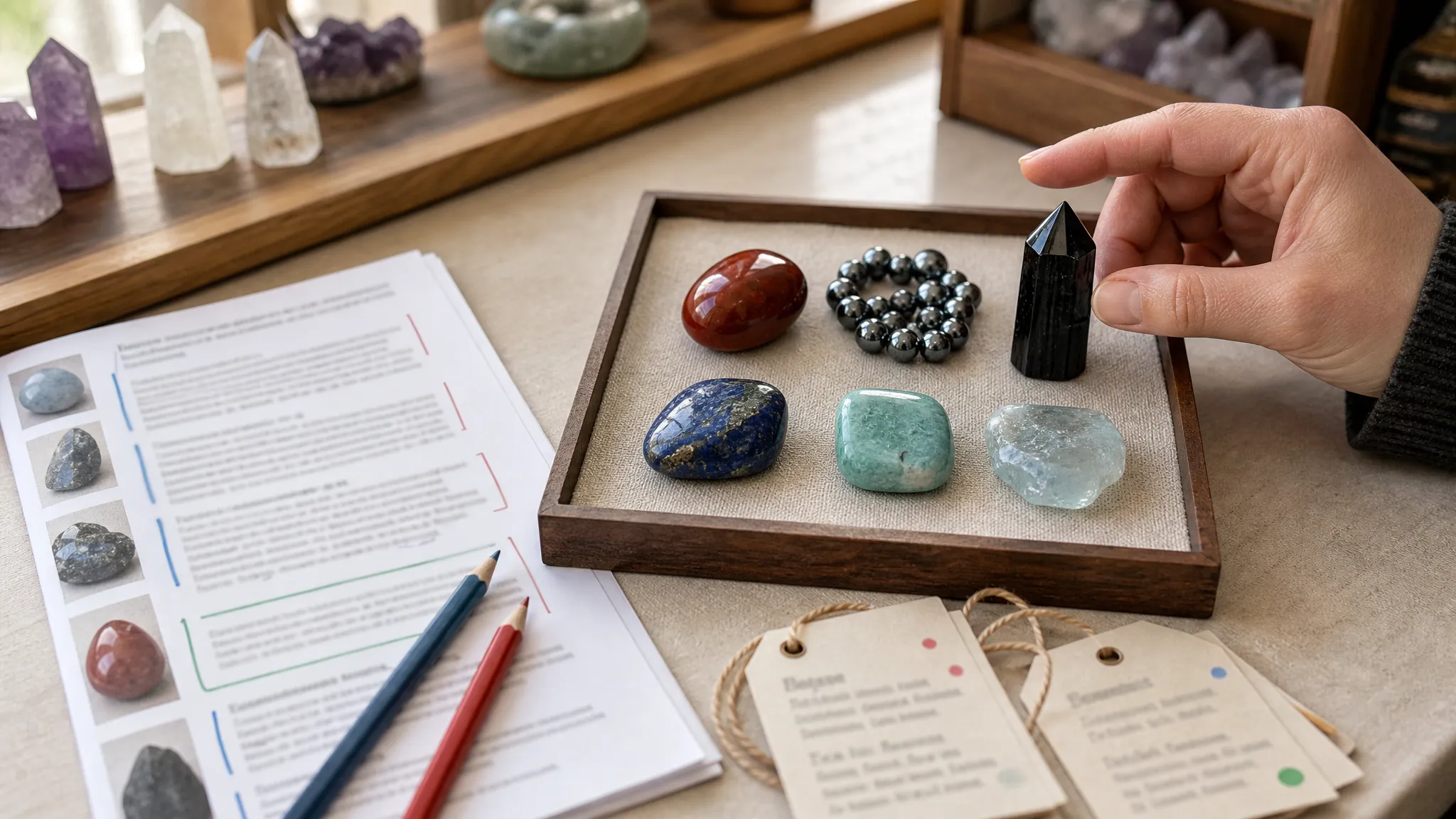
- a red jasper palm stone shown from several angles;
- a hematite bracelet with bead size listed;
- a black tourmaline point with chips, surface texture, and dimensions visible;
- an amazonite or aquamarine piece described by color range, translucency, polish, and setting;
- a lapis lazuli item with visible blue body color and possible gold-toned pyrite flecks.
Those details do not confirm a chakra effect. They simply give you something concrete to evaluate. Gemological references are helpful here because they keep the focus on identity, appearance, disclosure, and material description rather than metaphysical meaning. A listing with clear photos, consistent naming, size information, and enhancement notes is easier to judge than one that relies mostly on energetic language.
Photo consistency matters. If one image shows a deep red stone, another looks brown, and the description says “you will receive one similar piece,” the seller may be using a representative photo. That is not automatically a problem, but it changes what you can infer. You are not buying the exact color pattern shown unless the page says so clearly.
A useful first question is: If I removed every chakra sentence from this listing, would I still understand what stone I am buying? If the answer is no, slow down.
Separate retail wording from chakra tradition language
Crystal retail wording often blends product promotion with symbolic vocabulary. A shop may describe a stone as connected with the root chakra, Muladhara, earth, grounding, stability, security, survival, or foundation. These words are common on chakra-market pages, especially for red, black, and brown stones such as garnet, red jasper, black onyx, black tourmaline, tiger eye, and hematite.
Read that language as symbolic unless the seller gives a different kind of support. In chakra traditions, the root chakra is commonly described as the first chakra and associated with the base of the spine, the earth element, red color, and themes of foundation or steadiness. That is cultural and spiritual context. It is not the same as an anatomical statement, a health explanation, or a measurable product function.
This distinction also helps with blue-green stones. A shop may discuss lapis lazuli, aquamarine, or amazonite in relation to root chakra-themed personal practice even though they are not the classic red, black, or brown retail choices. In that setting, a careful page should explain the symbolic reasoning: perhaps the stone is being used as a calming visual companion, a contrast stone, a personal anchor, or part of a broader chakra layout. The language still needs to stay in the realm of interpretation.
Careful sentences sound like this:
- “Many crystal practitioners associate red jasper with root chakra themes such as steadiness and foundation.”
- “Some shops place black tourmaline in root chakra collections because black stones are often linked with earth and grounding symbolism.”
- “A practitioner may use lapis lazuli alongside root chakra stones as a personal contrast or reflection stone.”
A less careful sentence turns the association into an assured result. When a listing moves from “associated with” to “will change your condition,” it has left symbolic chakra associations and entered outcome language.
Notice when meaning turns into a promise
Shop copy can change tone quickly. A paragraph may begin with ordinary Muladhara shop wording, then slide into statements about blocked energy, emotional states, sleep, physical discomfort, or protection from negative forces. It may also suggest that certain feelings or body complaints reveal a root chakra problem.
That is where the line matters. A stone name can be accurate while the outcome attached to it remains unsupported. A seller may correctly identify a red jasper tumble and still overstate what it can do. Judge the product description and the spiritual sales language separately.
Advertising and consumer guidance are useful boundary tools here: confident wording is not proof. Health-adjacent product claims deserve scrutiny, especially when they sound evidence-like, promise a specific result, or encourage the reader to rely on a product for serious personal concerns. Complementary-practice guidance points in the same direction: personal or spiritual practices should not be turned into health guidance.
Slow down when you see language that:
- presents a crystal as producing a specific emotional or physical result;
- explains body complaints or distress through root chakra “clearing” language;
- uses guarantee-style balance language;
- implies that a stone can identify what is wrong;
- states protection as a factual safety outcome;
- attaches exact results to a placement, ritual, or wearing pattern;
- uses sleep, pain, digestion, reproductive concerns, panic, trauma, or similar concerns as sales hooks.
You do not have to reject every spiritual phrase to read carefully. “This stone is used by some people as a grounding symbol” is different from “this stone will produce a grounding result.” The first is belief-based context. The second asks for support the listing usually does not provide.
A simple way to mark up a shop page
When reading crystal shop claims, sort each sentence into one of these labels.
Product detail
How to read it: Potentially factual if clear and consistent.
What to ask: Can I see it in the photos? Are size, material, finish, and price logic clear?
Retail description
How to read it: Seller language.
What to ask: Is this a shopping prompt, a style description, or a sales phrase?
Chakra association
How to read it: Symbolic or tradition-based.
What to ask: Does the page say “associated with,” “used in,” or “in chakra traditions”?
Outcome promise
How to read it: Needs caution.
What to ask: Is the seller implying a result, a health change, a diagnostic meaning, or assured protection?
This works better than trying to decide whether a whole shop page is “good” or “bad.” Many listings are mixed. A page may have useful photos and a reasonable size description, then overreach in the spiritual copy. Another page may use gentle chakra language but give almost no product information. Keep the categories separate.
Useful translations
Shop-style wording: “This root chakra crystal brings stability and clears blocked energy.”
Careful reading: “The seller associates this stone with stability and root chakra symbolism; the stated energetic result is not an observable product feature.”
Shop-style wording: “Place this stone at the base of the spine to restore balance.”
Careful reading: “The page is describing a root chakra crystal placement used in personal practice; the outcome should be read as belief-based, not assured.”
Shop-style wording: “Choose the crystal that jumps out at you because it knows what you need.”
Careful reading: “This is intuitive shopping language. It may be meaningful to some buyers, but it does not verify stone identity, quality, or effect.”
This approach lets you enjoy symbolic language without letting it replace basic shopping judgment.
Check disclosure before trusting the tone
A calm, polished listing can still leave out important product details. Before giving weight to any root chakra association language, look for the practical disclosures that help you understand the item.
For a loose stone, check:
- exact stone name or trade name;
- whether the photo shows the exact item or an example;
- approximate size and weight;
- finish, such as raw, polished, tumbled, carved, bead, cabochon, or point;
- visible inclusions, chips, cracks, or natural variation;
- enhancement or dye information where relevant;
- return policy and shipping clarity.
For jewelry, also check:
- metal type or plating description;
- bead size and stringing material;
- clasp or cord information;
- whether the stone is natural, composite, dyed, imitation, or otherwise altered;
- care notes for water, sunlight, friction, and storage.

This is where crystal treatment disclosure matters. Some gem materials are commonly enhanced for color or appearance, and some retail names are more poetic than mineral-specific. A seller does not need to turn every listing into a laboratory report, but vague product identity plus strong outcome language is a poor combination for a careful buyer.
The same applies to price. A very low price does not automatically mean a piece is false, and a high price does not make the spiritual copy stronger. Price should make sense in relation to material, size, craftsmanship, setting, rarity, and disclosure—not in relation to promised chakra results.
Why root chakra language can sound more certain than it is
Root chakra pages often borrow the rhythm of structured teaching: Sanskrit terms, diagrams, color systems, symbols, stone lists, placement instructions, and affirmations. That structure can make a page feel more authoritative than a plain product listing. But structure is not the same as support.
Muladhara, the first chakra, red color, earth symbolism, square imagery, four petals, and foundation language may all appear in chakra materials. These details help explain why a shop groups certain stones under root chakra crystals and stones. They do not establish that the stone can verify, correct, or change a person’s condition.
The same caution applies to root chakra crystal placement. A page may suggest holding a stone, wearing it near the body, placing it near the feet, setting it by a meditation cushion, or using it during a quiet personal ritual. Those are personal-practice suggestions. They become a problem when the listing treats the placement as a dependable mechanism for a promised outcome.
A careful reader can translate the language like this:
- “Grounding” becomes “a symbolic theme in this shop’s description.”
- “Stability” becomes “a meaning commonly attached to root chakra practice.”
- “Security” becomes “a personal or spiritual association, not a verified product function.”
- “Cleansing” becomes “ritual language unless the seller is describing ordinary physical cleaning.”
- “Protection” becomes “a belief-based claim unless it is about a physical feature, such as a pouch protecting the stone from scratches.”
That last distinction is useful. “This pouch protects the bracelet from abrasion” is a practical product statement. “This stone protects your life from unseen forces” is a spiritual outcome claim. They should not be read the same way.
A short checklist before you buy or bookmark
Use this checklist when reading a root chakra crystal listing:
- Can I identify the stone?
The listing should give a name, photos, and enough description to understand what is being sold. - Can I separate appearance from meaning?
Color, shape, finish, and size are product details. Grounding, stability, and security are symbolic chakra associations unless the page gives stronger support. - Does the page disclose the actual item?
Look for exact-item photos, representative-photo notes, size ranges, and visible variation. - Does the seller explain enhancements or materials?
Dyeing, polishing, carving, bead treatment, composites, imitation materials, or trade names should not be hidden behind spiritual language. - Does the page promise an outcome?
If the wording implies health changes, diagnosis-like explanations, assured energy results, or guaranteed balance language, do not treat it as a stone fact. - Would the listing still be useful without the chakra copy?
If yes, you have product information to work with. If no, the page may be leaning too heavily on atmosphere.
Bottom line
The careful way to read root chakra crystal shop claims is not to argue with every symbolic phrase. It is to keep the categories clean. Observable stone details help you decide what you are buying. Crystal retail wording tells you how the seller wants the item to feel in the marketplace. Symbolic chakra associations explain how practitioners or shops frame the stone in personal practice. Outcome promises, especially health-adjacent or guarantee-style claims, should not be treated as verified product information.
If a listing gives clear stone details and uses modest belief-based language, it is easier to read responsibly. If it hides product basics behind confident claims about what the stone will do for you, pause before buying. A crystal can be meaningful in a personal ritual without the shop page needing to promise more than it can support.