
How to Read Color Names on Red and Black Root Chakra Stones
Read the label in layers. Root chakra stone color names usually mix four things: what you can see, what the material is called, whether the color may have been modified or presented in a certain way, and the symbolic language used in chakra practice.
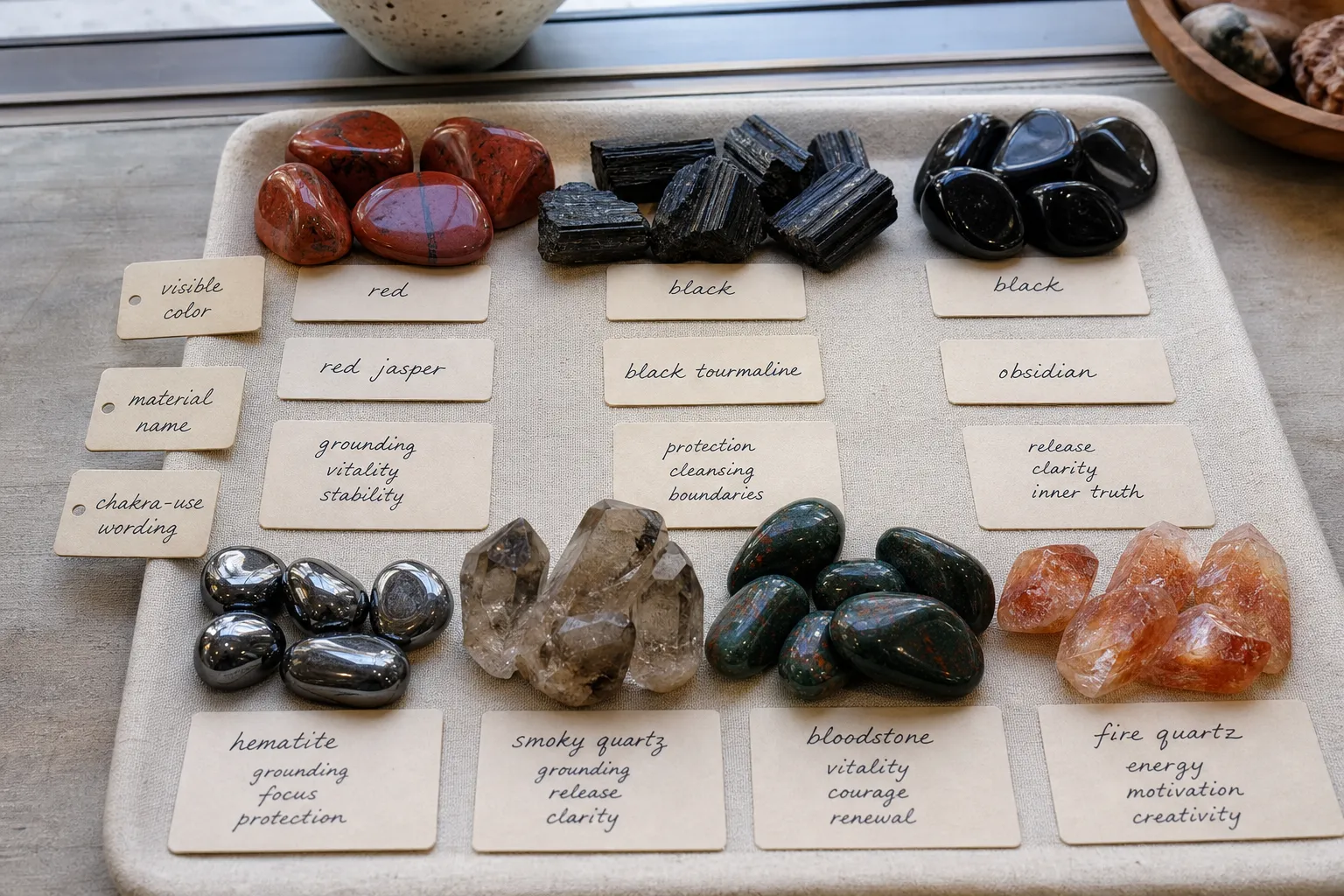
Start with the stone itself: red body color, black body color, smoky brown-black tone, metallic grey-black sheen, red spots, red inclusions, banding, opacity, glassy surface, or polish. Then ask whether the label is naming a mineral or material, a retail trade style, a treatment clue, or a Muladhara/root chakra use phrase. The color name is helpful, but it is not enough on its own to identify the stone or explain its meaning.
upward
Read the full overview first
Use the broader guide first if you need the full scope before this page.
Start with the color you can actually see
Before reading the spiritual or shop wording, look at the piece like a normal object in your hand.
Ask:
- Is the main color red, brick red, brownish red, black, grey-black, or smoky brown?
- Is the red spread through the whole stone, or only in spots, veins, patches, or inclusions?
- Is the dark color matte, glassy, metallic, or slightly translucent at the edges?
- Are there bands, mottling, white veins, green areas, or a polish that changes the color?
- Does the photo look heavily lit, saturated, or edited?
This matters because labels such as “red jasper,” “black tourmaline,” “obsidian,” “hematite,” “smoky quartz,” “bloodstone,” and “fire quartz” do not use color in the same way.
Red jasper
A red jasper color name usually points to a red or reddish body color in an opaque stone. Jasper can occur in red, brown, yellow, green, and mottled forms, with red tones often associated with iron-bearing material. For a shopper, the useful takeaway is simple: “red jasper” is mainly a body-color phrase, though individual pieces may still show veins, specks, or uneven tones.
Black tourmaline
A black tourmaline color label works differently. In mineral references, black tourmaline is often discussed through the tourmaline-group mineral schorl, while crystal shops usually use the more familiar retail name. For a beginner, the immediate cue is the dark body color and crystal habit, not the full mineral classification.
Obsidian
An obsidian color description often points to a dark, glassy volcanic material. Polished black obsidian can look smooth and reflective; rough obsidian may look less mirror-like. Here, “black” usually describes overall appearance, not just chakra symbolism.
Hematite
A hematite grey black sheen can be confusing because polished hematite often looks metallic, steel-grey, or silvery black rather than flat black. A shop may place it with dark root chakra stones because of its dark metallic look.
Smoky quartz
A smoky quartz brown black color may range from pale brownish grey to very dark brown or nearly black. “Smoky” does not mean the same thing as solid black. A dark smoky quartz piece may still show a brown or grey cast when held to light.
Separate body color, inclusions, spots, and sheen
Many confusing crystal shop color descriptions come from mixing different visual features into one name. The cleanest split is body color versus inclusions.
Body color
Body color is the dominant color of the stone mass. A red jasper bead, black tourmaline point, or dark obsidian palm stone is usually being described by its main visible color.
Inclusions
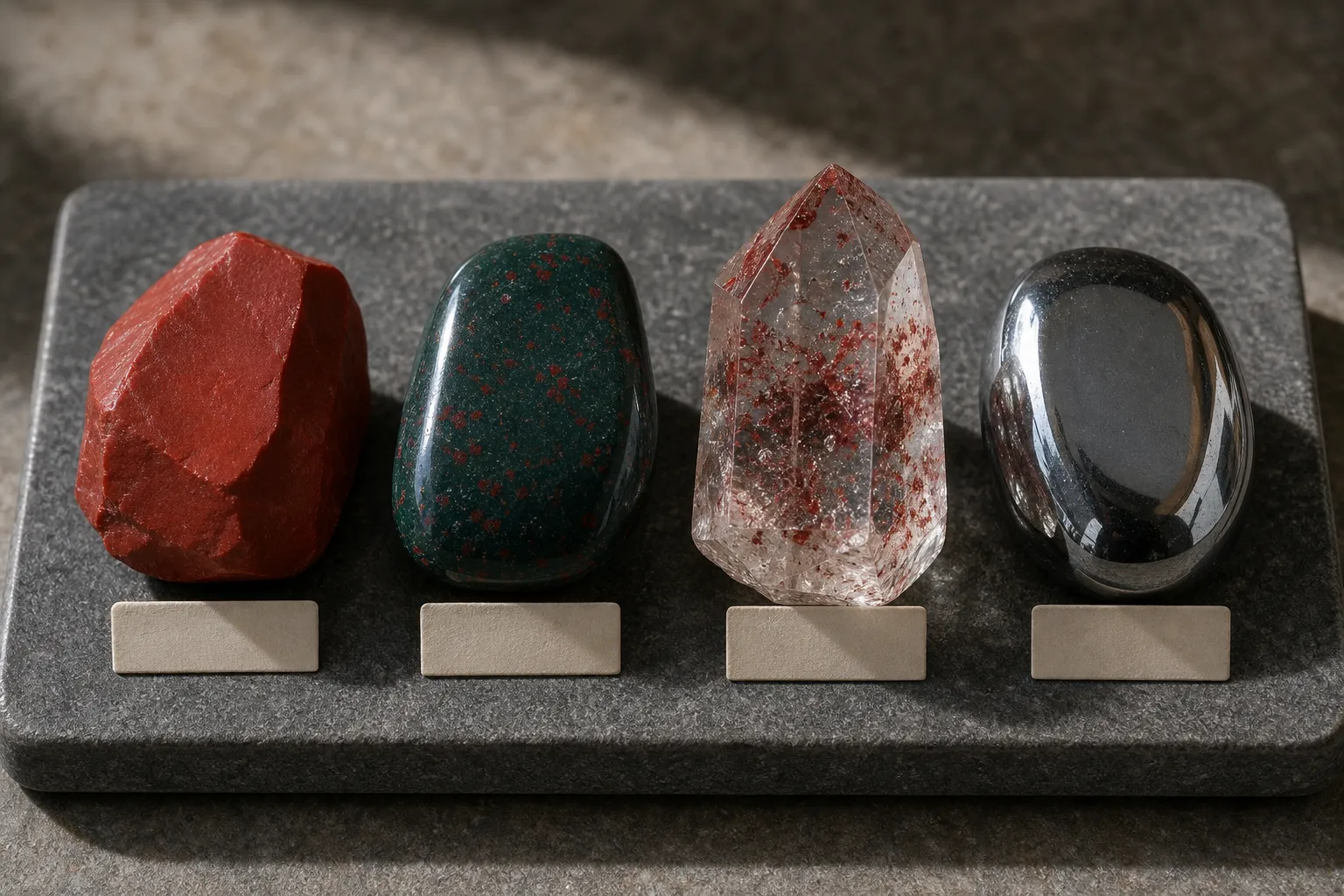
Inclusions are internal features that change the look without making the whole stone that color. Fire quartz, often sold as hematoid quartz, is commonly chosen for reddish internal streaks, clouds, patches, or iron-related color effects. The better question is not “Is this a red stone?” but “Is the red the body color, or is it inside the quartz?”
Spots
Spots are another layer. Bloodstone, also called heliotrope, is a good example. The word “blood” may make a beginner expect a red stone, but bloodstone is commonly described as dark green with red spots. The red is often a feature, not the main body color.
Sheen
Sheen is surface behavior. Hematite may look dark because of its metallic grey-black polish. In that case, the label may be pointing to shine and visual weight as much as hue.
Banding and mottling add one more wrinkle. Jasper and agate-related materials can show bands, patches, veins, or mixed tones. A plain visual description often helps more than the chakra phrase on the tag: “opaque brick red with black specks,” “dark green with red spots,” “clear to cloudy quartz with red inclusions,” or “metallic grey-black polish.”
Know what kind of wording the label is using
A label on red and black root chakra stones may contain several kinds of wording at once. They can sit side by side on a price tag, but they are doing different jobs.
Material or mineral wording
Material or mineral wording names what the stone is being sold as. Examples include jasper, tourmaline, quartz, obsidian, hematite, and bloodstone. Treat these as identity clues. If identity matters to you, especially for a higher-priced piece, compare the label with a gemological or mineral reference and the seller’s disclosure.
Alternative or variety names
Alternative or variety names may point to the same general retail category from another angle. Black tourmaline may be called schorl in more mineral-focused contexts. Bloodstone may appear as heliotrope. Fire quartz may be sold as hematoid quartz. These names are not automatically wrong, but they can blur whether the label is emphasizing mineral identity, visual effect, or familiar shop language.
Trade-style wording
Trade-style wording is looser. Words such as “fire,” “storm,” “midnight,” “earth,” or “root chakra blend” may be chosen because they sound memorable or symbolic. They may not tell you much about mineral identity.
Chakra-use wording
Chakra-use wording belongs to a symbolic or personal-practice layer. In many modern chakra traditions, the root chakra, or Muladhara, is linked with red, earth imagery, foundation, and grounding crystal colors. Black and dark stones also appear in root chakra displays because many crystal practitioners associate dark colors with anchoring, protection language, and earth connection.
That explains why black stones may appear beside red stones in the same section. It does not make the color wording a measurable effect statement. On this page, words such as “grounding,” “protective,” or “root chakra” are best read as symbolic, retail, or personal-use language.
Watch for dyed, coated, enhanced, and presentation clues
Color names become trickier when the appearance has been altered or strongly shaped by presentation. Treatment and enhancement wording is separate from simple color description. You do not need to become a gemologist to shop carefully; you only need to notice when the color name raises a reasonable question.
Look more closely when:
- the color is extremely uniform across many beads;
- the red or black looks unusually vivid compared with natural-looking examples;
- the surface color seems to collect around cracks, pits, or bead holes;
- the listing uses words such as dyed, coated, treated, enhanced, heated, irradiated, stabilized, or plated;
- the seller gives a dramatic trade name but no material name;
- the photos show only stylized lighting and no neutral close-up.
Dyed chakra stones are common enough in retail settings that a bright color should not be assumed natural without disclosure. Coated crystal color labels also deserve attention because a coating can create a surface effect that differs from the stone’s internal body color.
Some treatments are accepted in parts of the gem trade when properly described, while others may matter to buyers who prefer untreated stones. The practical question is: “Is this color natural to the material as sold, or is it the result of treatment, coating, lighting, or trade presentation?”
A color name alone cannot answer that. If the listing is vague, ask for plain wording: the material name, whether the color is natural or modified, and whether the red or black feature is body color, inclusion, coating, or surface effect.
A quick way to read common red and black labels
Use this as a shopper’s translation guide, not as a full identification chart.
Red jasper
Check for opaque red, brick red, brownish red, mottling, and veins. The wording usually points to red body color plus a jasper material name.
Black tourmaline
Check for dark black crystal form and rough or polished surface. The wording usually combines dark appearance with a familiar mineral or retail name.
Obsidian
Check for a black or dark glassy look, smooth polish, and reflective surface. The wording often describes a dark volcanic glass appearance.
Hematite
Check for steel-grey, metallic grey-black sheen, and heavy-looking polish. The wording often emphasizes sheen and dark metallic appearance.
Smoky quartz
Check for brown, grey-brown, smoky black tone, and some translucency. “Smoky” may mean brown-black tone rather than solid black.
Bloodstone / heliotrope
Check for a dark green body with red spots or patches. Red may be spots, not the whole stone body.
Fire quartz / hematoid quartz
Check for quartz with red, orange, or brownish inclusions or clouds. Red may be internal features rather than body color.
Root chakra stone
Check for red, black, dark, earthy, or mixed stones grouped together. The wording is usually a symbolic use category, not a mineral identity.
This clears up a common misunderstanding: red and black root chakra stones are not all red stones, and they are not all black stones. A root chakra display may group stones by symbolic color language, dark appearance, retail tradition, and personal-use themes. That is why a dark green bloodstone with red spots, a metallic hematite piece, and a brick-red jasper bead may sit in the same shop category.
Four questions before you rely on the label
When a label feels unclear, read it in this order:
- What color do I actually see? Name the visible color without the shop phrase: red, brick red, black, grey-black, smoky brown, dark green with red spots, or clear quartz with red inclusions.
- Where is the color located? Is it body color, banding, spots, internal inclusions, surface sheen, coating, or lighting?
- What is the material name? Look for jasper, tourmaline, obsidian, hematite, quartz, bloodstone, or another material term. If the label only gives a mood phrase, it is incomplete for identification.
- Is the chakra wording symbolic? Muladhara stone color language, “root chakra,” “grounding,” or “earth” usually describes a tradition, shop category, or personal ritual frame. Keep that separate from the stone’s visible features and disclosed material details.
That is the main habit: read red and black root chakra stone color names as layered descriptions. A color name can guide your eye. A material name can guide further checking. A treatment note can shape your buying expectations. A chakra phrase can guide personal symbolism. If those layers do not line up, ask for clearer wording before relying on the label.