
Stone comparison
Red Jasper, Garnet, and Red Agate as Root Chakra Stones
Red Jasper, Garnet, and Red Agate all show up in root chakra lists because they are red or reddish stones, but they are not interchangeable. Red Jasper is usually the earthiest and most opaque choice, Garnet is typically darker and more gem-like, and Red Agate is better understood as a red agate or chalcedony-style option used by some people for color symbolism.
For the search phrase red jasper garnet red agate root chakra, the stone descriptions can be grounded in visible material qualities. The chakra association belongs to modern crystal practice, retail language, and personal symbolism, not mineral science or professional health guidance.
If you are choosing between them, begin with what you can see: color depth, opacity, shine, banding, bead size, polish, and whether the piece suits a bracelet, pocket stone, altar layout, or quiet personal ritual.
upward
Start with the broader guide
Use the broader guide first if you need the full scope before this page.
Quick comparison: three red stones, three different looks
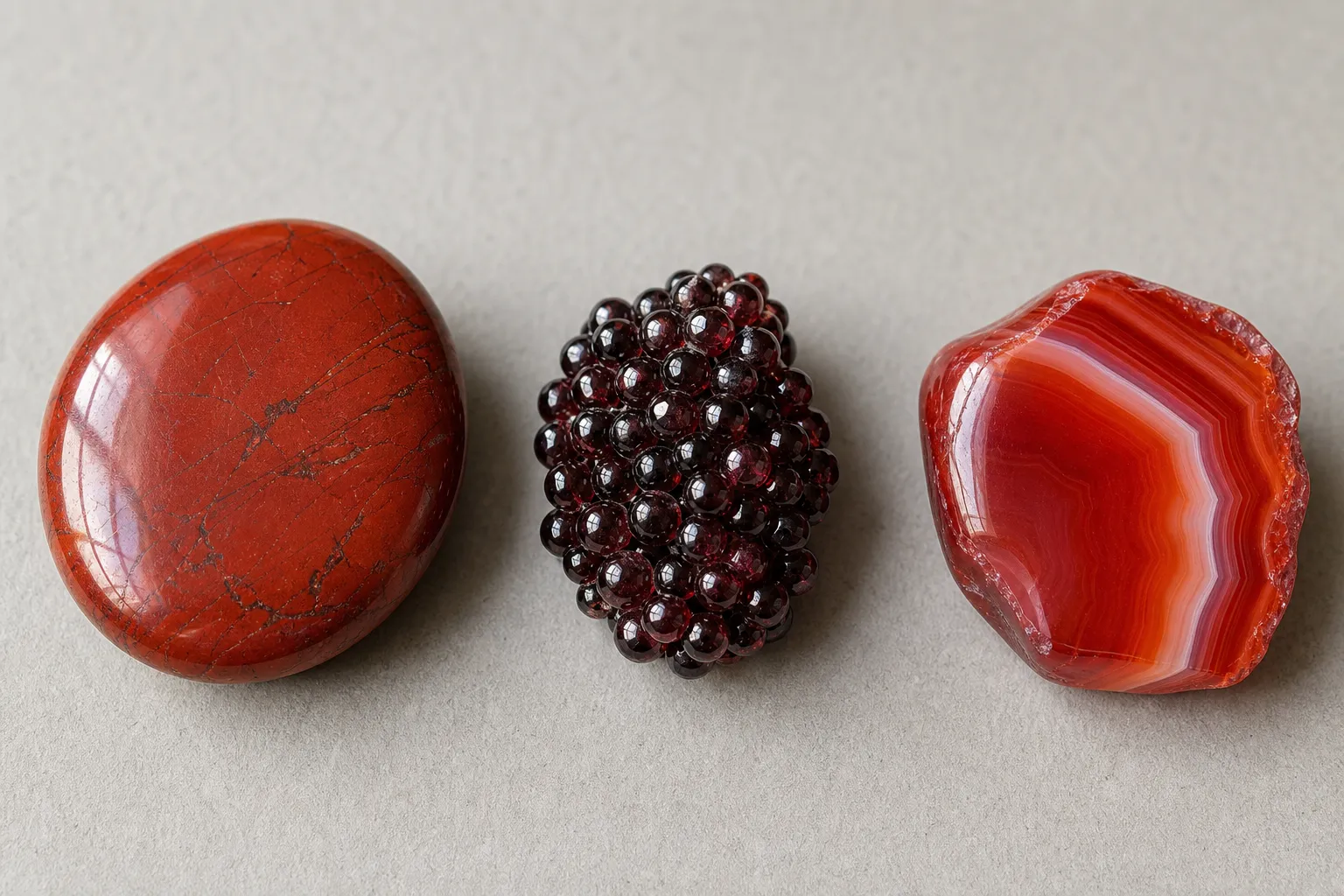
These stones are often grouped together because they sit in the same visual family: brick red, brown-red, burgundy, wine red, orange-red, or deep red. That shared color is why they appear in searches for red root chakra stones, red grounding crystals, and beginner root chakra crystals. In the hand, though, they create very different impressions.
The useful beginner question is not “which one is strongest?” It is: which stone matches the look and personal meaning you want?
Red Jasper gives a matte, dense, earthy impression. Garnet reads more like a gemstone: darker, shinier, and often more formal. Red Agate sits closer to pattern and variation, especially when it shows banding, translucency, or color zoning.
Red Jasper: opaque, earthy, and easy to recognize
Red Jasper is one of the clearest beginner examples in root chakra crystal lists because it fits the red-stone shorthand so well. Mineralogical descriptions place jasper among silica-rich gemstone materials, commonly opaque and often red, brown, yellow, or green. Red tones in jasper are often associated with iron-bearing inclusions, and many pieces show mottling, veining, spots, or uneven earthy color rather than a clear jewel-like appearance.
For someone comparing red stones for root chakra symbolism, Red Jasper is usually the least visually ambiguous of the three. It does not rely on sparkle or transparency. A bead, palm stone, or pocket piece usually reads as solid, warm, and earthy at a glance.
In modern chakra and crystal-shop language, Red Jasper is commonly presented as a root chakra stone. A careful way to understand that is: many practitioners use it as a symbolic object for themes they connect with the root chakra, such as steadiness, the base of a layout, the ground, or the color red.
Choose Red Jasper if you want:
- an opaque red stone rather than a glassy one;
- a casual bracelet bead, worry stone, or small display piece;
- a root chakra crystal example that is easy for beginners to identify;
- a stone that visually feels earthy instead of dressy or formal.
The main buying caution is naming and color treatment. Some red stones are sold under broad labels, and polished beads can be hard to identify from color alone. If the exact material matters to you, look for listings that give the stone name clearly and mention any treatments when relevant.
Garnet: darker, glassier, and more jewelry-like
Garnet brings a different visual mood to the same root chakra theme. Instead of the opaque brick-red look of Red Jasper, many red garnets appear dark red, wine-red, purplish red, or almost black-red in low light. Gemological research on red to violet-red pyrope-almandine garnets discusses color appearance in relation to mineral composition, including elements such as iron and manganese. For a shopper, the practical point is simpler: Garnet often looks deeper, glossier, and more gem-like than jasper.
That makes Garnet a natural choice for root chakra jewelry stones when someone wants a bracelet, pendant, or ring that feels less rustic. Garnet beads may look nearly black indoors and show red more clearly under stronger light. Faceted garnets can look lively in jewelry lighting but subdued in a dim room. That lighting shift is normal for many dark red gems, and it is one reason product photos may not match the piece in everyday settings.
In root chakra lists, Garnet is often grouped with red grounding crystals or dark red stones. Keep that wording symbolic. A practitioner may choose Garnet to represent depth, warmth, commitment, or a more intense red focus in a personal layout. That is different from saying the mineral produces a specific result.
Choose Garnet if you want:
- a darker red stone with a polished jewelry appearance;
- beads or a pendant that feel more formal than Red Jasper;
- a red stone that pairs well with black, brown, or gold-toned materials;
- a root chakra symbol that reads as deep red rather than earthy red.
Garnet is also where “red” can become visually tricky. Some pieces are so dark that they may not look red unless light passes through an edge, bead, or facet. If you want an obviously red bracelet at a glance, Red Jasper or a lighter Red Agate may show the color more clearly.
Red Agate: attractive, variable, and best framed with care
Red Agate needs the most careful wording of the three. Agate is widely described as a form of chalcedony, often recognized by banding, color variation, and silica-based structure. Research on agate and related chalcedony materials notes that red, yellow, orange, and brown colors are often associated with iron oxides or hydroxides such as hematite and goethite. Some red agates are vivid; others are brown-red, orange-red, or patterned.
For root chakra use, Red Agate is not as straightforward as Red Jasper. The available mineral references support Red Agate as an agate or chalcedony-related gemstone material and help explain how red coloration can occur. They do not establish Red Agate as a fixed or universal root chakra stone. Its inclusion is usually better understood through modern color symbolism: people see a red agate-like stone and group it with other red stones for root chakra practice.
A careful description: Red Agate can be used as a personal red-color symbol in a root chakra-themed layout, especially if its color, banding, or translucency appeals to you.
Choose Red Agate if you want:
- a red stone with more pattern or translucency than jasper;
- beads that vary from red to orange-red or brown-red;
- a piece where banding or color zones are part of the appeal;
- a symbolic stone chosen mainly through red color and personal association.
One practical note: some agate on the market is dyed or color-enhanced. Bright, uniform red beads, especially inexpensive ones, may not reflect natural coloration. That does not make them unusable for personal symbolism, but it does matter if you are building a collection around natural stone appearance.
How to choose between them
The right stone depends less on a ranking and more on use, visibility, and how literal you want the red color cue to be.
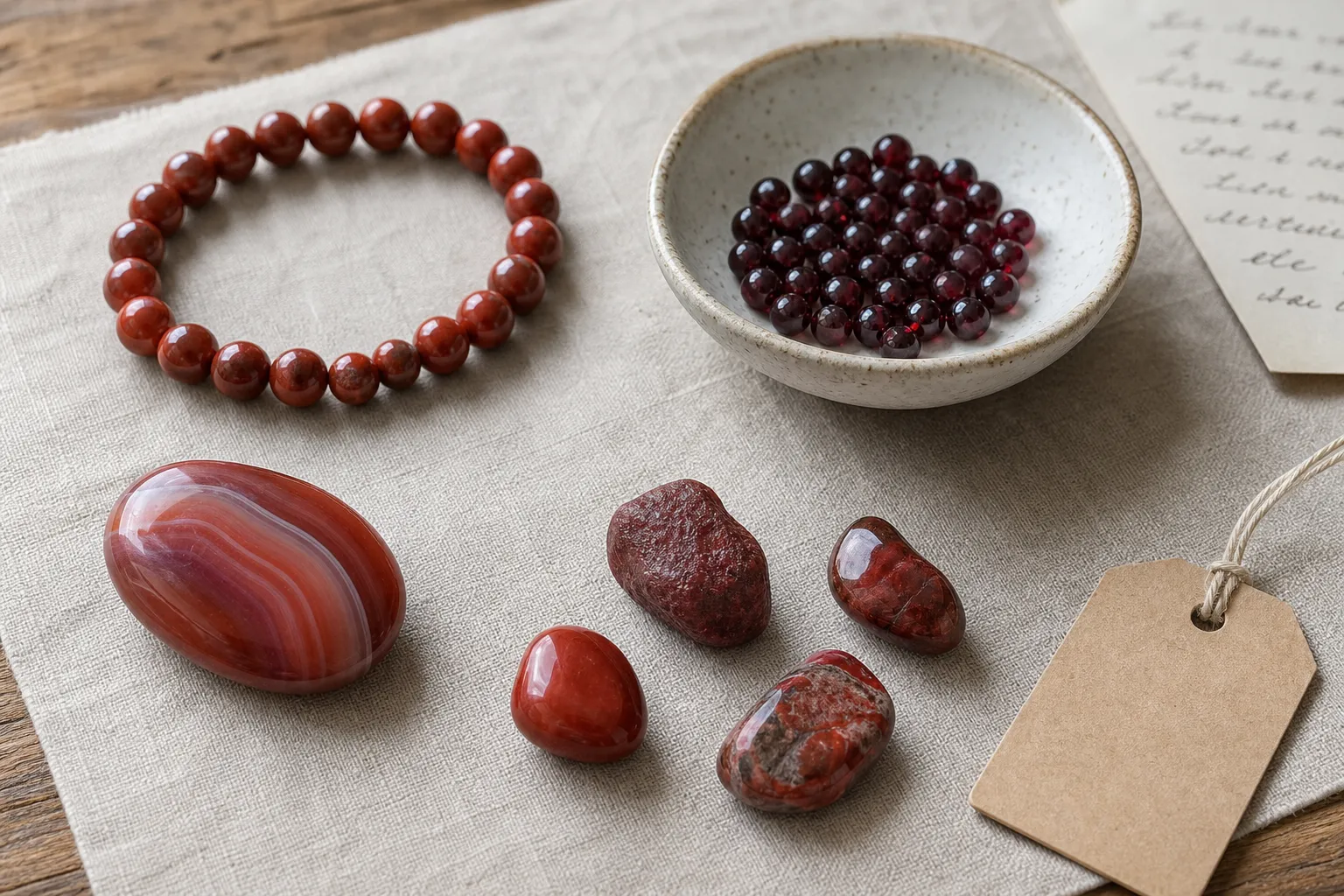
For a bracelet, Red Jasper is often the most visually direct. It keeps its red-brown look in ordinary light and pairs easily with dark spacer beads. Garnet beads can be beautiful, but they may read as black-red unless the lighting is strong. Red Agate can make a bracelet more patterned, especially when the beads show bands or translucent areas.
For a pocket stone, Red Jasper and Red Agate are often easier choices than Garnet because larger polished jasper or agate pieces are common and visually readable. Garnet pocket stones exist, but garnet is more often encountered as smaller beads, chips, or faceted jewelry.
For a small altar or personal layout, you might use Red Jasper as the main opaque red stone, Garnet as a darker accent, and Red Agate as the patterned red piece. If you use chakra placement, keep it personal and symbolic: the stones can mark an intention, a color theme, or a moment of attention without being presented as tools that change the body.
For a gift, choose the stone whose appearance is easiest to explain. Red Jasper is the clearest beginner root chakra example. Garnet feels more like a jewelry gift. Red Agate works well for someone who enjoys bands, translucency, and variation.
Common confusion around red root chakra stones
The biggest confusion is that retail charts often blur three different things: stone identity, color symbolism, and wellness-style promises. A chart may place Red Jasper, Garnet, Ruby, Carnelian, or dark stones such as Black Tourmaline and Obsidian under the root chakra. That can make it seem as if there is one fixed list. In practice, many modern crystal lists are retail or practitioner conventions.
Another confusion is color matching. Red is commonly presented as the root chakra color in modern chakra retail language, so readers may assume any red stone automatically belongs there. Color is a useful symbolic cue, but it is not a scientific rule and not the only reason a practitioner might choose a stone. Some lists include black or smoky stones because those colors are also associated with ground, weight, or protective symbolism in crystal communities.
A third confusion is the word “grounding.” In this context, read it as a symbolic or subjective practice word. A person might carry Red Jasper as a reminder to slow down, wear Garnet as a dark red focus point, or place Red Agate in a color-based layout. The meaning comes from the user’s tradition, interpretation, or ritual structure, not from verified mineral effects.
A simple selection checklist
Use this short checklist before choosing among Red Jasper, Garnet, and Red Agate:
- Do you want an earthy opaque stone? Start with Red Jasper.
- Do you want a darker, dressier red stone? Look at Garnet.
- Do you want bands, translucency, or red-orange variation? Consider Red Agate.
- Do you need the red color to be obvious in low light? Red Jasper or lighter Red Agate may be clearer than dark Garnet.
- Are you buying beads? Check whether the listing gives a material name, bead size, and any treatment information.
- Are you using it for root chakra symbolism? Treat the meaning as personal or tradition-based, not as a factual effect.
- Are you unsure about cleaning? Keep care conservative: avoid harsh chemicals, avoid rough storage with harder jewelry, and do not assume water exposure is appropriate for every bead strand, metal setting, or treated stone.
That last point matters because many water and cleansing lists online are informal or commercial. Without stronger care information for a specific item, gentle dry wiping and separate storage are the better default for ordinary handling.
Bottom line
For a beginner root chakra comparison, Red Jasper is the most direct earthy red choice, Garnet is the darker and more gem-like choice, and Red Agate is the patterned or chalcedony-style red choice that should be framed more cautiously.
All three can fit a personal root chakra color theme. If you want the clearest root chakra stone example, choose Red Jasper. If you want jewelry depth, choose Garnet. If you want red color with variation and possible banding, choose Red Agate. Let the visible stone guide the choice before any shop chart does.