
Chakra meaning note
Aquamarine and Amazonite Chakra Meanings: Why They May Appear Near Root Work
Aquamarine and amazonite are not usually described as classic Root Chakra stones. A clearer reading is this: aquamarine amazonite chakra meanings usually sit closer to blue-green symbolism, especially Heart and Throat themes. When they appear near root work, it is usually because a shop, practitioner, or personal routine is using them as supporting stones for steadiness, nature imagery, reflection, or calm communication.
That distinction matters. Gemology and geology can tell us what aquamarine and amazonite are, and what they tend to look like. Chakra placement is a belief-based, interpretive layer used in modern crystal practice; it is not a mineral classification.
upward
Read the full overview first
Use the broader guide first if you need the full scope before this page.
Start with what the stones look like
Aquamarine and amazonite are often grouped together because both can fall into the blue-green family, but they are different materials.
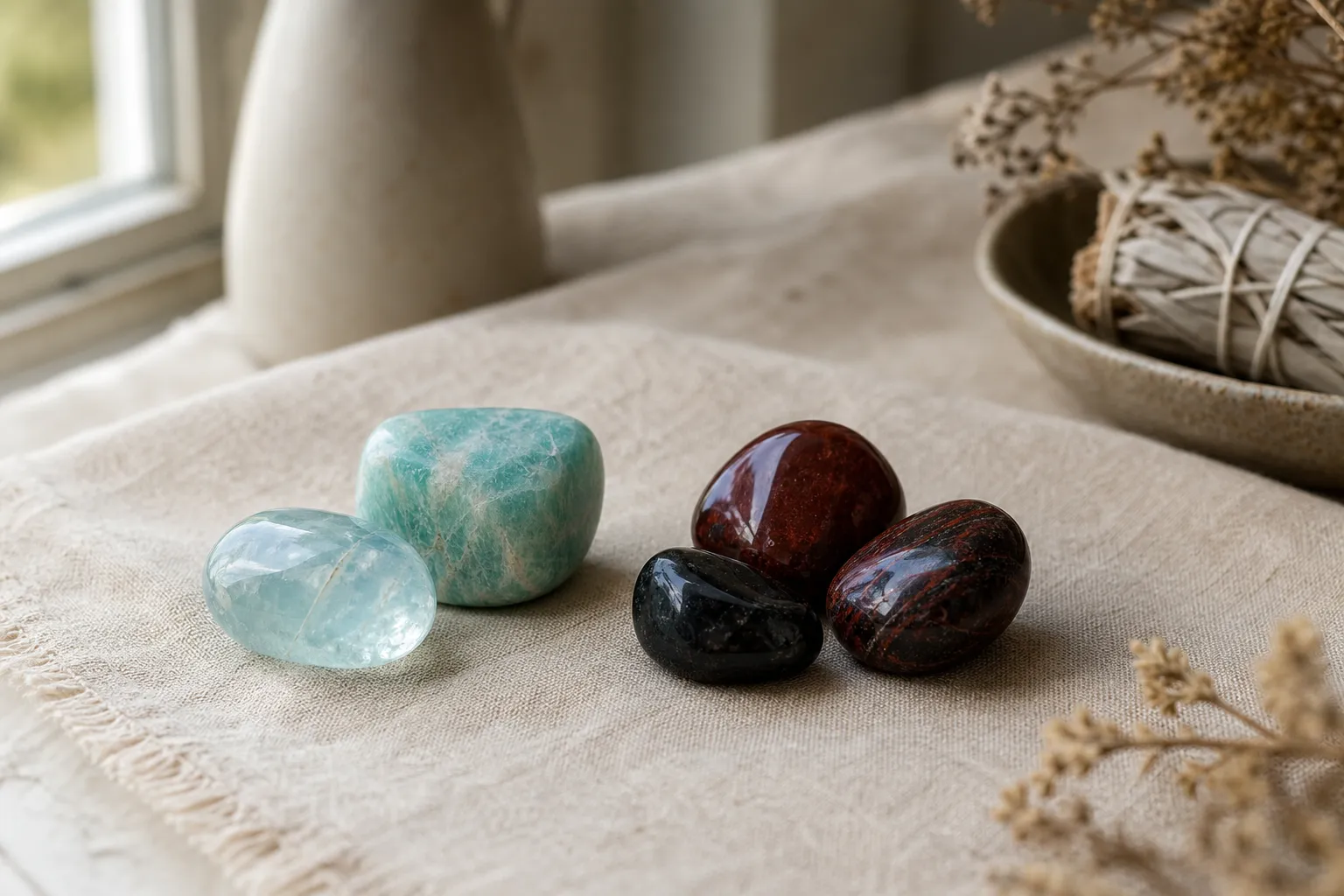
Aquamarine is a variety of beryl. Gemological references commonly describe aquamarine as blue to greenish blue, often with a clear, watery look when it is cut as a gemstone. For this article, the useful point is simple: aquamarine’s visible cue is usually pale to medium blue or blue-green.
Amazonite is different. It is commonly described as a blue-green to green variety of feldspar. In shops, amazonite may look aqua, pale green, blue-green, mottled, speckled, or veined. Many pieces are more opaque than gem-quality aquamarine, with a stone-like surface pattern rather than a transparent, glassy look.
That visible difference helps explain the symbolic split. Aquamarine often reads as water-like and airy. Amazonite often reads as green-blue, mineral, patterned, and a little earthier. Those impressions shape how people talk about their chakra meanings.
The usual chakra meanings for aquamarine and amazonite
Aquamarine
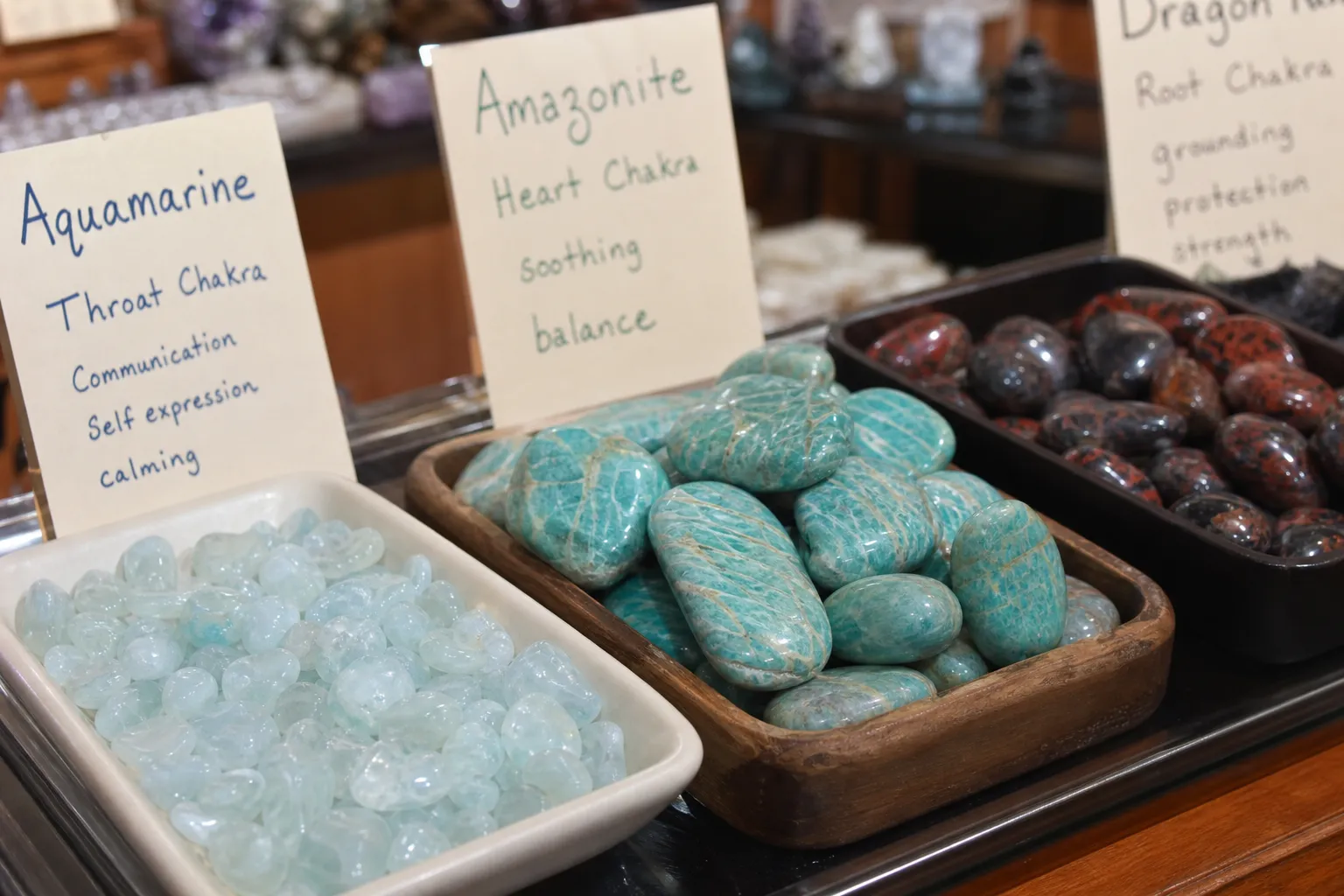
In modern crystal-practice language, aquamarine chakra meaning is commonly linked with blue symbolism: voice, expression, clear speech, and gentle communication. That is why aquamarine often appears near the Throat Chakra in retail descriptions. Some writers also connect its greenish-blue tone with Heart themes, especially when they are working from color symbolism rather than a fixed placement chart.
That does not make aquamarine root-centered by default. If you see aquamarine and root chakra language, it is usually a secondary use. Someone may place aquamarine near root work as a reminder to slow down, speak honestly, or reflect before making practical choices. In that setting, the stone is being used symbolically, not because beryl has an assigned chakra.
Amazonite
Amazonite chakra meaning is usually framed a little differently. Many crystal shops and practitioners describe amazonite as a Heart and Throat stone: Heart because of the green side of its color, Throat because of the blue side. This is the context behind phrases like amazonite heart throat chakra.
Amazonite is also the one more likely to drift into grounding language. Its green-blue color, opaque or mottled appearance, feldspar identity, and nature-like shop descriptions make it easier for sellers and practitioners to connect it with earth, stability, or grounded routines. That is why amazonite and root chakra mentions appear more often than a strict color-chakra chart might suggest.
Why blue-green stones show up near root work
A beginner may reasonably wonder: if the Root Chakra is usually associated with red, brown, black, or earthy stones, why do blue-green stones show up in root-focused sets or articles?
The answer is that modern crystal practice does not use one single placement system. Some people follow color correspondence closely. Others choose stones by intention, texture, name, appearance, shop tradition, or personal association. That creates overlap.
Blue-green stones may appear near root work for a few practical reasons:
- They may be supporting stones, not the main root symbol. A root-themed routine might use a darker stone as the central object, with aquamarine or amazonite added for reflection, communication, or steadier focus.
- Amazonite often carries nature language. Even when it is described as Heart/Throat-oriented, it may also be linked with earth, plants, landscape, or stability imagery.
- Green can bridge Heart and earth symbolism. In some personal practices, green stones are treated as reminders of growth, landscape, and physical surroundings.
- Blue can be used before practical action. Someone may include aquamarine in root work when the routine involves journaling, naming a concern, or preparing for a grounded conversation.
- Crystal meanings and gemstone identity are different layers. A mineral species does not determine a chakra placement. The chakra layer is interpretive.
So blue green stones in root work are usually there because of symbolic layering. They are not replacing the more traditional root-associated stones in every system.
Aquamarine in root work: when the idea makes sense
Aquamarine can make sense near root work when it is not being labeled as a classic Root Chakra stone.
For example, someone might place aquamarine beside a journal before writing down practical next steps. In that setting, the stone is a blue-green visual cue for clear speech, quiet reflection, or a softer approach to a grounded task. Someone else might wear aquamarine jewelry during a personal reset because they already associate it with communication.
A careful way to describe aquamarine chakra placement is:
- commonly Throat-oriented in modern crystal language;
- sometimes Heart-adjacent when its greenish tone is emphasized;
- occasionally included near root work as a secondary symbol for reflection, communication, or easing into practical action.
What would be misleading is to present aquamarine as primarily a Root Chakra stone in a universal or factual sense. The supported physical description is that aquamarine is blue to greenish-blue beryl. The chakra meaning is a modern symbolic layer.
Amazonite in root work: why it causes more confusion
Amazonite creates a bigger category blur.
On one hand, amazonite chakra placement is often Heart/Throat in shop language. Its green-blue color makes that easy to understand: green is commonly pulled toward Heart symbolism, while blue is commonly pulled toward Throat symbolism.
On the other hand, amazonite can look more grounded than aquamarine. A tumbled amazonite stone may be opaque, veined, speckled, or softly patterned. It often has a more earthy presence than a transparent aquamarine gem. Retail descriptions also tend to lean into nature and stability language. That creates the path toward amazonite grounding symbolism.
A beginner can read it this way:
- Amazonite is usually not introduced as a primary Root Chakra stone.
- It may appear near root work because some practitioners treat it as a nature-linked or stabilizing companion stone.
- Its Heart/Throat associations do not disappear when it is used near root work; the root-work use is an added layer.
This is especially useful when a listing sounds mixed. A shop may call amazonite a Heart/Throat crystal in one sentence and mention grounding in another. That is usually not a mineral contradiction. It is a sign that the listing is combining color symbolism, retail language, and personal-practice vocabulary.
Crystal meanings versus gemstone identity
The easiest way to avoid confusion is to separate three layers.
Layer
What it can tell you
What it cannot tell you
Gemstone or mineral identity
Aquamarine is beryl; amazonite is a feldspar variety; both can appear blue-green
Which chakra the stone must belong to
Visible appearance
Aquamarine may look clear and watery; amazonite may look opaque, mottled, or veined
Whether a stone creates a specific outcome
Chakra or crystal meaning
How modern practitioners and shops symbolically use the stone
A verified physical or emotional result
This keeps the answer grounded. Mineral references are useful for color, composition, and identification. They are not evidence that a chakra practice produces measurable body changes. Commercial crystal pages can help explain the language readers encounter, but they often blend symbolism, personal practice, and sales copy.
So if your question is “What are the aquamarine and amazonite chakra meanings?” the answer is mostly symbolic: aquamarine is commonly read through blue, Throat-style, water-like themes; amazonite is commonly read through Heart/Throat and green-blue nature themes.
If your question is “Why are they near root work?” the answer is contextual: they may be used as supporting stones in a grounding-themed practice, especially when the routine includes steadiness, journaling, communication, or earth/nature symbolism.
How to read a shop listing without over-reading it
When a listing puts aquamarine or amazonite in a root-themed set, look at the wording around the stone.
If amazonite is included for communication, compassion, or self-expression, it is probably being treated as a Heart/Throat companion inside a broader set. If the listing talks about earth, nature, stability, or grounding symbolism, the seller is using a more flexible interpretation. If aquamarine appears in a root-focused routine, it is often there for a softer reflective layer rather than as the main root symbol.
A simple check helps: is the stone being used for its color, its look, its name, or its usual shop category?
A blue-green stone beside darker stones may be there for contrast. A mottled amazonite palm stone may be chosen because it looks visually earthy. A pale aquamarine pendant may be chosen because the wearer connects it with speaking clearly during a personal reset.
None of those uses require treating the meaning as a fixed rule.
A modest way to include them in personal grounding practice
If you already own aquamarine or amazonite and want to include one near root work, keep the role simple and symbolic.
You might place amazonite beside a notebook while writing down practical priorities. You might wear aquamarine jewelry while reflecting on what needs to be said before taking action. You might keep either stone near a more traditionally root-colored stone if your practice uses pairings.
The point is not to force a new chakra label onto the stone. It is to give the stone a clear role in your own routine.
For handling, use ordinary care. Avoid harsh chemicals, abrasive surfaces, rough storage, and prolonged strong heat or sunlight. If a piece is set in jewelry, strung, glued, treated, or uncertain, be cautious with water. Ritual cleansing or charging language belongs to personal practice; practical cleaning is about protecting the material and setting.
The bottom line
Aquamarine and amazonite may appear near root work because modern crystal practice is flexible and often shaped by color, appearance, and personal symbolism.
Aquamarine is usually read through blue or blue-green Throat-style meanings. Amazonite is usually Heart/Throat-oriented, but its green-blue, nature-like, sometimes earthy presentation makes it easier to include in grounding-themed language.
The most grounded interpretation is not “these are classic Root Chakra stones.” It is: they are blue-green stones that some practitioners use as supporting symbols near root work, especially when the practice includes steadiness, nature imagery, reflection, or communication before action.