
Evening reflection
Evening Reflection Practice With Blue-Green Chakra Crystals
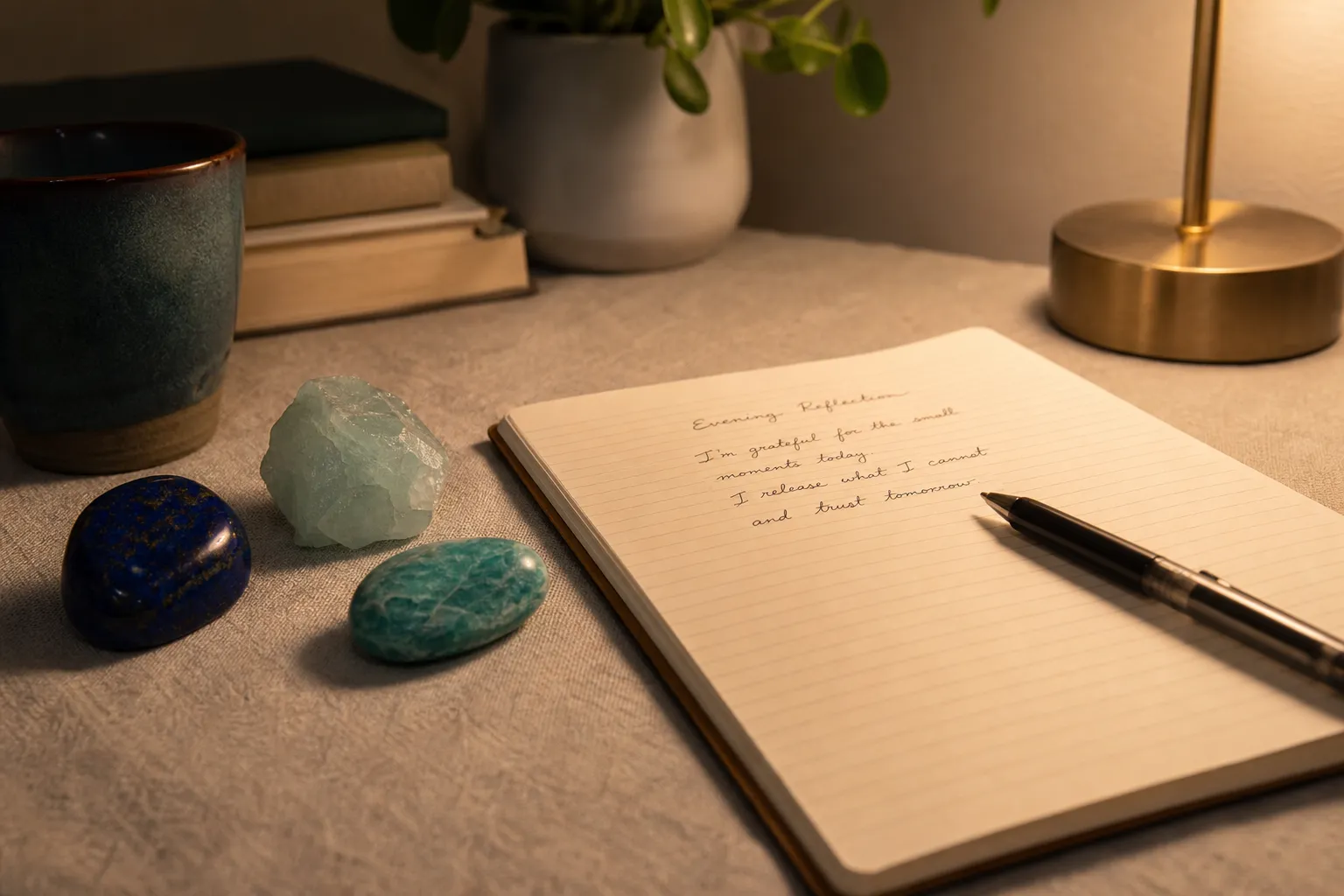
An evening reflection practice with blue green chakra crystals can stay very simple: choose one to three stones, place them where you can see them, sit quietly for a few minutes, and write one or two lines about the day. The crystals do not need to “do” anything. In this kind of personal ritual, their role is visual and symbolic: a deep blue, pale aqua, green-blue, or teal stone gives the eye a steady place to rest, while names such as lapis lazuli, aquamarine, and amazonite may carry meaning for readers who already use chakra language.
Keep the routine brief, optional, and belief-framed. It works best as a reflective habit, not as a promise of a specific result.
upward
Read the full overview first
Use the broader guide first if you need the full scope before this page.
A Simple Blue-Green Crystal Routine for Evening Reflection
For a beginner, the best routine is the one you can repeat without making it feel like a performance. Ten minutes is plenty. Three minutes can be enough if the goal is to pause, notice the day, and choose a closing thought.
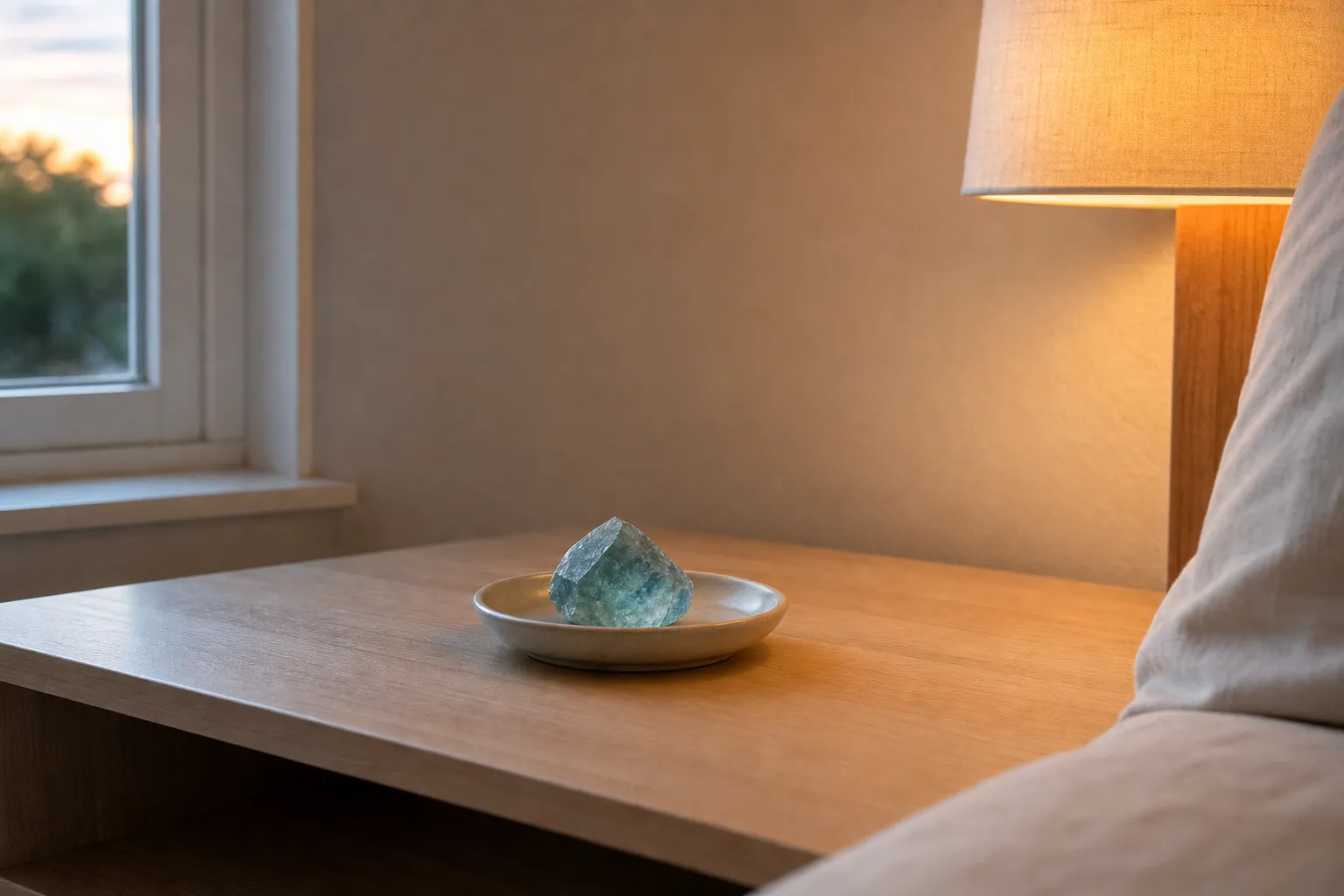
Place your chosen crystal or small group of stones on a cloth, tray, bedside table, desk, or windowsill. You do not need special equipment. A quiet corner, low light, and a notebook usually matter more than a complicated altar. If a candle, soft music, or incense already suits your evening, you can include it, but the practice does not depend on those extras.
A clear sequence
- 1. Place one blue-green crystal, or a small group, in front of you.
- 2. Notice its color, surface, weight, shape, and visible variation.
- 3. Take a few slow breaths without forcing a particular feeling.
- 4. Write one to three lines about the day.
- 5. Choose a closing phrase, intention, or practical next step for tomorrow.
- 6. Put the stones back in a consistent place.
This is a beginner crystal reflection habit. The value is in the attention you bring to the moment: you are using a visible object to mark the shift from daytime activity into a quieter evening pace.
If you already have a lapis lazuli evening practice, or if aquamarine and amazonite feel more natural to you, use those stones as symbolic anchors. One reader might connect a dark blue stone with honesty. Another might connect a pale blue-green piece with gentleness. Someone else may simply enjoy the color and texture without assigning a meaning.
Choosing One to Three Stones Without Overcomplicating It
For this night crystal routine, you do not need a large collection or a perfect set. You need a stone or small object you can handle comfortably, recognize easily, and return to the same place.
Darker blue
One darker blue stone can give the practice a strong visual focal point.
Lighter contrast
One lighter blue or blue-green stone can add contrast without making the routine complicated.
Greenish tone
One greenish stone can fit if that color connects with growth, steadiness, or reflection in your own symbolic language.
Many crystal practitioners associate blue and blue-green stones with communication, self-expression, calm attention, or heart-and-throat symbolism in personal chakra practice. Those associations are tradition-based or personal meanings, not factual effects. Use them if they help you frame a question, but do not make the stone responsible for what only rest, care, conversation, or practical support can provide.
For a lapis lazuli evening practice, the appeal is often the deep color and the serious, grounded look it can bring to a small reflection space. For aquamarine and amazonite reflection, readers often imagine a softer blue-green palette. Without reliable source support here, this page should not make detailed claims about composition, origin, hardness, water tolerance, or exact stone identity. The practical point is simpler: choose the piece you can look at without distraction.
If you are unsure whether a stone is genuine, dyed, delicate, or mislabeled, do not build the practice around certainty you do not have. Treat it as a visual and symbolic object. If you later want factual care information, check a reliable mineral or gem reference before using water, salt, oils, direct sunlight, or cleaning products.
Journal Prompts That Keep the Practice Grounded
A gentle evening reflection works best when the prompt is narrow. Broad questions can turn a quiet ritual into another task. Let the stone sit beside the notebook as a marker of attention, while the writing stays concrete.
Try one prompt from a group, rather than using all of them at once.
For closing the day
- What is one moment from today I want to remember accurately?
- What did I handle reasonably well?
- What unfinished thought can wait until tomorrow?
For personal symbolism
- What does this stone’s color suggest to me tonight?
- If this blue-green crystal were only a visual reminder, what would it remind me to notice?
- What word fits the mood I want to carry into the rest of the evening?
For a practical reset
- What is one small thing I can put away before bed?
- What is one message, task, or decision that does not need attention tonight?
- What is one simple action that would make tomorrow morning easier?
The point is not to extract a special message from the crystal. A cautious crystal routine treats the stone as a chosen focus, not as an authority. If a meaning comes to mind, write it as your interpretation: “I associate this color with patience,” or “Tonight this stone reminds me to speak more carefully tomorrow.”
That wording keeps the practice honest. A reflective ritual can feel meaningful without claiming that the object produced the meaning. You are making a space, choosing a visual cue, and giving yourself a few minutes to think.
What Can Change the Practice
The strongest version of this routine depends less on the “right” crystal and more on the conditions around it. A quiet room, a short time limit, and a clear prompt usually matter more than a large collection.
- If the stones feel distracting, reduce the set to one. A single piece is easier to notice closely: color, shape, surface marks, coolness or warmth in the hand, and the way it looks under evening light. Visible stone qualities give your attention somewhere simple to land.
- If the routine starts to feel like an obligation, shorten it. A blue green crystal routine should not become another standard you have to meet. One sentence in a notebook can still be a complete practice.
- If you live with other people, place the stones where they will not be knocked over, handled by children, or mistaken for toys. Small objects should be stored thoughtfully, especially around pets or young children.
- If you do not know whether a stone should touch water, oils, salt, or cleaning products, avoid those methods until you have care information for that specific material. Dry display and gentle handling are the lower-commitment choice.
- If the practice brings up difficult thoughts, keep the crystal role modest. The stone can remain a visual cue, but it should not be framed as solving serious distress or replacing real-world help.
Common Misunderstandings About Blue-Green Chakra Crystals at Night
The sequence does not need to be exact
An evening ritual does not need a precise sequence to be valid. In personal chakra practice, structure can help, but the structure is there to support attention. If counting breaths, arranging stones by color, or repeating a phrase feels artificial, simplify.
One color can carry more than one meaning
Blue-green stones do not have to belong to only one chakra category. In many contemporary crystal settings, people connect colors, chakras, and intentions in different ways.
Stronger claims do not make it better
Claims about automatic change or certain results create a burden the practice cannot responsibly carry. A clearer phrase is: “I use this stone as a reminder to reflect before bed.”
More stones can create more decisions
For a beginner, more stones often create more decisions: which one to hold, where to place each one, what each one is supposed to mean. If the goal is gentle evening reflection, fewer objects can make the practice easier to repeat.
Some people place blue stones near communication themes. Some read green tones through heart-centered symbolism. Some combine both in a personal practice that does not follow one fixed system.
A Compact Version for Beginners
The simplest possible version
- Choose one blue, green, or blue-green crystal you enjoy looking at.
- Place it beside a notebook in the evening.
- Write one sentence about what stood out today.
- Write one sentence about what you want to leave for tomorrow.
- Put the stone away or leave it in a stable display spot.
That is enough for an optional personal ritual. You can add lapis lazuli, aquamarine, amazonite, or another blue-green stone later if you want a small set, but the practice should not depend on owning a particular crystal. It depends on repetition, attention, and clear personal symbolism.
For a slightly fuller version, choose three words before you begin: one for the day, one for the stone, and one for tomorrow. For example: “busy,” “clear,” “steady.” The words do not need to be mystical. They simply give the reflection a shape.
Where the Belief Boundary Belongs
Blue-green chakra crystals can belong in an evening reflection practice as symbolic objects, color anchors, and personal reminders. They should not be presented as verified tools for changing health, sleep, mood, or life outcomes. That distinction lets the practice remain meaningful without asking the stones to carry claims this page cannot support.
Use belief language when you describe the ritual to yourself or others: “I associate this stone with reflection,” “some people use blue-green crystals for evening intention-setting,” or “in my personal chakra practice, this color helps me mark the end of the day.” Those phrases keep the experience yours. They also leave room for another reader to use the same stone differently, or not use stones at all.
The most grounded evening practice is modest: a quiet setting, a visible stone, a few written lines, and a clear stopping point. If the crystal helps you remember to pause, observe, and close the day with intention, it has served its role in the routine.