
Everyday Practice
Everyday Chakra Practice Ideas for Lapis Lazuli, Aquamarine, and Amazonite
If you are drawn to lapis lazuli, aquamarine, and amazonite, the practical question is usually not “Which stone is strongest?” It is “How can I use these blue and blue-green pieces in a routine I will actually repeat?” An everyday chakra practice with lapis lazuli aquamarine amazonite can be as modest as placing one stone beside a journal, carrying one as a reminder, or arranging all three before a few quiet minutes of reflection.
This page treats chakra practice as personal ritual and symbolic interpretation. The stones can support a habit of attention because you choose to use them that way; they are not presented here as tools that create guaranteed outcomes. The useful work is in the routine: what you notice, what you name, and what you decide to return to.

upward
Read the full overview first
Use the broader guide first if you need the full scope before this page.
Start With the Stones Before the Meaning
A grounded practice begins with what is actually in front of you: color, shape, size, surface feel, and where the stone will sit during the day.
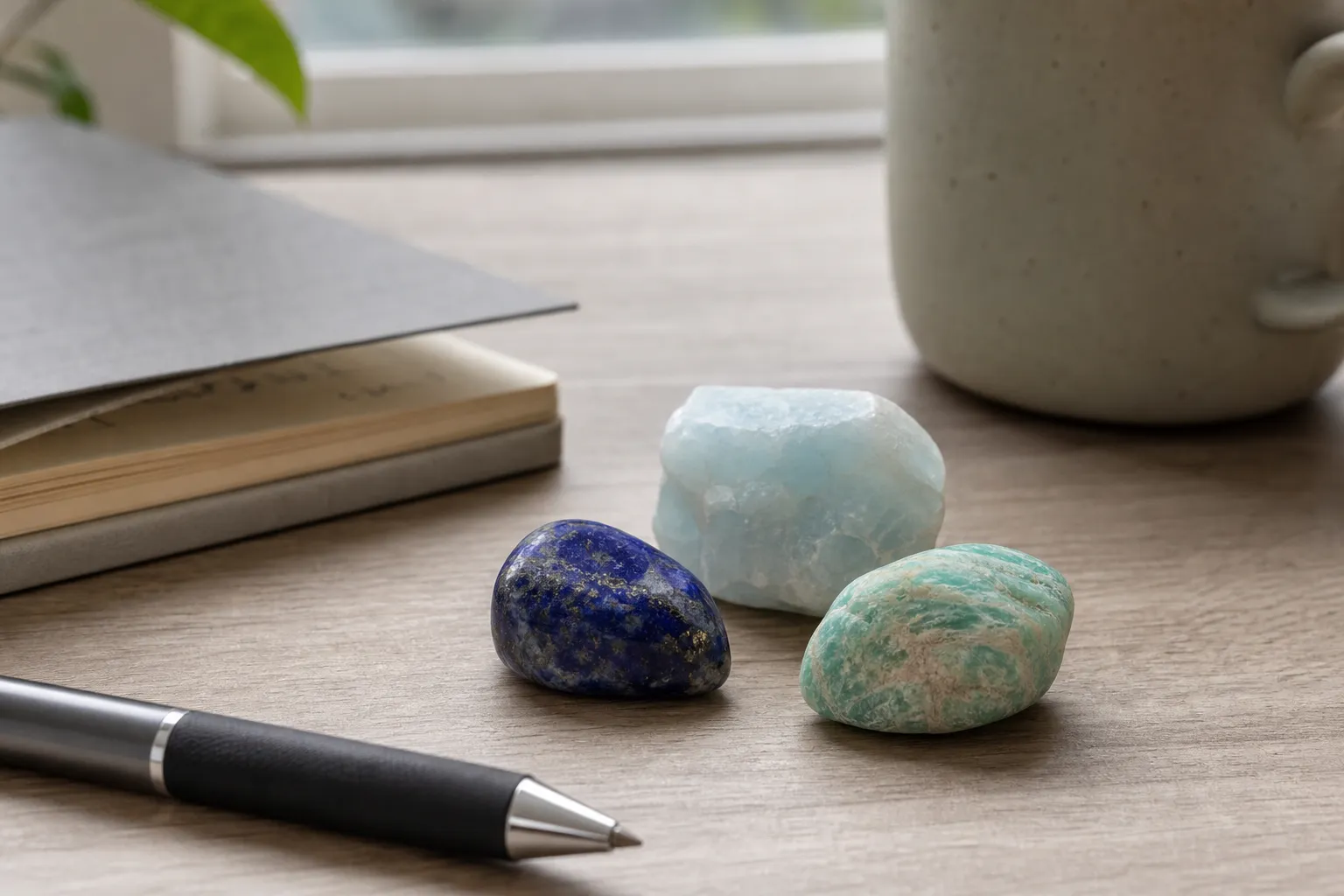
Lapis lazuli is commonly recognized for its deep blue appearance, sometimes with lighter or golden-looking flecks depending on the piece. In personal chakra traditions, many practitioners connect it with reflection, inner honesty, and thoughtful speech. For everyday use, that makes it a natural choice for journaling, reading, or pausing before writing a message.
Aquamarine is usually approached through its pale blue to blue-green look. In chakra-inspired practice, some readers use it as a cue for slower pacing, clearer listening, or a softer tone. The stone does not have to be treated as the source of those qualities; it can simply become the object that reminds you to practice them.
Amazonite is often selected for its green-blue or turquoise-like appearance. In crystal-practitioner language, it is commonly associated with steadiness in communication and a more settled personal rhythm. In daily use, it works well as a desk stone, pocket stone, or visual marker near a notebook.
The distinction is small but important: the stone is the object; the practice is the habit you attach to it. Without that distinction, a personal symbol can turn into an overstatement.
How to Build a Five-Minute Chakra Practice With Lapis Lazuli, Aquamarine, and Amazonite
A five-minute chakra practice does not need a special room, a complex sequence, or all three stones every time. It needs a shape you can repeat.
Try this
- Choose one stone, or place all three in a small row.
- Notice the visible color and texture before assigning meaning.
- Name one intention in ordinary language, such as “speak more carefully today” or “pause before reacting.”
- Sit quietly for a few breaths while looking at the stone.
- Put the stone somewhere you will see or handle it later.
For lapis lazuli practice ideas, the five-minute version may center on a journal prompt: “What do I need to say more clearly?” For aquamarine chakra practice, the prompt might be: “Where can I slow my response today?” For amazonite chakra practice, it might be: “What steady choice can I return to?”
These prompts are not messages from the stones. They are reader-made reflection tools. The crystal gives the routine a visual anchor so the practice feels less abstract.
If you use all three stones, keep the roles simple: lapis lazuli for naming the thought, aquamarine for softening the pace, amazonite for choosing one practical next step. That is enough for a beginner-friendly routine.
Morning Intention Practice With Lapis Lazuli, Aquamarine, and Amazonite
Morning practice works best when it is brief and easy to repeat. The point is not to create a perfect ritual, but to connect the stones with a small decision before the day becomes busy.
Place the stones somewhere ordinary: beside a mug, near a planner, on a clean tray, or next to your keys. Pick one to hold or look at for a moment.
Lapis lazuli
Write one sentence you want to keep honest and simple.
Aquamarine
Choose one conversation where you want to listen before answering.
Amazonite
Choose one steady action you can complete without drama.
This is where using blue green crystals can be visually useful. Lapis lazuli offers a deeper blue focal point. Aquamarine may feel lighter in the arrangement. Amazonite adds a green-blue tone that can make the group look more balanced on a desk or tray. The visual contrast helps you remember which intention you assigned to each stone.
If the routine starts to feel performative, reduce it. One stone and one sentence can still be a complete personal practice.
Evening Reflection Practice With Blue-Green Chakra Crystals
Evening reflection has a different rhythm. Morning practice points forward; evening practice looks back without turning the stones into judges of the day.
Set one stone near a notebook or bedside table. Ask a plain question:
- Lapis lazuli: “Where was I clear, and where did I avoid saying something simple?”
- Aquamarine: “Where did I move too quickly, and where did I give myself more space?”
- Amazonite: “What helped me stay steady, and what pulled me away from that?”
You can also place all three stones in a small triangle and write three short lines, one for each. Keep the language concrete. Instead of writing a sweeping statement about your whole life, write about one moment, one conversation, or one choice.
If a situation is bigger than a personal ritual, the stone practice should stay in its lane. It can help you review your day in a reflective way, but it should not replace practical decisions, support from people you trust, or a more formal support context when that is what the situation calls for.
How to Rotate Lapis Lazuli, Aquamarine, and Amazonite in a Weekly Chakra Practice
Some beginners try to use every stone every day and then lose interest. A weekly chakra practice can be easier because each stone gets a simple role.
One possible rotation:
This kind of weekly chakra practice is not about assigning cosmic rules to each day. It is a way to prevent the routine from becoming cluttered. Rotation also helps you notice which stone you actually reach for, which colors you enjoy seeing, and which settings make the practice easier to remember.
If you prefer simplicity, use only one stone per week. If you enjoy variety, rotate all three. The better choice is the one you will repeat without strain.
Pocket Carry, Desk Practice, and Reminder Stones
Everyday practice often happens away from a meditation cushion. A stone in a pocket, on a desk, or beside a notebook can be more realistic than a longer routine.
Pocket carry ideas are best kept practical. Choose a smooth piece that is comfortable to handle, keep it away from keys or rough items if you want to reduce scuffing, and decide what the stone is meant to remind you of before you leave home. Without that decision, the stone becomes just another object in a bag.
- Lapis lazuli: “say the simple version.”
- Aquamarine: “slow the reply.”
- Amazonite: “come back to the steady choice.”
These are personal cues, not claims about what the stones do by themselves.
Desk practice ideas can be even simpler. Place one stone at the edge of your keyboard, beside a notebook, or on a small dish. When you notice it, take a short pause and ask whether your next action matches the intention you set. This works especially well for people who do not want an obvious ritual in a shared space.
Crystal reminder stones are useful because they interrupt autopilot. Their role is visual and tactile: they catch your eye, sit in your hand, or mark a place in your routine. The meaning remains yours.
Journaling Prompts for Lapis Lazuli, Aquamarine, and Amazonite Chakra Practice
Journaling is one of the easiest ways to keep a personal crystal practice grounded because it turns vague symbolism into written reflection.
Lapis lazuli for clarity
- “What am I trying to say?”
- “What detail am I avoiding?”
- “What would a simpler answer sound like?”
Aquamarine for pacing
- “Where can I leave more space?”
- “What response does not need to be rushed?”
- “What would listening look like here?”
Amazonite for steadiness
- “What choice can I repeat today?”
- “What helps me stay consistent?”
- “What small action would make this easier?”
These journaling prompts are intentionally plain. Overly dramatic prompts can make a beginner feel as if the practice has to produce a major insight every time. A better everyday routine leaves room for ordinary answers.
You can also use a three-line format:
- What I notice.
- What I choose.
- What I will do next.
Place the stone beside the line it belongs to. That keeps the practice tactile without asking the stone to carry more meaning than the exercise can support.
Simple Meditation Setup With Lapis Lazuli, Aquamarine, and Amazonite
A simple meditation setup can be quiet and visual rather than elaborate. Use a clean surface, enough light to see the stones, and a position that feels comfortable. If you prefer, sit at a table rather than on the floor.
Arrange the stones in a line from darkest to lightest, or place the one you want to focus on in the center. Begin by looking at the stone’s color, shape, and surface. Then move into a short period of quiet breathing or reflection. If your mind wanders, return to the visible object.
For a three-stone setup
- Lapis lazuli can mark the question you want to name.
- Aquamarine can mark the pause before response.
- Amazonite can mark the practical choice you want to remember.
Nothing about the arrangement needs to be universal. Another reader might reverse the order or use only amazonite because that stone feels easier to work with. In a belief-framed practice, consistency often matters more than complexity.
When finished, put the stones away with care. A small pouch, tray, or dedicated dish keeps them from being scattered or knocked around. Ordinary handling matters because these are physical objects, not just symbols.
Should You Use One or All Three Stones?
Use one stone if you want a cleaner routine. This is usually better for beginners, pocket carry, and morning intention work. One stone means one prompt, one reminder, and less mental noise.
Use all three if the visual grouping helps you think in stages. A three-stone layout can work well for journaling, evening review, or a weekend reset. The tradeoff is that all three stones can make the practice feel busier if you assign too many meanings.
A useful decision frame
- Choose lapis lazuli when your practice is about naming something clearly.
- Choose aquamarine when your practice is about slowing the pace of response.
- Choose amazonite when your practice is about returning to a steady action.
- Choose all three when you want a sequence: name, pause, choose.
- Choose none for the day if the routine starts to feel forced.
The last option matters. An everyday chakra practice should remain optional. Skipping a day does not break the meaning of the stones. It simply means the routine is part of life, not a rule system.
Common Misconceptions About Daily Chakra Practice With Blue-Green Crystals
Color is not a rule system
A stone’s color does not have to match only one chakra idea. Appearance, personal meaning, and chosen routine all matter.
More stones are not always clearer
More stones usually make a routine more complex. For beginners, a single stone often creates a clearer habit.
Meanings need careful phrasing
Many practitioners associate a stone with a theme, and some readers use it as a reminder for that theme.
Daily practice can be ordinary
A stone near a notebook, a short prompt, a pocket reminder, or a two-minute pause can be enough.
How to Keep a Personal Crystal Practice Grounded
A grounded crystal practice stays close to what you can honestly observe and choose. You can observe the stone’s color. You can choose where to place it. You can write an intention. You can use the stone as a reminder to pause, reflect, or return to a task.
The available material for this page does not provide public reference support for scientific or guaranteed claims about lapis lazuli, aquamarine, amazonite, or chakra effects. That does not make personal practice meaningless; it simply places it in the right category.
Use language such as
- “I use this stone as a reminder.”
- “In my practice, this color helps me focus on the prompt.”
- “Many crystal practitioners associate this stone with this theme.”
- “This routine is for reflection, not for promising a result.”
That wording protects the value of the practice because it keeps it honest. The stones remain beautiful, tactile, and symbolically useful. The routine remains personal and flexible. The reader remains in charge of what the practice means.
For lapis lazuli, aquamarine, and amazonite, the most sustainable everyday approach is not to search for the perfect formula. It is to choose one visible stone, give it one clear role, use it in one ordinary setting, and let the practice stay modest enough to repeat.