Crystal meaning note
What Does Grounding Mean in Crystal Practices
In crystal practices, “grounding” usually means using a stone as a symbolic, tactile reminder of steadiness, presence, Earth connection, or root chakra intention. The grounding crystals meaning is not a fixed scientific definition. It is a belief-based phrase used in crystal communities, shop descriptions, and chakra traditions to explain how someone frames a stone during personal practice.
A grounding stone, in this context, is better understood as an object a person may hold, wear, carry, or place nearby as a cue for feeling more settled or present. The meaning comes from the practice, the symbolism, and the person’s relationship with the stone—not from a confirmed physical effect.
upward
Read the full overview first
Use the broader guide first if you need the full scope before this page.
Why “grounding” appears on crystal labels
Beginners often see phrases such as “crystals for grounding,” “grounding stones,” “black crystals for grounding,” or “root chakra grounding crystals.” In those settings, the word usually points to a few overlapping ideas.
It may mean returning attention to the present moment. Someone might hold a stone and notice its weight, texture, coolness, shape, or color as a way to bring attention back to the body and surroundings.
It may also mean Earth connection. Crystal-practice language often uses images of soil, roots, stone, feet, weight, and the lower body. The stone becomes a small physical object that represents rootedness rather than something abstract.
In chakra language, grounding is often associated with the root chakra, also called Muladhara in many modern chakra discussions. Contemporary crystal communities commonly describe the root chakra as symbolically linked with the base of the body, physical life, stability, and being rooted. When a stone is called grounding in that context, it is usually being placed inside that symbolic map.
The phrase is loose, though. One shop may use “grounding” to mean centered. Another may mean Earth-connected. A meditation-style note may mean a focus object for returning attention to the body. These meanings overlap, but they are not the same as electrical grounding, health-oriented Earthing, or a clinical technique.
What are grounding crystals?
Grounding crystals are stones commonly described as matching grounding symbolism. The phrase does not name a mineral category. It is a meaning label.
Stones often described this way in modern crystal-shop and practitioner language include:
These names should be read as examples of market and tradition language, not as a ranked list with confirmed outcomes. Black Tourmaline may be called grounding because it is dark and visually dense. Red Jasper may be included because its red-brown color fits root chakra symbolism. Smoky Quartz may be chosen because its gray-brown transparency has an earthy, shadowed look.
For a beginner, the more useful question is not “Which stone works?” but “What quality is this stone being used to represent?” In grounding stone symbolism, the answer is often weight, steadiness, roots, the ground underfoot, the lower body, or a return from scattered attention to physical presence.
The look and feel behind grounding stones
A lot of grounding crystal meaning comes from the way a stone looks and feels. That makes the idea easier to understand without accepting every claim that appears in retail copy.
Stones marketed as grounding are often:
- black, gray, brown, deep red, or smoky;
- rough, raw, matte, metallic-looking, or earthy in appearance;
- visually dense rather than bright and airy;
- small enough to hold, carry, wear, or keep on a desk;
- described with words such as rooted, steady, heavy, solid, or Earth-linked.
Color is not a rule or a mechanism. Still, dark crystals for grounding are common because black, brown, gray, and deep red easily suggest soil, rock, shadow, iron-like tones, and the lower-body symbolism used in root chakra practice.
Texture also changes how the object is experienced. A rough piece may feel more earthy to one person. A smooth tumbled stone may be easier to keep in a pocket. A bracelet or pendant keeps the reminder visible through the day. These are ordinary handling differences, not proof that one form carries a stronger effect.
Care should stay stone-specific. Without a reliable mineral reference for the exact stone, it is better not to assume that water, salt, sunlight, or rough handling is appropriate for every “grounding” crystal.
How grounding crystals are used in personal practice
When people ask what grounding means in crystals, they are often asking what someone actually does with the stone. In contemporary crystal practice, the use is usually simple.
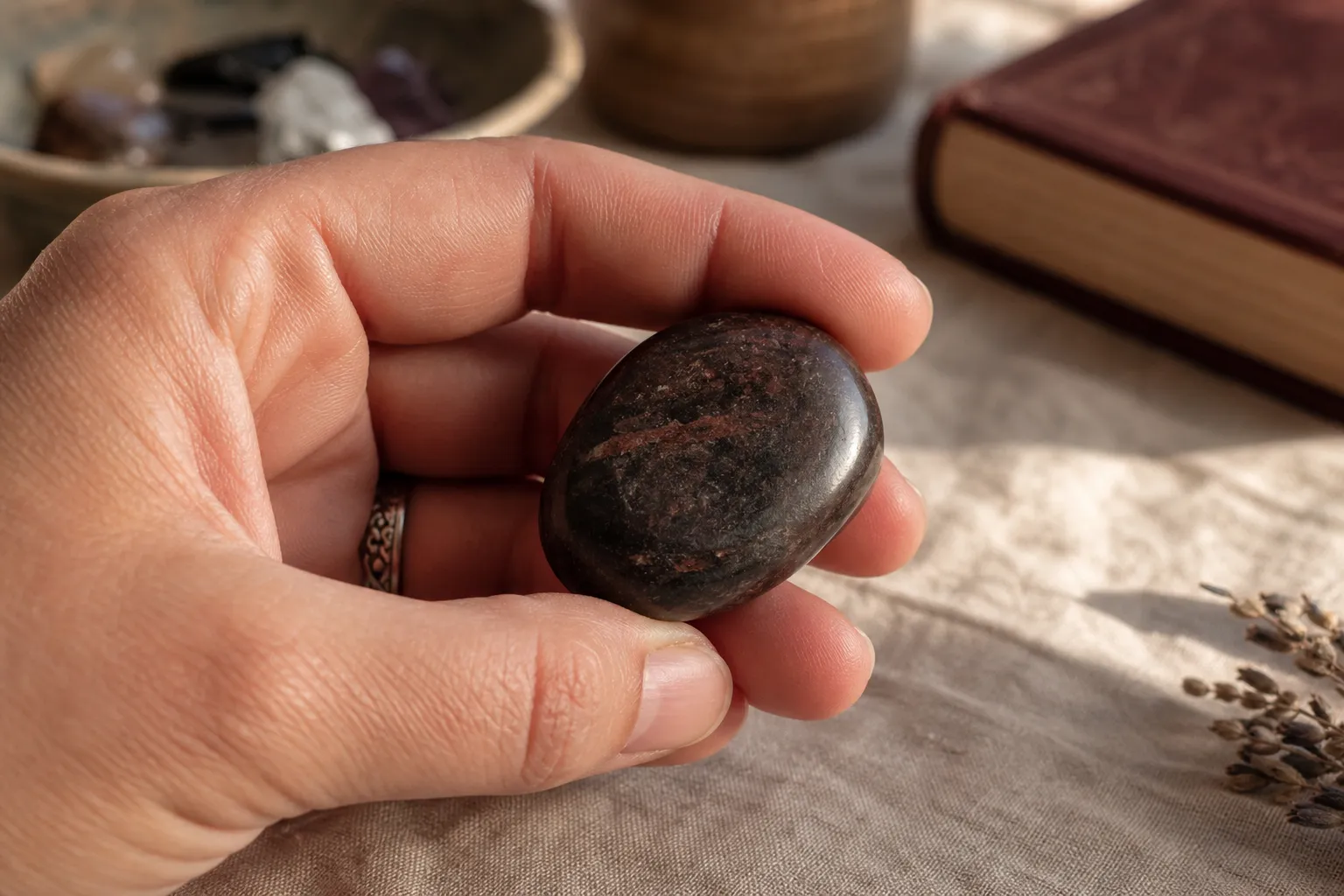
A person may hold a stone while sitting quietly and use it as a focus object. They might notice the surface, shape, temperature, or weight, then pair that attention with an intention such as “stay present” or “return to the body.” The stone is acting as a physical reminder.
Some people carry a grounding stone in a pocket or bag. The practice may be as ordinary as touching the stone during the day and remembering the meaning they assigned to it.
Others wear grounding jewelry. The value is often visibility and repetition: the bracelet, pendant, or ring keeps the symbolic cue close. It does not need to be framed as an invisible force to be meaningful to the wearer.
In chakra-style practice, someone may place a stone near the feet, near the base of a seated posture, or close to the lower body while visualizing roots, soil, or downward connection. That is best described as a belief-based ritual or symbolic exercise.
A stone may also sit on a desk, bedside table, altar shelf, or entryway. In that setting, it works more like a visual anchor: a dark or earthy object that reminds the owner of steadiness when they see it.
Why the meaning changes from person to person
Grounding stone symbolism changes with the tradition, the stone, and the person using it.
For someone focused on root chakra symbolism, grounding may mean working with red, black, or earthy stones and lower-body imagery. For someone less interested in chakras, it may simply mean choosing a stone that feels solid in the hand. For a collector, the meaning may sit alongside appreciation for color, luster, pattern, or natural form.
The same stone can carry different meanings in different settings. Hematite may be discussed for its metallic look in one context and for grounding symbolism in another. Smoky Quartz may be chosen for its appearance by one person and as a grounding stone by another. Obsidian may appeal because it is dark and glassy, while Red Jasper may appeal because its color fits root chakra themes.
Form matters too. A palm stone invites touch. A pendant invites wearing. A raw piece invites display. A small tumbled stone invites pocket carry. None of these forms makes the grounding meaning more true; they simply shape how the object is used.

Common confusion: crystal grounding, Earthing, and electrical grounding
The word “grounding” appears in several different worlds, which is why the phrase can be confusing.
In crystal practices, grounding is usually symbolic, tactile, and intention-based. It belongs to personal ritual language, chakra symbolism, and contemporary metaphysical vocabulary.
Electrical grounding is a technical term involving circuits and connection to the Earth for equipment and shock protection. That is not what a crystal shop usually means when it labels a stone “grounding.”
Health-oriented Earthing is also separate. It usually refers to direct bodily contact with the Earth or conductive systems. That topic has its own research debates and should not be folded into crystal meaning. A grounding crystal is not an electrical ground, an Earthing device, or a health intervention.
There is also an attention-based use of “grounding” in which people orient themselves to the present. Crystal practice may borrow everyday words such as present or centered, but a crystal label should not be read as a care plan or promised outcome.
The clean distinction is this: in crystal practice, grounding is a meaning attached to a stone and a way of using it as a reminder. It is not a universal technical claim.
Where the evidence line sits
The available material supports a cautious explanation of language, symbolism, and personal use. Commercial and practitioner sources show that “grounding” is widely used in crystal communities to describe steadiness, presence, Earth connection, root chakra symbolism, and dark or weighty stone associations. Those sources are useful for understanding how people talk about grounding crystals.
They do not establish that crystals create measurable health, emotional, energetic, or environmental effects.
Consumer health and library-style sources generally frame crystal use as a complementary or spiritual practice rather than a demonstrated physical mechanism. A broader academic discussion of human fascination with crystals also helps explain why stones can become meaningful objects: unusual shapes, transparency, reflection, color, and natural pattern have drawn human attention for a long time. That context supports the symbolic appeal of crystals, but it does not verify stronger claims sometimes attached to them.
So the most accurate answer is modest: grounding in crystal practices is a symbolic and tactile way of relating to a stone. People may find personal meaning in that practice, but the meaning should not be presented as a guaranteed result.
How to read “grounding” on a crystal label
When you see a crystal described as grounding, translate the label into a few practical questions:
- Is the stone being linked with root chakra symbolism?
- Is its color dark, smoky, earthy, black, gray, brown, or deep red?
- Is the description focused on weight, steadiness, roots, body awareness, or Earth imagery?
- Is the suggested use simple, such as holding, wearing, carrying, or placing it nearby?
- Is the seller moving beyond symbolic meaning into broad outcome promises?
The first four questions help explain the grounding stones meaning. The last one helps keep the language in proportion.
If you like the symbolism, you can choose a stone because its look, feel, and story fit your personal practice. If you are looking for a verified health effect, crystal-practice language around grounding does not provide that kind of support.
Short answer to remember
Grounding in crystal practices means using a stone as a personal symbol or touchpoint for steadiness, presence, Earth connection, and root chakra intention. Grounding crystals are stones commonly described with that symbolism, especially dark, smoky, metallic-looking, earthy, or weighty-feeling stones. The meaning can be useful as a personal ritual frame, but it should not be read as a scientific, clinical, electrical, or guaranteed effect.