
Visual stone practice
How to Use a Root Chakra Stone as a Visual Meditation Focus
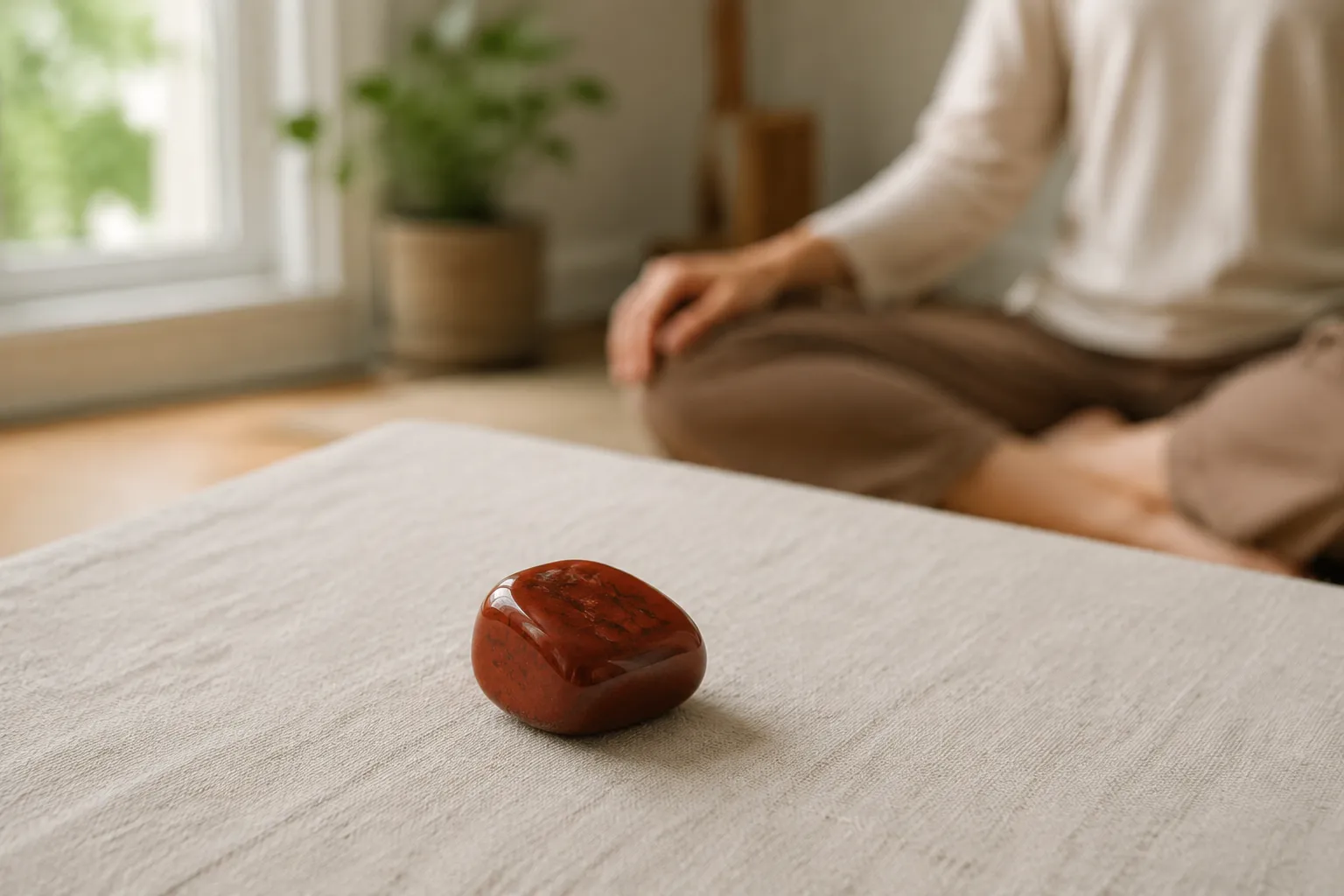
A root chakra stone can be used as a simple eyes-open focus object: choose one steady stone, place it where you can see it without strain, soften your gaze, notice its color and shape, and return your attention to the stone whenever your mind wanders. That is the practical core of a root chakra stone visual meditation focus.
Keep the chakra meaning in its proper frame. In many yoga and chakra traditions, the root chakra, or Muladhara, is associated with the base of the spine, foundation imagery, and the color red. Crystal communities often extend that theme to red, reddish-brown, and black stones. The stone is not doing a health task. It is a visible anchor for attention inside a personal ritual.
upward
Read the full overview first
Use the broader guide first if you need the full scope before this page.
A Simple Eyes-Open Stone Focus Practice
Pick one stone instead of arranging several pieces. A tumbled stone, palm stone, sphere on a stand, or stable raw piece is easier to use than tiny chips or a pointed shape that rolls. If the object keeps shifting, the session becomes about adjusting the stone rather than noticing it.
Place the stone on a table, cloth, shelf, or low stand at a comfortable distance. You should not need to crane your neck, stare upward, or lean forward. Soft daylight or a gentle lamp usually works better than harsh glare, because the point is to see the stone clearly without forcing your eyes.
Sit in a way you can maintain for a few minutes. Keep your eyes open and let your gaze rest on the stone. This is closer to object meditation than to closed-eye visualization. SessionLab’s description of object meditation uses the ordinary mechanic of observing an object and returning attention to it when distracted; a stone can serve that same neutral role.
A beginner sequence can stay very small
- 1. Set the stone where it is steady and easy to see.
- 2. Let your eyes rest on it without turning the gaze into a hard stare.
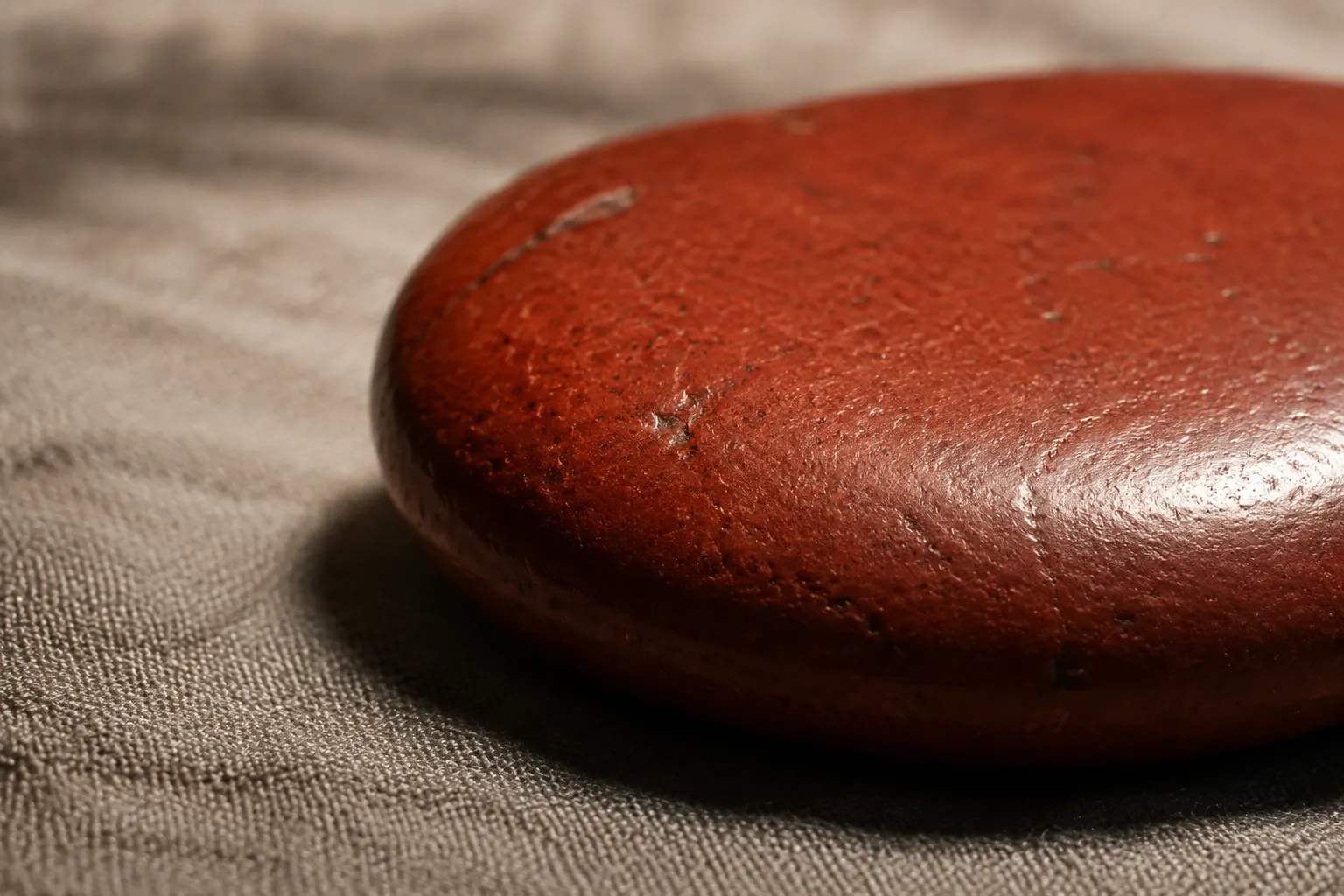
- 3. Notice one visible feature: color, edge, shadow, surface shine, banding, speckles, opacity, or contrast with the cloth beneath it.
- 4. When thoughts move elsewhere, gently return to the same stone.
- 5. After a few minutes, look around the room before standing up or moving on.
That last step helps the practice feel contained. The stone is something you looked at for a short ritual, not something you need to keep monitoring.
Choosing a Stone That Works for Looking
For this specific practice, choose the stone you can look at comfortably. It does not need to be rare, large, expensive, or dramatic. It should be steady, visible, and interesting enough to hold attention for a short session.
In chakra and crystal retail language, root chakra stones are commonly described as red, reddish-brown, brown-red, or black. Red stones are often grouped with root chakra symbolism, and black stones appear frequently in commercial root chakra lists. Those patterns help explain what readers usually mean by a root chakra crystal focus object, but they should not be treated as proof of an effect.
The color link comes from tradition and interpretation. Arhanta Yoga’s overview of Muladhara describes the root chakra in yoga and chakra contexts as the first chakra and associates it with red symbolism. That supports careful wording such as “in many chakra traditions, red is associated with the root chakra.” It does not make a red stone a guaranteed outcome tool.
If you want a classic root-chakra look, choose a red stone visual focus or a black stone meditation focus. If you are working within a broader interest in lapis lazuli, aquamarine, or amazonite, the fit is more personal. Blue-green stones are not the traditional red root chakra color, but some practitioners may still place them in a root chakra-themed ritual because of contrast, personal meaning, or a paired practice. Keep the distinction clear: traditional color association is one thing; personal symbolism is another.
Shape matters as much as color. A palm stone visual meditation can work well because the surface is broad enough to notice. A tumbled stone meditation focus can also work if it is not too small. A sphere may look calm and simple if it sits securely on a stand. A raw piece can be visually rich, but it should sit firmly and should not shed grit onto the surface beneath it.
What to Notice While Meditating With Stone Color
Meditating with stone color does not mean forcing an image or trying to make the stone “send” something to you. In this narrower method, color is simply the first visible feature you return to.
With a red or reddish-brown stone, you might notice warmth, depth, cloudy patches, or darker inclusions. With a black stone, you might notice whether it looks matte, glossy, ridged, or uneven at the edges. If the stone has mixed tones, let the eye move slowly between them rather than trying to decide which color is most “correct.”
Visible details that can become anchors
- the line where the stone meets the surface beneath it;
- a small chip, pit, or polished curve;
- a bright reflection from a lamp;
- a soft shadow on one side;
- a band, speckle, or cloudy area;
- the difference between the top edge and the background.
Keep the meaning modest
These details keep the practice grounded in observation. You are not required to feel anything special. If a symbolic phrase helps, keep it modest: “This stone represents foundation in my personal practice,” or “I am using this color because root chakra traditions often connect red with foundation themes.” That is different from presenting the stone as changing the body or guaranteeing a mental state.
Some people like to hold a stone while looking at it. That can add touch as a secondary cue, especially with a palm stone. Still, the center of this method is visual attention. If holding the stone pulls your gaze downward into an uncomfortable neck angle, place it on a table instead.
Common Confusion: This Is Not a Body-Placement Layout
Many chakra stone pages describe placing stones on or near chakra points. That is a different style of practice. This article is about eyes-open stone meditation, where the stone sits in your field of view and works as a focus object.
You do not need to place the stone at the base of the spine. You do not need a grid, a full set of seven stones, or a color sequence. You also do not need to copy formal candle-gazing or Trataka practices. Those traditions have their own contexts and can involve more intense gazing than a beginner needs for a simple stone focus.
A softer approach is enough: look, notice, drift, return. The “returning attention to the stone” part is the practice. Wandering attention is not a failure; it is simply the moment when you notice and come back to the visible object.
Another confusion comes from strong retail language. Some commercial crystal pages present stones as if they create dependable emotional, energetic, or health-related results. This page does not use that framing. A root chakra stone can carry meaning for you within chakra communities or personal ritual context, but meaning is not the same as a verified effect.
When to Stop or Change the Practice
Begin with a short session. Two to five minutes is enough to learn whether the setup feels comfortable. Longer sessions are not automatically better, especially if your eyes feel strained or your attention becomes tense.
Stop or change the practice if eyes-open focus feels unpleasant, agitating, disorienting, or emotionally intense. Look away from the stone, name a few ordinary objects in the room, feel your feet on the floor, or choose a non-gazing practice instead. The stone is optional.
Health-information sources treat meditation as a broad family of practices, not as one universally pleasant experience. The National Center for Complementary and Integrative Health notes that some people report negative experiences with meditation and mindfulness practices. Research discussions of meditation-related adverse effects make the same general point: meditation should not be presented as automatically suitable for every person in every setting.
That caution does not prove anything about crystals or chakras. It simply keeps the practice ordinary and optional. If stone focus feels useful as a personal ritual, keep it brief and gentle. If it does not suit you, the stone can remain a display object instead.
A Short Practice You Can Repeat
Set one stable root-chakra-associated stone on a cloth in soft light. Sit where your head and shoulders can relax. Let your gaze settle on the stone’s color, then on its edge, then on one small surface detail. When attention moves elsewhere, return to the visible stone without making a story out of the distraction.
After a few minutes, look at the table, the wall, the floor, and the space around you. Put the stone away or leave it on display.
Used this way, the stone is a quiet visual anchor inside a belief-based chakra practice. Its meaning is interpretive, personal, and cultural; the practical action is simply seeing, noticing, and returning.