
Meditation setup
How to Use Root Chakra Stones in Meditation
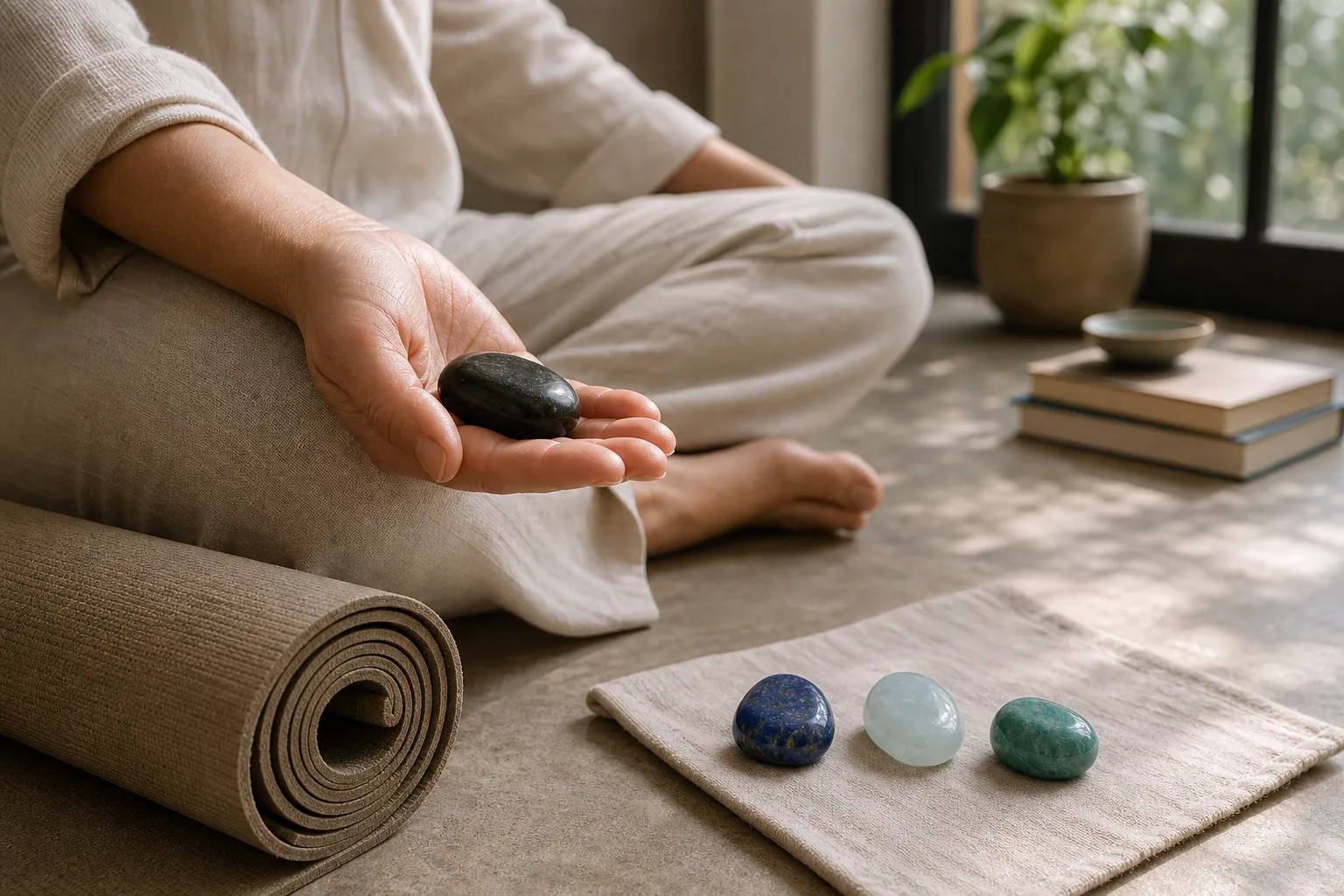
A smooth dark stone in your palm, a blue-green crystal beside your mat, or a small piece near your feet can give a quiet routine something visible to return to. That is the simplest way to understand how to use root chakra stones in meditation: use the stone as an optional focus object, not as a force that has to produce a result.
In chakra communities, root chakra meditation stones are often linked with ideas such as steadiness, presence, and feeling settled. Those meanings belong to belief-based and personal ritual language. They are not measurements, instructions, or promises.
For a beginner, the useful question is practical: which stone is comfortable to handle, where should it go, how long should the session be, and what should you actually notice?
upward
Start with the broader guide
Use the broader guide first if you need the full scope before this page.
Start With the Stone, Then Add Meaning Carefully
Root chakra stones for beginners are easier to work with when you keep two layers separate.
The physical layer
A stone has color, weight, surface texture, size, temperature, edges, and a shape that may or may not feel comfortable in the hand. Lapis lazuli may appear deep blue with golden-looking flecks. Aquamarine is commonly pale blue to blue-green. Amazonite often shows green-blue color with lighter streaking or cloudy variation. These are appearance notes, not proof of an effect.
The interpretive layer
In many chakra traditions and crystal-practitioner settings, people connect certain stones with symbolic themes. A root chakra frame often points toward grounding language, routine, stability, and connection with the floor or lower body. On this page, that language stays inside personal ritual and reader interpretation.
That distinction changes the practice. You do not need the “right” stone to make the meditation count. You need a stone that is easy to notice without becoming the whole event.
A good beginner choice is usually:
- A size you can hold without gripping tightly.
- A surface that is not sharp, crumbly, or distracting.
- A color or pattern you can look at calmly.
- A piece you can place on a cloth, table, floor, or beside your seat.
- A stone that does not feel so precious that you worry about it throughout the session.
Simple tumbled pieces often work better for root chakra stone meditation than large display specimens. A dramatic crystal may look beautiful on a shelf, but if you spend the session worrying about dropping it, it is not serving the routine.
Simple Root Chakra Stone Meditation for Beginners
A simple crystal meditation routine does not need many steps. The stone is there to provide a tactile or visual point of return.
Before you sit down, choose one stone and decide how you will use it. Hold it, place it nearby, or use it as a visual focus. Try not to change the setup every minute; constant adjustment can become more distracting than the stone itself.
A beginner root chakra meditation might look like this:
- Choose a quiet place where the stone can rest securely.
- Sit on a chair, cushion, or floor, or lie down if that is more comfortable.
- Place the stone in your hand, near your feet, beside your seat, or in front of you.
- Notice one simple feature: weight, color, coolness, shape, or texture.
- Set a short intention if you want one, such as “I will sit here and return to the present moment.”
- Sit quietly for a few minutes, returning attention to the stone when your mind wanders.
- When finished, put the stone somewhere clean, dry, and easy to find.
The intention should be modest. Setting an intention with stones is not the same as making a demand of the stone. It is closer to choosing a theme for your attention. If the phrase feels forced, skip it and simply observe the object.
For crystal meditation for beginners, short sessions are usually easier to understand than ambitious ones. Five minutes can be enough to learn whether holding the stone feels calming, distracting, awkward, or neutral for you. The point is to notice how the object fits into your quiet routine.
Where to Put Root Chakra Stones During Meditation
Placement depends on your posture, the size of the stone, and how much contact you want with it. There is no single placement every person must use.
If you are sitting, the most practical options are your palm, your lap, the floor near your feet, or a small table in front of you. Holding a stone gives you direct texture and weight. Placing it on the floor or table makes it less physically demanding and easier to leave alone.
If you are lying down, the stone can rest beside you, near your feet, or on a stable surface within view. Some people like placing a stone on the body during meditation, but beginners should think first about comfort, stability, and pressure. A heavy, pointed, or unstable piece can interrupt the session. If a stone slides, presses, or makes you tense, move it beside you instead.
The placement question is really about attention
Do you want to feel the stone, see it, or simply know it is nearby?
- Use the hand when touch helps you stay oriented.
- Use the floor near the feet when you want the stone connected to the setting rather than your grip.
- Use a table or cloth when the stone is mainly a visual meditation focus.
- Use a small bowl or tray if the piece rolls easily.
Holding vs placing root chakra stones in meditation is not a hierarchy. Holding is more tactile; placing is often less effortful. If your hand tightens around the stone, placing it down may make the session easier. If your eyes keep scanning the room, a stone in the hand may give your attention a clearer anchor.
Sitting, Lying Down, and Session Length
Sitting with root chakra stones tends to make the stone easier to hold or view. A chair works well if you want both feet on the floor. A cushion may suit readers who already sit that way comfortably. The root chakra frame often uses lower-body and floor imagery, so a seated posture can feel symbolically consistent without needing to carry a stronger claim.
Lying down changes the session. It may feel quieter, but attention can also become softer or sleepier. If you lie down, place the stone where it will not fall, press into the body, or get lost in blankets. A nearby tray, cloth, or bedside surface is often simpler than balancing it on yourself.
How long should you meditate with root chakra stones? For beginners, a short, repeatable window is usually more useful than a long session done once. Try three to ten minutes and stop while the practice still feels clear. If you already have a meditation routine, you can add the stone for only the first few minutes, then continue without it.
Length should change when the stone becomes a distraction. If you find yourself checking whether you are “doing it correctly,” shorten the session. If the object gives your mind a gentle place to return, keep the same length for several sessions before changing anything.
The stone does not need to be present every time. Regular meditation objects can include breath, sound, a candle, a phrase, a body sensation, or a simple visual point. Root chakra stones as meditation objects are one option among many, not a requirement for quiet practice.
One Root Chakra Stone or Several?
One stone is usually clearer for a beginner. It reduces decision-making and makes the routine easier to remember. If you choose lapis lazuli, aquamarine, amazonite, or another stone used in your personal root chakra-themed practice, stay with that piece for the session and observe how it functions as an object.
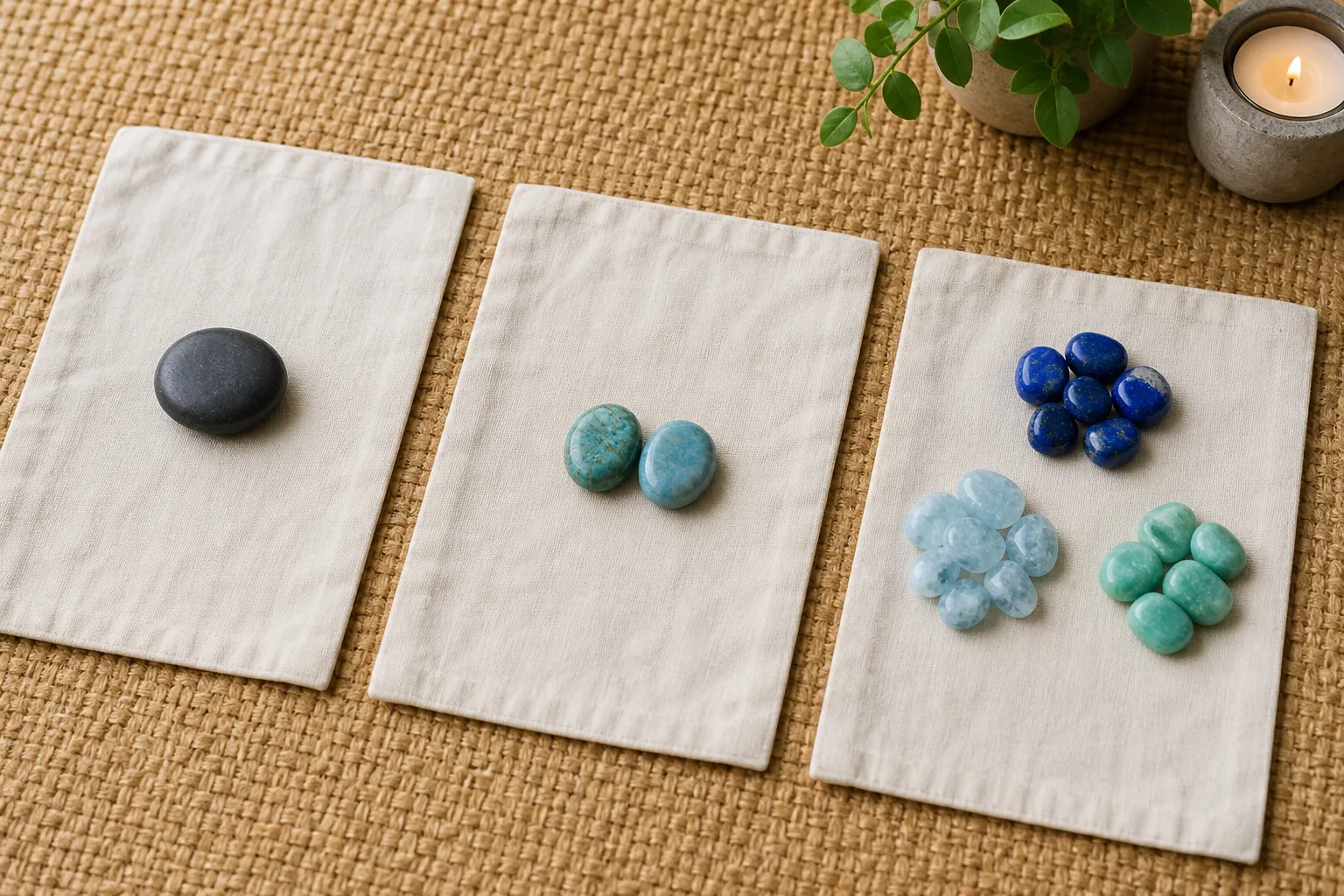
Several stones can be visually appealing, but they add complexity. You may start comparing colors, meanings, arrangements, and names instead of settling into the routine. A small group can work if each piece has a simple role: one held in the hand, one placed near the feet, or one set in front as a visual point. More than that often turns meditation into display design.
This is where blue-green stones in a root chakra frame can confuse readers. Root chakra language is often associated with red, brown, black, or earthy tones in many modern crystal contexts, while this site also discusses lapis lazuli, aquamarine, and amazonite. The presence of blue-green crystals does not mean they have one fixed root chakra function. It means some readers bring them into root chakra-themed routines through personal symbolism, color preference, collection habits, or a broader interpretation of steadiness and reflection.
A practical way to decide
One stone
Better when you want a simple beginner routine. Possible drawback: less visual variety.
Two stones
Better when you want one tactile and one visual object. Possible drawback: more setup decisions.
Several stones
Better when you already enjoy arranging stones before practice. Possible drawback: easy to focus on display instead of meditation.
No stone in hand
Better when touch feels distracting. Possible drawback: less tactile feedback.
Stone nearby only
Better when you like symbolic presence without handling. Possible drawback: easier to forget it is part of the routine.
The right number is the number that supports attention without making the setup feel busy.
What to Focus On During Root Chakra Stone Meditation
The clearest focus is something ordinary and observable. Notice the stone’s surface, outline, color, or weight. With lapis lazuli, you might notice dark blue areas and small flecks. With aquamarine, you might notice pale blue-green clarity or softness of color. With amazonite, you might notice green-blue tones and natural-looking variation. Keep the description simple.
After that, you can add a belief-based layer if it fits your practice. Some crystal practitioners use root chakra language around steadiness, grounding, or returning attention to the present setting. A personal phrase might be, “I am sitting here,” “I can return to this moment,” or “I will keep this practice simple.” These are reflective prompts, not outcome claims.
Root chakra visual meditation is useful if you do not want to hold the stone. Place the piece on a cloth, tray, or low table. Let your eyes rest on one visible detail. When your attention moves away, return to that detail without turning it into a test.
If you prefer meditating without crystal beliefs, you can still use the stone as a regular attention object. In that case, the stone does not need a chakra meaning. It can function like any small item used for focus: a pebble, bead, shell, or simple shape. The only difference is that you have chosen a stone commonly discussed in chakra or crystal communities.
That option matters because not every reader approaches these objects with the same beliefs. Some enjoy the symbolism. Some like the color and texture. Some are curious but cautious. A grounded routine can leave room for all three without pushing a stronger interpretation.
When the Stone Feels Distracting
A distracting root chakra stone is not a sign that the practice has failed. It may simply be the wrong object, placement, size, or session length for that day.
Common distractions include a stone that is too sharp, too large, too visually busy, too cold in the hand, or too emotionally loaded because it was expensive, fragile, or recently purchased. A piece with dramatic patterning may keep pulling the eye into analysis. A small rolling stone may create low-level worry that it will fall.
Adjust one variable at a time:
- Put the stone down instead of holding it.
- Move it farther away but keep it visible.
- Switch to a smoother or smaller piece.
- Shorten the meditation.
- Use the stone only at the beginning and end.
- Skip the stone and return to breath, sound, or another ordinary focus.
This is better than forcing the object to “mean” something. In personal ritual work, a stone can be meaningful and still not be useful in every posture, mood, or room. Comfort, attention, and simplicity are enough to guide the choice.
Care also matters after the session. Storing root chakra stones safely can be as simple as placing them in a dry pouch, tray, small box, or shelf space where they will not scratch other pieces or roll off a surface. Keep special display pieces separate from stones you handle often, especially if rough edges or delicate surfaces make them less practical for meditation.
Common Misconceptions About Root Chakra Stone Meditation
The stone must touch the body
Touch can be useful, but a nearby object can still serve as a focus point. If holding the stone creates tension, placing it nearby may be the better choice.
A root chakra stone has to be a specific color
Many modern crystal conversations use color symbolism, but personal practice is often messier. Readers may choose a blue-green stone because it is familiar, beautiful, already in their collection, or connected with a private meaning. The color does not need to carry a universal conclusion.
More stones make the meditation stronger
More objects often mean more decisions. Beginners usually learn more from one clear focus than from a crowded arrangement.
Discomfort proves something hidden about the stone
Usually, the explanation is more ordinary: the piece is awkward to hold, the posture is not working, or the session is too long. Start with the practical explanation first.
The largest misunderstanding is treating crystal language as verified instruction. Chakra meanings can be culturally and personally significant, but this page does not present stones as producing guaranteed physical or emotional outcomes. The practice described here is a quiet personal routine using a stone as an optional focus object.
A Clear Beginner Framework
If you want a simple way to judge your own setup, use four questions before each session.
What is the stone doing?
It may be a hand focus, a visual point, a symbolic object, or a nearby reminder. Give it one job.
Where is it placed?
Choose palm, lap, floor, table, tray, or cloth based on comfort and stability, not pressure to follow a rigid rule.
What will you notice?
Pick one feature: color, weight, shape, temperature, or a short intention. Avoid turning the session into a search for signs.
What will you do afterward?
Put the stone away cleanly and consistently. A small storage habit keeps meditation stones from becoming clutter or fragile objects left in risky places.
Used this way, root chakra meditation stones stay modest and practical. They can mark the beginning of quiet time, support a personal ritual, or give your attention a visible place to land. The meaning stays interpretive; the handling stays simple. That is enough for a beginner routine.