
How to Compare Root Chakra Stones Before Choosing One
If you are trying to compare root chakra stones, the challenge is usually not finding a list. It is knowing what the list is really comparing.
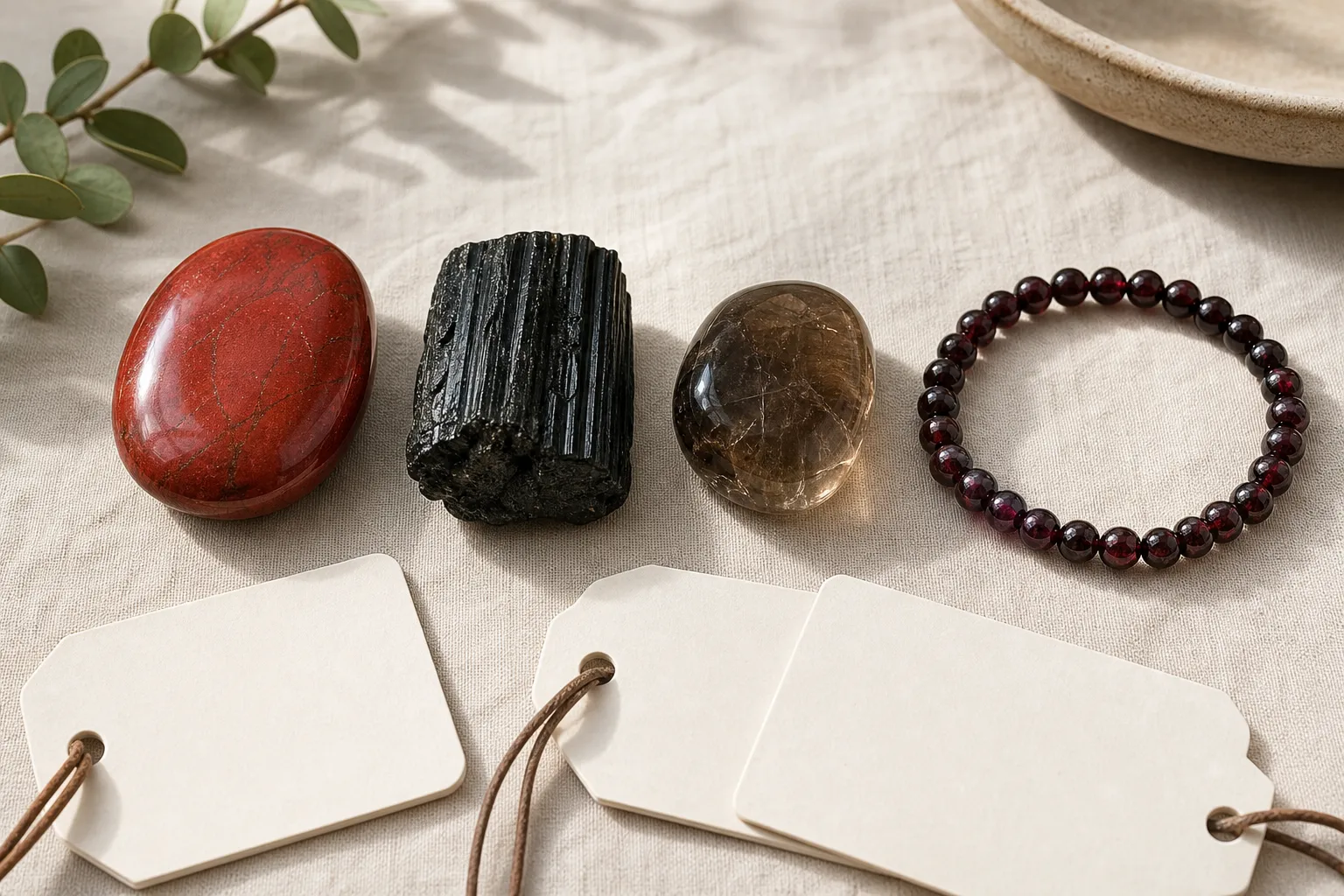
A red jasper palm stone, a black tourmaline point, a smoky quartz tumble, and a garnet bracelet may all appear in root chakra crystal lists, but they are not interchangeable objects. They differ in color, surface, weight, price, wearability, care needs, and the kind of symbolic language attached to them.
A useful choice starts with what you can observe: color, opacity, polish, shape, size, weight, surface condition, and how you plan to use or display the stone. Meanings can still matter in a personal practice, but they are better read as chakra-community, practitioner, or retail associations rather than as mineral facts or promised outcomes.
upward
Read the full overview first
Use the broader guide first if you need the full scope before this page.
Start With the Category: “Root Chakra Stone” Is Not a Mineral Type
A root chakra stone is usually a crystal-community label. It does not describe one mineral group, one geological origin, or one fixed set of physical properties.
In chakra traditions, the root chakra is commonly discussed as the first chakra and is often connected with foundational or earth-related symbolism. Modern crystal sellers and practitioners then link certain stones to that theme, especially stones that look red, black, brown, smoky, iron-toned, dense, or visually “earthy.”
That is why root chakra stone comparison often includes very different materials: jasper, quartz varieties, tourmaline, obsidian, garnet, hematite-like stones, tiger eye, and other retail names.
The chakra label will not tell you:
- what the stone is made of;
- whether it is natural, dyed, coated, glass, composite, or imitation;
- whether it suits daily wear;
- how it should be cleaned;
- whether the surface may chip, scratch, flake, or dull;
- whether the price reflects mineral identity, finish, size, rarity, branding, or packaging.
A better comparison keeps two questions separate:
- What is this object physically?
Look at color, transparency, polish, structure, weight, finish, and any available mineral identification. - What meaning is being attached to it?
Read chakra language as cultural, spiritual, retail, or personal-use framing, not as a measurable property of the stone.
That separation keeps the decision practical without dismissing why a stone may feel meaningful to you.
Compare Root Chakra Stones by Color Without Overreading the Color
Color is the first cue many beginners notice. It is also one of the easiest cues to overuse.
Root chakra stones by color are often grouped into red, black, brown, smoky, and iron-toned families. These groups can help you narrow the mood or style you want, but color alone does not identify the material.
Red and red-brown stones
Red jasper, garnet, carnelian, and hematoid quartz are common examples in root chakra crystal lists. Retail descriptions may frame them as warm, earthy, strong-looking, or connected with symbolic energy themes.
- Is the red flat, brick-like, orange-red, wine-red, or translucent?
- Does the stone show banding, speckles, fractures, or cloudy zones?
- Is it opaque like many jaspers, glassier like some quartz pieces, or more gem-like in a faceted form?
- Is the listing using a mineral name, a trade name, or a broad phrase such as “red crystal”?
A red color can come from different causes in different materials. It can also be enhanced or imitated in some market settings. Do not buy a stone only because it matches a chakra color chart. If the name, price, or material matters to you, look for clearer labeling.
Black and very dark stones
Black tourmaline, obsidian, hematite-like stones, and dark smoky quartz often appear in root chakra selections. In small product photos, they may look similar. In the hand, they can feel quite different.
- glossy glass-like surfaces versus more granular or striated surfaces;
- natural-looking ridges versus machine-polished smoothness;
- metallic sheen versus matte black;
- weight in the hand;
- whether the piece is raw, tumbled, carved, or set in jewelry.
Dark color is not identification. A black stone may be volcanic glass, a mineral specimen, a polished trade item, or another dark material sold under familiar retail wording. If authenticity matters, a vague label such as “black grounding crystal” is less useful than a specific stone name with consistent visual details.
Brown, smoky, golden, and iron-toned stones
Smoky quartz, tiger eye, brown jasper, and iron-stained quartz varieties often sit between classic root chakra color language and broader earth-tone symbolism. People may choose them because they look visually grounded: smoky translucence, bands, golden chatoyancy, rusty inclusions, or layered patterns.
- Do you prefer a quiet neutral stone or one with dramatic bands?
- Will the pattern still be visible in the size you are buying?
- Does the stone work better as a palm stone, bead, pendant, or display piece?
- Does the label explain the color clearly, or does it lean on a vague trade phrase?
Color is a good starting filter. It should not be the final proof of identity, quality, or meaning.
Compare Root Chakra Stone Meanings Without Turning Them Into Claims
Root chakra stone meanings are not the same kind of information as mineral hardness, polish, or size. They are interpretive.
Many crystal practitioners associate root chakra stones with symbolic themes such as grounding, stability, presence, earth connection, or a sense of foundation. Those words can be useful for journaling, meditation, altar display, or choosing a stone that fits a personal ritual mood.
They become misleading when written as if the stone will create a specific health, emotional, or life result.
A careful comparison sorts the information into layers:
Visible qualities
Color, pattern, polish, size, form, wearability.
Be careful: Appearance does not prove meaning.
Mineral or material facts
Identity clues, durability, care needs.
Be careful: Mineral facts do not establish chakra effects.
Practitioner associations
Symbolic themes used in crystal communities.
Be careful: Association is not a promised outcome.
This is especially important when choosing root chakra crystals from retail lists. Confident language is common in product copy. Your comparison can stay quieter: “This stone is commonly associated with this theme” is more useful than “this stone will do this for me.”
If you want a stone for personal ritual, choose a meaning that helps you focus your intention. If you want a stone for collecting, jewelry, or display, prioritize the physical object. Many people want both; just do not collapse the two into one claim.
Raw, Tumbled, Palm, or Jewelry: Match the Form to the Use
Root chakra stone forms affect how the piece feels and where it realistically fits into daily life. The form may matter more than the stone name if you already like the appearance and symbolism.
Raw root chakra stones
Raw pieces can show natural crystal habit, rough texture, fracture faces, or matrix. They often appeal to readers who want a less processed look. They can work well on a shelf, desk, bowl, or display tray.
- whether edges are sharp or crumbly;
- whether small grains shed during handling;
- whether the base sits securely;
- whether the stone is comfortable to pick up;
- whether the surface traps dust.
A raw piece may be visually expressive, but it is not always ideal for pocket carry or jewelry. Some raw shapes snag fabric or scratch nearby items.
Tumbled root chakra stones
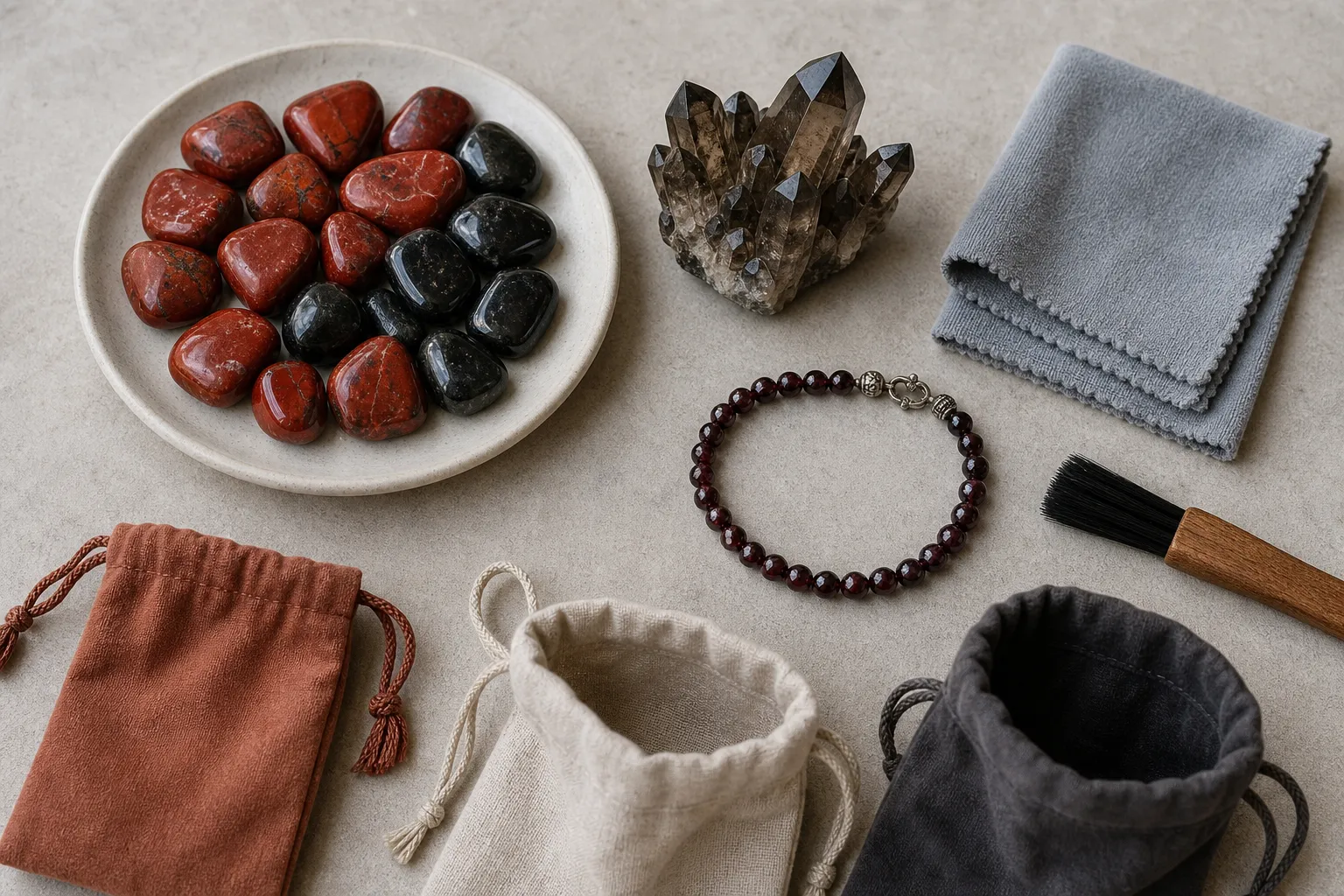
Tumbled stones are usually smoother and easier to carry. They are common in beginner sets because they are small, approachable, and easy to arrange by color.
- polish quality;
- chips around edges;
- flat spots;
- visible cracks;
- whether the color looks surface-deep or consistent;
- whether the stone feels pleasant in the hand.
A tumble is not automatically less interesting than a raw piece. It is simply a different finish with different uses.
Palm stones
Palm stones are larger, smoother pieces shaped to rest in the hand. They work well when you want one object that feels substantial without becoming a large display specimen.
- hand comfort;
- curve and thickness;
- weight;
- smoothness;
- whether the pattern remains interesting across a larger surface;
- storage space.
Palm stones are less discreet than small tumbles, but they can be more satisfying if you want a single object for a desk, bedside table, or personal practice space.
Root chakra jewelry
Root chakra jewelry shifts the comparison toward durability, setting, skin contact, and wear habits. A bead bracelet, pendant, ring, or anklet may be exposed to sweat, cosmetics, impact, water, and repeated rubbing.
- whether the stone is a bead, cabochon, chip, or faceted piece;
- whether it appears coated, dyed, sealed, or stabilized;
- whether it sits in metal, cord, elastic, or wire;
- whether you will wear it daily or occasionally;
- whether the seller gives care instructions.
If you do not know the exact material, be conservative with water, heat, chemicals, and rough handling.
Compare Root Chakra Stones by Care Needs Before Buying
Care is a practical comparison point, especially if you are choosing between pocket carry stones, home display stones, and jewelry.
Instead of memorizing one universal rule, use a care checklist:
- Water exposure: Some stones can handle a quick wipe better than soaking. Coatings, porous areas, metal settings, glue, or composite materials can make water a poor choice.
- Sunlight: Strong light may affect some materials or surface enhancements over time. Display pieces do not need direct sun to look good.
- Chemicals: Perfume, lotions, cleaning products, and household chemicals are not ideal for many stones, especially jewelry.
- Impact: A polished stone can still chip if dropped on tile or knocked against harder objects.
- Storage: Separate storage helps prevent scratches, especially when stones of different hardness are kept together.
- Dust and texture: Rough or grooved specimens may need gentler dusting than smooth tumbles.
Mohs hardness is often used in gemstone guides as a scratch-resistance scale, but it is not the whole durability story. Toughness, cleavage, fractures, porosity, surface enhancements, and setting style can also affect how a stone handles daily use.
A simple beginner rule: if the piece is unidentified, dyed-looking, coated-looking, metallic, porous, glued into jewelry, or part of a mixed set, use dry or slightly damp gentle cleaning only, then store it separately.
Choose the Right Size for Carrying or Display
Root chakra stone size changes the experience more than many product pages admit. A small stone can be convenient; a larger one can make the pattern, weight, and color easier to appreciate.
For pocket carry stones
Choose a stone that is smooth, not too heavy, and unlikely to scratch your phone, keys, or wallet. Tumbled stones and small palm stones usually make more sense than sharp raw pieces.
- Can it sit comfortably in a pocket or pouch?
- Does it have sharp corners?
- Will it rub against metal objects?
- Is it easy to find by touch?
- Would you mind if the polish becomes less glossy over time?
If you carry it daily, the surface finish matters. Chips, coatings, fragile points, and soft settings will show wear sooner.
For home display stones
Home display allows more freedom. You can choose larger raw pieces, towers, spheres, palm stones, or bowls of mixed tumbles.
- Does the color show well in the room’s light?
- Does the stone sit steadily?
- Is it away from direct sunlight, moisture, pets, and small children?
- Does the display invite handling, or is it mostly visual?
- Is the piece easy to dust?
For display, the most meaningful stone may not be the rarest. It may be the one whose color, shape, and symbolic role make sense in the place where you will actually see it.
One Root Chakra Stone or a Small Set?
A single stone is easier to understand. A small set gives variety. Neither is automatically better.
Choose one stone if:
- you are new and want to learn what one material looks and feels like;
- you prefer a simple meditation or desk object;
- you care about buying a clearer, better-labeled piece;
- you do not want to manage many care instructions;
- you are drawn to one color family.
Choose a small set if:
- you want to compare red, black, smoky, and brown stones side by side;
- you enjoy arranging stones by color or meaning;
- you are building a personal display;
- you want a mix of pocket, palm, and decorative pieces;
- you accept that some labels may use broad retail terms.
The main issue with sets is labeling. Crystal set labels can compress many assumptions into a small card: stone name, chakra association, short meaning, and sometimes very strong result language. Read the card as a starting map, not as proof. If the set includes stones that are hard to distinguish, look for individual names and photos rather than a single blended promise.
Read Crystal Set Labels Before You Trust the Comparison
Beginner sets are convenient, but they can blur important distinctions. When reading a root chakra crystal set label, compare the language as carefully as the stones.
More useful label details include:
- specific stone names;
- whether pieces are natural, dyed, coated, glass, synthetic, or imitation where relevant;
- approximate size;
- form, such as raw, tumbled, bead, palm, or pendant;
- country or source information if offered without overstatement;
- basic care notes;
- clear photos of the exact set or a representative set.
Less useful label details include:
- sweeping result language;
- vague “high vibration” wording;
- chakra claims without stone names;
- “natural” used without explanation;
- stock photos that do not match the actual pieces;
- large price differences with no material or size explanation.
Natural, dyed, and imitation root chakra stones can all exist in the market, depending on the material and seller. Dyed or imitation does not always mean useless for decoration or personal symbolism, but it should be represented honestly. A dyed stone may still be visually appealing; it just should not be priced or described as something it is not.
Color alone cannot settle this. Gem identification can be complex, and professional settings sometimes use specialized methods to separate natural materials, imitations, and enhancements. A beginner does not need lab equipment to buy a small tumble, but the complexity is a reminder to be cautious with expensive pieces or unclear labels.
Do Finish and Polish Change the Choice?
Finish changes touch, appearance, and use. It does not create a different chakra category by itself.
A high polish can make color look deeper and patterns more visible. A matte or raw surface can make the same stone feel more earthy or specimen-like. Carving can turn a stone into a heart, sphere, tower, bead, or palm shape.
Compare finish by use:
- Glossy polish: easier to wipe, pleasant to hold, common for tumbles and palm stones.
- Matte finish: softer visual effect, may show oils or dust differently.
- Raw texture: more natural-looking, less pocket-friendly.
- Beads: wearable, but exposed to repeated friction.
- Carvings: decorative, though points and edges may chip.
The meaning you attach may shift with form. A black tourmaline point on a shelf feels different from a black bead bracelet, even if both are sold with root chakra language. That difference is about use, visibility, and personal association, not a separate mineral property.
What Price Differences May Mean
Price can reflect many things at once. When you compare root chakra stones, do not assume the most expensive piece is the most meaningful, most authentic, or most suitable.
Price may change because of:
- stone size;
- polish quality;
- carving labor;
- bead matching;
- jewelry setting;
- mineral rarity;
- clarity or color intensity;
- origin claims;
- seller branding;
- packaging;
- whether the piece is natural, enhanced, dyed, synthetic, composite, or imitation.
For beginner purchases, a modest, clearly labeled stone is often more sensible than a costly piece described mainly through symbolic language. If a seller asks a premium, the listing should explain the material reasons for that premium. “Root chakra crystal” by itself is not enough.
For higher-priced stones, especially jewelry or named gem materials, look for clearer gem or mineral information and realistic care guidance. A comparison page can help you ask better questions, but it cannot verify every stone identity from a photo.
A Beginner Decision Frame for Choosing Root Chakra Crystals
Before choosing, move through the decision in this order:
- Choose the use first.
Pocket carry, jewelry, desk display, meditation object, shelf specimen, or small set?
- Choose the form.
Raw, tumbled, palm, bead, pendant, carving, or display piece?
- Choose the visual family.
Red, black, brown, smoky, iron-toned, patterned, translucent, or metallic-looking?
- Check the label.
Is the stone named clearly? Are natural, dyed, imitation, coated, or enhanced details explained where relevant?
- Consider care.
Will it be exposed to water, sunlight, cosmetics, impact, or pocket friction?
- Read the meaning as symbolic.
Does the association fit your personal practice without expecting the stone to produce a specific result?
- Match price to clarity.
Pay more only when the material, size, workmanship, or setting justifies it.
This order keeps the choice grounded. You can still choose by intuition, color, or symbolic meaning, but you are less likely to confuse a retail phrase with a physical fact.
Quick Answers for Common Comparison Questions
Are root chakra stones always red?
No. Many lists emphasize red because of common chakra color associations, but modern root chakra selections often include black, brown, smoky, and iron-toned stones as well. Color is a theme, not a rule.
Is a raw root chakra stone better than a tumbled one?
Not generally. Raw stones show more natural texture, while tumbled stones are usually smoother and easier to carry. The better form depends on whether you want display, handling, jewelry, or portability.
Can I choose a root chakra stone only by meaning?
You can choose by meaning for personal ritual or symbolism, but it is still wise to compare the physical object. Care needs, size, finish, and honest labeling matter, especially for jewelry or daily carry.
What is the simplest beginner choice?
A clearly labeled tumbled stone or palm stone is often the easiest starting point. Choose one whose color, feel, size, and care needs make sense to you, then read chakra meaning as a personal association rather than a promised result.