
Color, meaning, and practice boundaries
Why Blue and Green Crystals Appear in Root Chakra Practices
A beginner looking at root chakra stones usually expects red jasper, garnet-colored pieces, hematite, black tourmaline, or obsidian. Then a shop list, a meditation layout, or a community recommendation adds lapis lazuli, aquamarine, amazonite, or another blue-green stone. That is the color-confusion behind searches for blue green crystals for root chakra: is the stone being chosen for color, for meaning, or because modern chakra practice is looser than a simple rainbow chart suggests?
The useful answer is this: blue and green stones usually appear as support stones, mixed-association stones, or personal ritual choices. Their color does not make them classic root chakra matches in the common modern color map. Their role depends on the symbolic frame being used.
upward
Read the full overview first
Use the broader guide first if you need the full scope before this page.
Why Blue and Green Stones Seem Out of Place
In the familiar seven-chakra color sequence, the root chakra is usually linked with red. Black stones also appear often in crystal-community language because many practitioners associate dark, heavy-looking stones with grounding imagery, weight, protection symbolism, or an earth-like mood. In that same sequence, green is commonly placed with the heart area, while blue is commonly placed with the throat area.
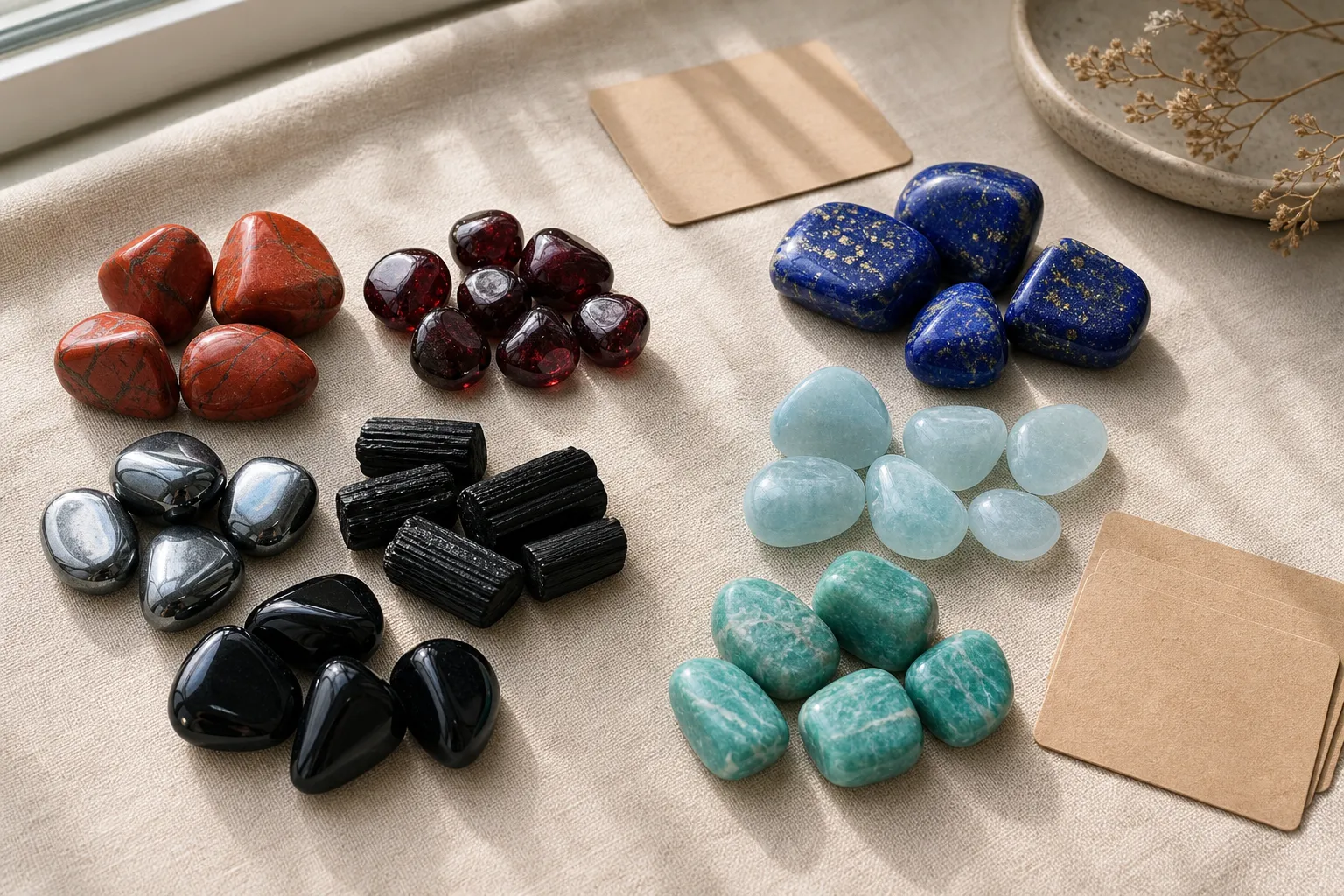
So blue crystals for root chakra practice can feel contradictory at first. Lapis lazuli is visibly blue to violetish blue, often with golden pyrite flecks and sometimes white calcite areas. Aquamarine is usually described in pale blue to blue-green color language. Amazonite is often encountered by readers as a green-blue or turquoise-looking stone. None of those visual cues looks like the expected red or black root chakra palette.
Three layers that often get mixed together
Stone appearance
Can tell you color, visible inclusions, polish, texture, and common retail wording.
Cannot establish chakra effects or personal results.
Chakra color mappings
Can show how many modern systems assign colors and meanings.
Cannot prove one rule followed by every tradition or practitioner.
Retail and community language
Can show what shoppers are likely to see in lists and labels.
Cannot provide strong backing for outcome claims.
Once those layers are separated, non red root chakra stones become easier to read. A blue or green crystal is rarely a direct root-color match. It is more often brought into a root chakra-themed practice for a secondary reason: contrast, personal symbolism, mixed chakra associations, or a seller’s broader grouping around an intention.
Root Chakra Color Meanings Are Common, Not Fixed
Root chakra color meanings are useful as a map, but not as a single universal rulebook. Chakra ideas appear across varied historical and cultural contexts, and the familiar seven-center rainbow layout used in many modern English-language resources is a modern interpretive structure. That does not make the color map meaningless. It means the map should be read as a convention within contemporary practice, not as a rule that controls every stone choice.
For beginners, this distinction changes the question. If a page says root equals red, heart equals green, and throat equals blue, it is using a simplified teaching frame. If another source includes lapis lazuli root chakra language or amazonite root chakra practices, it may be using a blended personal-practice frame. Those two approaches can sit beside each other, but they are not making the same kind of claim.
A clean way to judge the wording
- Is the stone being chosen because it visually matches the root chakra color?
- Is it being used as a support stone beside more traditional red or black stones?
- Is the writer blending root themes with communication, calm, heart-centered, or personal-symbolic language?
- Is the source describing a belief-based ritual, or presenting the stone as changing health or life outcomes?
The first three can be discussed as symbolic practice. The last one needs a firmer editorial limit. The available material supports stone appearance, color-map variation, and reader-language patterns; it does not establish that crystals change the body, emotions, or life circumstances.
Why Someone Might Use Blue Crystals for the Root Chakra
Blue crystals may appear in root chakra practices when color match is not the main selection rule. The stone may be chosen for contrast, personal meaning, or a layered ritual theme.
Lapis lazuli is the clearest blue example because its physical description is better supported than many other stones in this source set. Gemological references describe lapis lazuli as a rock aggregate mainly associated with lazurite, calcite, and pyrite. Its color is commonly blue to violetish blue, with possible golden pyrite flecks and visible white calcite. Those are observable features, not chakra claims.
How lapis lazuli may be interpreted in a root setting
- Liking the visual weight of deep blue beside black or red stones.
- Using it as a symbolic contrast rather than a color match.
- Connecting its common crystal-community associations with voice, reflection, or inner steadiness.
- Building a layout that includes more than one chakra theme at once.
Those are personal-use interpretations. They do not make lapis lazuli a standard root chakra stone in the same way red or black stones are commonly presented. A careful reading is: lapis may appear in root chakra practices when the practice is organized around a broader symbolic theme, not only around the root color.
Aquamarine needs even more cautious wording. Readers often meet aquamarine in blue or blue-green crystal searches, and some personal-practice contexts may place it near root chakra language when the ritual theme is gentle, steady, or transitional. The current source pool does not give strong support for aquamarine root chakra practices, so it is better treated as a possible support stone in contemporary crystal language, not as a core root recommendation.
Why Someone Might Use Green Crystals for the Root Chakra
Green crystals for root chakra practice usually come from a different kind of blending. Green is commonly tied to heart-chakra color language in the modern rainbow sequence, so a green stone is not a straightforward root chakra color match. When green stones appear near root language, the practice is often mixing themes: earth, growth, body awareness, stability, home, money symbolism, nature imagery, or heart-and-root connection.
This is where many beginners misread a list. If green aventurine, amazonite, or another green-blue stone appears beside red jasper and obsidian, the list may not be saying that the stone “belongs” to the root by color. It may be using the stone as a bridge. In retail and community language, bridge stones are often described as linking one symbolic area to another, though that wording is not a factual standard.
Amazonite is a good example of the needed restraint. Readers commonly encounter it as a green-blue or turquoise-looking crystal term, and it appears in search paths around blue-green stones. But the supplied evidence does not provide strong factual support for detailed amazonite claims in root chakra practice. A careful article should say that amazonite may show up in contemporary crystal lists as a blue-green support stone, while keeping its root chakra role interpretive and source-limited.
Green and blue-green stones are often better understood as context stones than as primary root chakra stones. They may sit beside classic root-color stones in a bowl, grid, altar, pocket set, or meditation space because the user wants more than a color match. The better question is not “Is green allowed?” but “What role is this stone playing here?”
Do Root Chakra Stones Have to Match the Root Chakra Color?
Root chakra stones do not have to match the root chakra color in every personal ritual context, but color match remains the simplest beginner rule. If the goal is to follow the common modern color map closely, red and black stones make more sense as primary choices. If the goal is a mixed-color layout or a symbolic support set, blue-green root chakra stones may appear without being the center of the practice.
The difference is not whether a stone is “right” or “wrong.” It is whether the source is clear about its selection logic.
Color-match approach
Choose red or black stones because those colors are commonly linked with root chakra language.
Theme-based approach
Choose a stone because its meaning, appearance, personal association, or placement supports the ritual theme.
Mixed-chakra approach
Include more than one color because the practice is intentionally connecting root themes with another symbolic area.
Retail-label approach
A shop may group a stone under root chakra recommendations because that wording matches what shoppers search for, even when the color logic is loose.
This is why root chakra stone recommendations can feel inconsistent. One list may be color-led. Another may be meaning-led. Another may be organized for jewelry, crystal sets, or a shop category. Without knowing which logic is being used, a beginner can mistake a support stone for a primary color match.
What Non-Red Root Chakra Stones Usually Mean
Dark or earthy choice
Black, brown, smoky, gray, or metallic-looking stones often appear because their visual weight fits common grounding symbolism in crystal communities. This is the least surprising non-red category.
Contrast
A deep blue lapis lazuli piece beside red or black stones can create a visual pause. Some personal-practice users may like that contrast because it changes the feeling of a layout or display, even if the blue stone is not a color match.
Bridge between themes
Green stones may connect root language with heart-centered symbolism, nature imagery, or growth language. Blue stones may pair root themes with speech, reflection, or calm personal focus. These are belief-based associations within contemporary practice.
Broadened retail wording
Crystal shops often create lists around shopper intent, not only strict color mapping. A product description may place a blue or green crystal near root chakra language because the seller is using a broad meaning story, a set-building approach, or search-friendly labeling.
This does not make every label equally useful. A clear label explains whether the stone is a main root-color stone, a support stone, or part of a mixed-color theme. A vague label simply places many attractive stones under one chakra heading and lets the shopper fill in the meaning.
Blue Green Crystals for Root Chakra: Color Meaning or Practice Theme?
When judging a blue-green crystal in a root chakra setting, start with the role it is being asked to play.
If the stone is supposed to represent the root chakra color directly, blue-green is a weak match in the common modern color sequence. Red and black remain the clearer color-language choices.
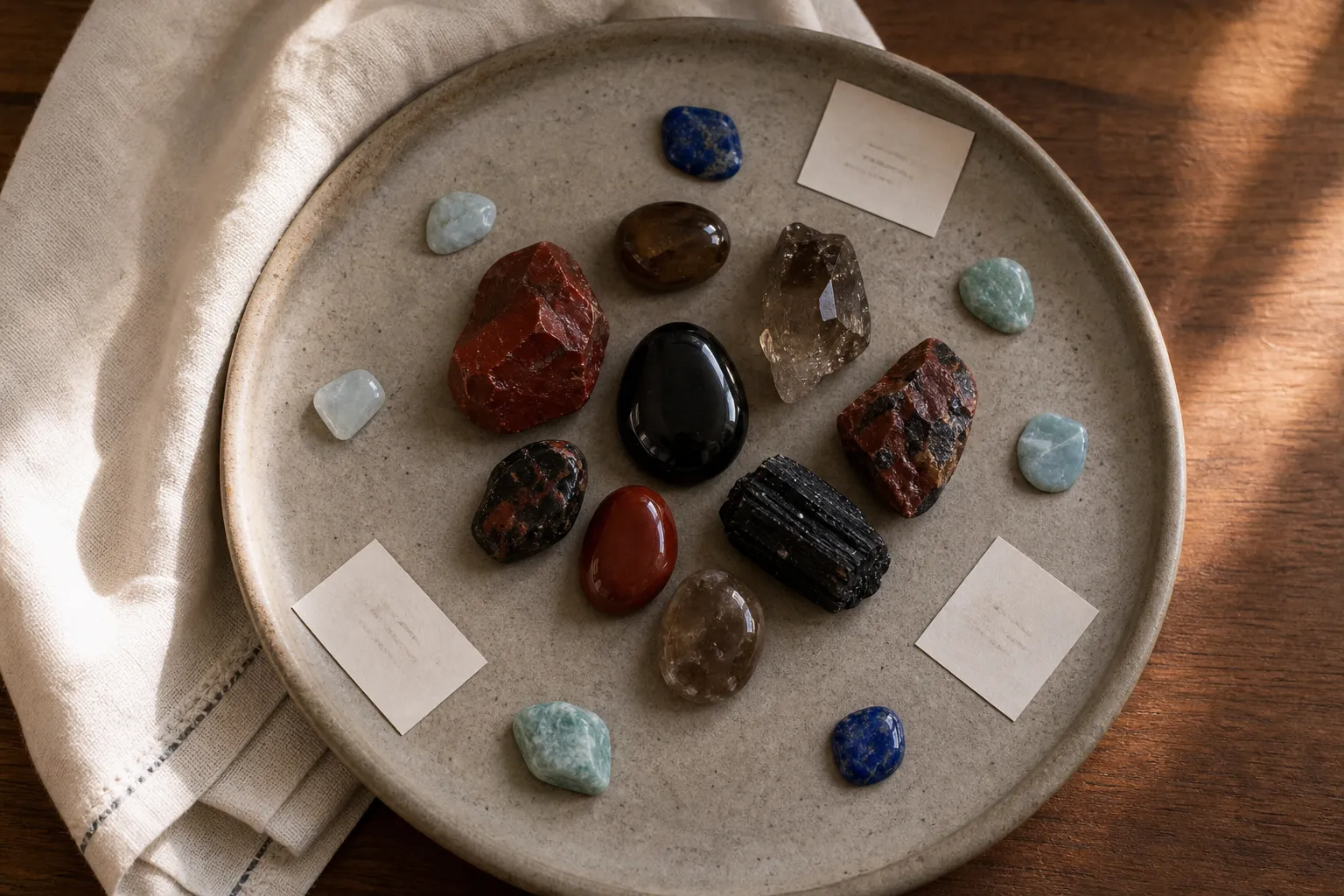
If the stone is meant to sit beside root stones, the answer changes. A blue-green crystal can be read as a support stone, especially when the practice is built around a mixed theme rather than a strict color chart. For example, a person might place amazonite near red jasper in a small display because the colors help separate two symbolic ideas. The article or seller should say that plainly instead of implying that every stone in the set has the same root association.
If the stone has more than one visible color, the reading becomes even more flexible. Mixed color root chakra stones invite layered interpretation: a blue stone with gold flecks, a green-blue stone with pale streaks, or a piece with white inclusions can be read visually before it is read symbolically. Lapis lazuli is useful here because its blue body, pyrite flecks, and white calcite areas show how one stone can carry several visible cues. The stone’s appearance is observable; the chakra meaning is assigned by the practice.
Color is something you can see. Meaning is something a tradition, seller, practitioner, or user attaches to the stone.
How Crystal Shops Label Blue and Green Stones for Root Chakra Use
Crystal shops and online lists often shape the way readers encounter this topic. A shop may label stones by chakra, color, intention, jewelry type, set size, or meditation use. Because those categories are made for browsing, they can blur the line between a traditional color association and a broad personal-practice suggestion.
Common retail patterns
- Grouping many stones under one chakra heading without explaining why each stone is there.
- Using strong outcome language where a quieter symbolic description would be more accurate.
- Treating placement, grids, jewelry, and carrying stones as if they all mean the same thing.
- Mixing classic root-color stones with blue or green support stones in one list.
- Presenting personal-practice associations as settled facts.
A beginner does not need to reject every shop label. It is enough to read the label carefully. Good wording tells you what the stone looks like, why it is being included, and whether it is a primary root-color stone or a secondary support piece. Less careful wording jumps straight from stone name to broad promises.
For blue and green stones, the best question is: “What is this label actually saying?” If it says lapis lazuli is deep blue with possible gold flecks, that is an appearance note. If it says a blue stone can be used in a personal ritual beside root stones, that is a practice suggestion. If it promises big life or health results, it has moved beyond what the available evidence supports.
When Blue-Green Stones Are Better Read as Support Stones
Blue-green crystals are often better read as root chakra support stones when they appear in mixed sets, layered layouts, or personal ritual spaces. This keeps the meaning useful without forcing the stone into a color role it does not naturally occupy.
A support-stone reading works especially well when
- The main root stone is already red, black, brown, smoky, or earthy-looking.
- The blue or green stone is placed nearby rather than treated as the central root symbol.
- The practice combines root themes with another chakra color association.
- The user is choosing by personal symbolism, not by a strict color chart.
- The source uses cautious language such as “many practitioners associate” or “some personal practices include.”
This framework also helps with aquamarine and amazonite. Rather than presenting them as standard root chakra stones, it is more accurate to say they may appear in contemporary blue-green crystal searches and mixed chakra practice language. Their role depends on the source’s interpretation, not on a fixed rule.
Care and display can stay simple. Keep stones where they are not likely to be scratched, dropped, or confused with items meant for consumption. If you use them in a layout, write down the role you are assigning: main root-color stone, support stone, bridge color, or personal reminder. That small note keeps the category from becoming vague.
Are Blue-Green Root Chakra Stones a Contradiction?
They are a contradiction only if the source claims strict color matching while using stones that do not match the root color. They are not a contradiction if the source is clear that the stone is being used as a support, bridge, or personal-symbolic piece.
A careful reading might look like this
- Lapis lazuli: visibly blue to violetish blue, sometimes with pyrite flecks and calcite; in root chakra practice, better read as a symbolic or support stone unless the source explains another rationale.
- Aquamarine: commonly encountered in blue to blue-green language; in root settings, should be framed cautiously as a contemporary personal-practice choice.
- Amazonite: often searched as a green-blue or turquoise-looking stone; root chakra use needs cautious wording because strong supporting material is limited.
- Green stones in general: more often bridge heart-color language with root themes than act as direct root color matches.
- Blue stones in general: more often bring contrast or mixed-theme meaning than serve as classic root stones.
The middle ground is stronger than either extreme. Blue-green stones are not automatically wrong, and they are not automatically root stones. Root chakra color mappings are common and useful, while contemporary crystal practice often adds extra symbolic layers. The clearer the source is about those layers, the easier it is for a beginner to decide what they are actually choosing.
A Practical Way to Judge a Non-Red Root Chakra Stone
Before using or buying a blue or green crystal for a root chakra-themed practice, ask five questions.
- What color story is being used? If the stone is blue-green, it is not matching the common red root color. That does not end the discussion, but it changes the role.
- Is the stone primary or supporting? A primary root stone carries the main root-color symbolism. A support stone sits beside that symbolism and adds a second meaning.
- Is the description based on appearance or belief? Blue color, gold flecks, white calcite, pale green-blue tones, polish, and shape are appearance details. Chakra meaning is interpretive.
- Is the source using careful language? Look for wording that says “in some contemporary practices,” “many crystal practitioners associate,” or “some personal rituals include.” Be cautious with language that turns a stone into a promised result.
- Does the practice still make sense without outcome claims? A grounded personal ritual can be about attention, symbolism, display, journaling, or quiet handling. It does not need a promise attached to be meaningful to the user.
Blue and green crystals appear in root chakra practices because modern crystal use is not always controlled by a single color chart. Sometimes the stone is a contrast. Sometimes it is a bridge. Sometimes it is market labeling. Sometimes it is personal symbolism. Read the color first, then the meaning, then the claim being made. That order keeps blue-green stones useful without asking them to carry more certainty than the evidence allows.